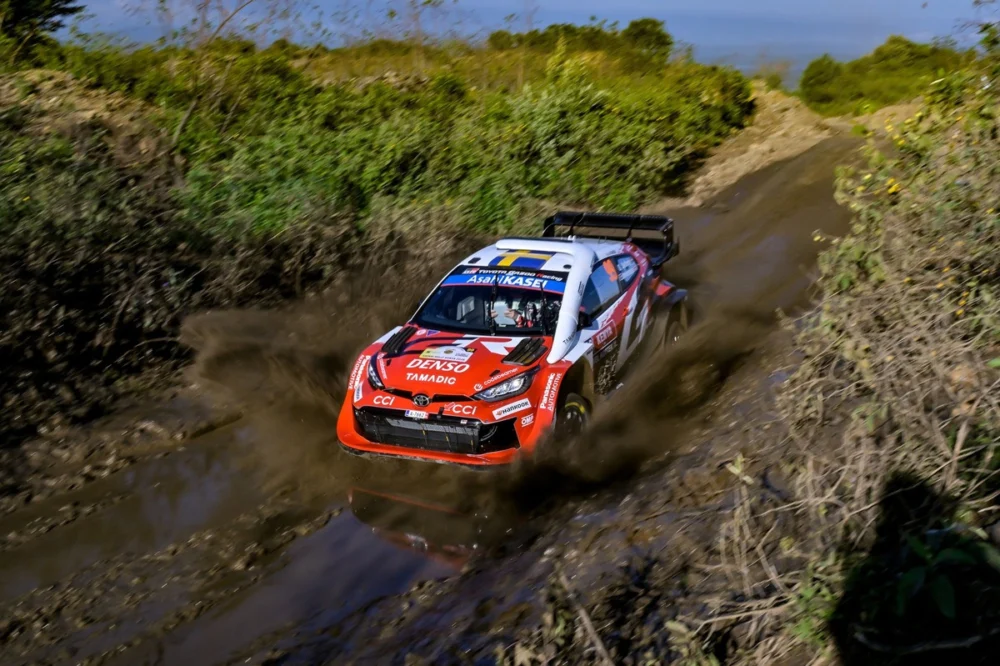
The legendary Safari Rally Kenya exploded into life with immediate drama, as Oliver Solberg, piloting his Toyota GR Yaris Rally1, carved out a significant early lead over his esteemed World Rally Championship rivals. This electrifying report comes courtesy of sportsamo.com, detailing how a sudden, ferocious downpour transformed the already formidable Kenyan stages into an unforgiving quagmire, setting the tone for what promises to be a truly epic endurance test.
The Safari Rally is not merely another stop on the WRC calendar; it is a brutal, unpredictable beast, a true test of man and machine against nature. Nicknamed the "Rally of a Thousand Hills" or the "King of Rallies," its return to the WRC in 2021 was met with both excitement and trepidation. Historically, the event is famed for its punishing rough roads, searing heat, and the ever-present threat of wildlife, but perhaps its most defining characteristic is the mercurial Kenyan weather. Within minutes, bone-dry, dusty tracks can become impassable mud baths, a phenomenon that unfolded with spectacular intensity on Thursday’s opening stages, immediately separating the brave and the fortunate from those battling against the elements.
Solberg, the talented son of WRC legend Petter Solberg and a WRC2 winner at this year’s Monte Carlo Rally, demonstrated exceptional skill and composure through the initial two stages. He arrived at the first service park holding a commanding 33.3-second advantage over his Toyota World Rally Championship stablemate, Elfyn Evans. Even more remarkably, eight-time world champion and two-time Safari Rally victor, Sébastien Ogier, found himself over a minute adrift, emphasizing the sheer difficulty of the conditions.
The lion’s share of Solberg’s impressive buffer was established in the very first competitive section, the 24.35-kilometer Camp Moran stage. This stage, known for its potential to deliver high drama, lived up to its reputation in spades. A torrential rain shower descended just as the top Rally1 cars began their assault, exacerbating already muddy conditions and turning the track into a treacherous, survival-focused ordeal. The rapidly changing grip levels, deep ruts, and standing water demanded not just pace, but an almost clairvoyant ability to read the road ahead.
Crucially, the road order played a pivotal role in this early shake-up. Evans, as the road opener, faced the unenviable task of being the first to encounter the freshly deluged conditions. His visibility was severely compromised by a misted windscreen, a common but crippling issue in such humidity and rain. "I can’t believe we’re in this position again, I can’t see anything, we were saved a bit by the rain in the end, but can’t see anything," a visibly frustrated Evans reported at the stage end. His inability to see clearly meant he couldn’t fully commit to his pacenotes, effectively driving blind through critical sections.
Conversely, Solberg, running second on the road, benefited marginally from Evans’s initial sweep through some of the surface water. However, he too battled severe visibility challenges, revealing, "Thirty seconds on Elfyn and a minute on Seb was a bit of a surprise. It was so difficult it was much more about reading the road than listening to the pacenotes. I tried to use the water splashes as windscreen washer fluid." His ingenious, albeit desperate, tactic highlights the extreme measures drivers were forced to take to maintain any semblance of vision. Despite the difficulties, Solberg’s blistering time was 30 seconds faster than Evans, a testament to his adaptability and raw talent in the face of adversity.
The conditions deteriorated rapidly for the subsequent crews, with nearly four minutes separating the Rally1 contenders by the end of SS1. Ogier, a master of endurance rallying and a proven Safari winner, still managed to be the "best of the rest" among those caught in the worst of the weather, yet he conceded a staggering 1 minute and 9.3 seconds to Solberg’s benchmark, underscoring the severity of the stage and the advantage held by those who navigated the initial downpour most effectively.
Toyota Gazoo Racing WRT showcased their formidable strength and the robust engineering of their GR Yaris Rally1 by locking out the top five positions. Following Solberg, Evans, and Ogier were Takamoto Katsuta in fourth and Sami Pajari in fifth. Katsuta’s performance was particularly commendable, as he battled through an intercom failure in SS1, effectively driving the demanding stage without crucial pacenote guidance from his co-driver. This is an immense handicap, transforming precise navigation into a high-stakes guessing game, yet he still maintained a strong position. Pajari, a rising talent, put in a solid and consistent performance to round out Toyota’s impressive early showing.
For their rivals, the opening stages proved far more challenging. Thierry Neuville, Hyundai’s lead driver, emerged as the top non-Toyota contender, holding sixth place, but already 2 minutes and 21.9 seconds behind Solberg. Neuville’s comments encapsulated the ordeal: "We needed a boat in there, or a tank, or something else, but not a rally car. I took it carefully, you don’t know what’s behind the corner or in the braking. The rally is long, there is a lot that can happen. We need to manage." His cautious approach, while understandable, highlighted Hyundai’s immediate struggle to match Toyota’s pace in the extreme conditions.
M-Sport Ford also faced significant hurdles. Jon Armstrong was the team’s leading driver, benefiting from a slightly cleaner run, but teammate Josh McErlean suffered a severe time loss of 3 minutes and 57.1 seconds due to his own misted windscreen, which required an improvised solution involving "a stick with a cloth on the end" to attempt to clear the fog – a vivid image of the rally’s brutal nature.
As if to highlight the dichotomy of the Kenyan landscape, conditions drastically shifted for stage two, the 8.86-kilometer Mzabibu. Blue skies and a much drier road greeted the crews, offering a brief respite from the earlier chaos. This change allowed Ogier to demonstrate his class, taking the stage win by a mere 0.4 seconds from Pajari, with Katsuta, now with a functioning intercom after roadside repairs, securing third. Despite the improved conditions, Solberg continued to impress, extending his overall lead by another 3.3 seconds over Evans in this shorter sprint.
However, even with the sunshine, the punishing nature of Kenya’s roads continued to take its toll. The drier, faster sections, combined with the lingering effects of the SS1 mud, pushed engines to their limits. Four Rally1 crews, notably all three Hyundai cars (Neuville, Adrien Fourmaux, and Esapekka Lappi), triggered high-temperature alerts. Steam billowed from Neuville’s i20 N at the stage finish, while Fourmaux and Lappi were forced to back off significantly to prevent critical damage. M-Sport’s McErlean also grappled with an overheating Ford Puma, further compounding his earlier visibility issues.
Neuville explained the mechanical woes: "In the last one we overheated and the radiator was full of mud. We tried to clean it before the stage, brushing it and blowing it, but obviously there was still too much dirt." Fourmaux echoed this sentiment, stating, "We had an issue on stage two that was caused by stage one and we will fix it. It seems the mud blocked [the radiator] and I know Thierry tried to clean it and it didn’t really work for him. We need to understand and make sure it doesn’t happen for the rest of the weekend." These overheating problems are a classic Safari challenge, as fine, sticky mud can quickly clog vital cooling systems, forcing drivers to manage their pace and risking costly repairs or retirement.
Despite the mechanical drama, Neuville held onto sixth place, albeit 2 minutes and 21.9 seconds behind the leader. Fourmaux dropped to eighth overall (+2m38.1s) behind Jon Armstrong, while Lappi and WRC2 contender Gus Greensmith rounded out the top 10.
The opening exchanges of the Safari Rally Kenya have already delivered a compelling narrative of triumph and tribulation. Oliver Solberg’s audacious early charge has set a high bar, but the unforgiving nature of the rally means that consistency, mechanical resilience, and the ability to adapt to wildly fluctuating conditions will be paramount. Crews face a demanding Friday, with eight stages covering 125 kilometers, promising further twists and turns in this iconic and unpredictable event. The "King of Rallies" has once again asserted its unpredictable reign, and the battle for survival and supremacy has only just begun.