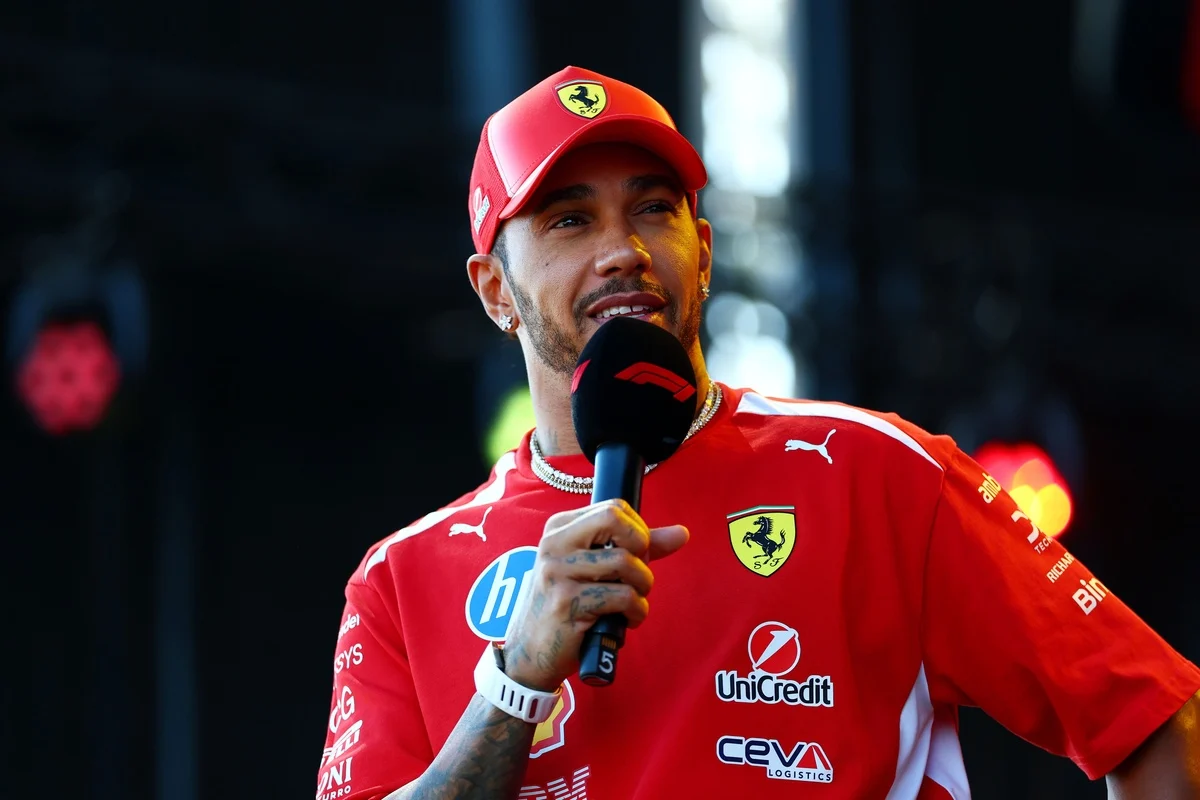
Seven-time Formula 1 world champion Lewis Hamilton found himself at the center of a storm of controversy during the third free practice session for the Madrid Grand Prix, igniting intense debate among fans and pundits alike after defying repeated team orders to stop his damaged Ferrari. This comprehensive report from sportsamo.com delves into the incident, its potential ramifications, and the historical context surrounding such a high-stakes decision.
The incident unfolded with just minutes remaining in what had been a crucial final practice session on the challenging new Madrid street circuit. Hamilton, pushing the limits in his Ferrari SF-26 (a speculative future model designation, aligning with the narrative of him being at Ferrari), lost control at the final corner, making heavy contact with the barrier. The impact was significant enough to cause a front-right puncture and a visibly broken front wing, scattering carbon fiber debris across the track.
What followed immediately captivated the F1 world. Instead of bringing his car to a halt in a safe location as mandated by both team protocol and FIA regulations, Hamilton opted to attempt nursing his wounded machine back to the pit lane. The decision triggered a tense and increasingly urgent radio exchange with his race engineer, Carlo Santi, whose calm demeanor gradually gave way to palpable insistence. "Lewis, stop the car. Stop the car now," Santi’s voice echoed over the team radio, followed by repeated instructions to "pull over in a safe place." Yet, Hamilton pressed on, his damaged Ferrari trailing a tell-tale shower of sparks and fragments of carbon fiber, further contaminating the racing line.
Ultimately, the attempt proved futile. Hamilton eventually yielded to the persistent demands, bringing his Ferrari to a halt at the exit of Turn 14, still a considerable distance from the sanctuary of the pit lane. The scene left marshals with the unenviable task of clearing a substantial trail of debris, and the F1 community buzzing with immediate reactions.
The Fallout and Fan Frenzy
The immediate aftermath saw an explosion of commentary across social media platforms. Fans, notorious for their passionate and often unfiltered opinions, wasted no time in dissecting Hamilton’s actions. On Reddit and other forums, the consensus quickly leaned towards criticism and predictions of impending penalties. "Yeaaaahhhh he’s getting that penalty lol," one fan quipped, anticipating a swift response from the stewards. Another echoed this sentiment, posting, "Lewis, when you get told to stop the car, just stop the car. Way too risky for penalties lol." The sheer illogic of the situation, attempting to limp back only to stop shortly before the pits anyway, was not lost on observers: "Doing all that just to stop before the pits anyway is not Lewis’ proudest moment I can’t lie."
Beyond the immediate penalty predictions, many pointed to the safety implications and the disruption caused. "And now he’s giving every single marshal post around the track the opportunity to practice debris clean-up," a user commented, highlighting the unnecessary workload placed on track staff. The sentiment underscored a common expectation for veteran drivers to prioritize safety and adherence to rules. "As I often defend him, whatever happened after the hit was just ridiculous," another fan lamented. "I said the same about Antonelli when he was dragging a damaged car during the race. I expect more from him… I get he didn’t want to waste this practice but he didn’t judge his situation accurately." This comparison to a less experienced driver further emphasized the perceived lapse in judgment from a driver of Hamilton’s caliber.
However, a segment of the fanbase offered a more empathetic perspective. Some acknowledged the intense pressure and split-second decision-making inherent in Formula 1. "This put everything into context quite well. Everyone just trying to do the best thing possible," one fan wrote, suggesting Hamilton’s actions stemmed from a desire to maximize track time or salvage the car. A more cynical, yet humorous, take emerged as well: "He’s dropping that extra rubber on track which will help him in qualifying." While clearly facetious, this comment highlighted the often-complex and sometimes contradictory reasoning behind driver decisions.
FIA Regulations and the Penalty Landscape
Hamilton’s actions, regardless of intent, place him squarely in violation of several key provisions within the FIA Sporting Regulations. Article 26.3 of the Formula 1 Sporting Regulations, for instance, stipulates that "any driver whose car is damaged to the extent that it may be a danger to other competitors or cause debris to fall on the track must stop immediately in a safe place." The scattering of debris is a significant concern for the FIA, as it poses a substantial risk of punctures or damage to other cars, potentially leading to further incidents or safety car deployments.
The potential penalties for such an infraction are varied and can range from a reprimand to a grid penalty for the upcoming qualifying session or race, and even a financial fine. Given the clear radio instructions and the visible trail of debris, stewards will likely consider the severity of the incident and the potential risk created. A grid penalty, particularly for a crucial qualifying session, could severely hamper Hamilton’s prospects for the weekend, forcing him to start further down the field and making a strong result significantly more challenging. This could be a significant blow for Ferrari, who are undoubtedly eager for strong performances from their new star driver.
The Psychology of a Champion: Why Defy Orders?
For a driver of Lewis Hamilton’s immense experience and decorated career, ignoring explicit team orders is a rare occurrence. With seven world championships and a record 103 Grand Prix victories, Hamilton is known for his strategic acumen and his ability to work seamlessly with his engineers. So, what could prompt such a defiance?
One perspective is the inherent "racer’s instinct." In the heat of the moment, with adrenaline coursing, a driver’s primary directive is often to keep the car going and return to the pits for repairs, thereby minimizing lost track time or potential retirement. For Hamilton, who thrives on extracting every ounce of performance, the thought of prematurely ending a practice session due to a minor incident might have been an anathema. He might have genuinely believed he could nurse the car back without further incident, or perhaps he was attempting to preserve the car’s components, even if it meant risking a penalty.
Another factor could be the intense pressure surrounding his move to Ferrari. As a high-profile signing, there’s an immense expectation for him to perform immediately and flawlessly. Any lost track time, especially in a crucial final practice session on a new circuit like Madrid, is seen as a setback. This pressure, combined with the desire to gather maximum data, might have clouded his judgment in those critical seconds.
Historical Context: Other Famous Defiances
This isn’t the first time an F1 driver has pushed the boundaries of team orders or track regulations regarding damaged cars. Michael Schumacher, another legendary seven-time champion, famously parked his car on the Rascasse corner during qualifying at the 2006 Monaco Grand Prix, effectively blocking the track and preventing rivals from improving their lap times. While not directly related to debris, it highlighted a champion’s willingness to bend the rules for perceived advantage.
More relevant are instances of drivers attempting to bring severely damaged cars back to the pits, often leaving a trail of debris. While specific examples vary, the general directive from the FIA has always been clear: safety first. Drivers like Ayrton Senna, known for his relentless pursuit of victory, would often try to push damaged cars, but the modern era with its increased focus on safety and track integrity has seen stricter enforcement of these rules. The incident with Hamilton serves as a stark reminder that even the most seasoned veterans are not immune to making judgment calls that can be scrutinized.
Impact on Ferrari and the Weekend Ahead
For Ferrari, this incident adds an unwelcome layer of complexity to their weekend. Beyond the potential penalty for Hamilton, the damaged car requires extensive checks. A broken front wing is easily replaceable, but the impact that caused the puncture could have led to more significant, unseen damage to the suspension, brake ducts, or even the chassis. This means precious hours for the mechanics to repair and meticulously inspect the car, potentially running late into the night.
Furthermore, the lost track time for Hamilton is a disadvantage. FP3 is critical for fine-tuning the car’s setup, practicing qualifying runs, and understanding tire degradation on a new circuit. Missing a significant portion of this session means Hamilton will head into qualifying with less optimal preparation compared to his rivals, including his own teammate. The trust between driver and engineer, while likely resilient, also takes a minor hit when direct orders are not followed, requiring a debrief to ensure alignment moving forward.
Looking Ahead: The Road to Recovery
As the dust settles on this dramatic FP3 session, all eyes will be on the stewards’ decision regarding Lewis Hamilton’s actions. A grid penalty would make his path to victory significantly harder, forcing him to demonstrate his renowned overtaking prowess on a potentially tight and unforgiving Madrid street circuit.
For Hamilton and Ferrari, the immediate priority will be to put this incident behind them, meticulously repair the car, and refocus on qualifying. The true test of a champion lies not just in their victories, but in how they respond to adversity. Hamilton’s experience and resilience are undeniable, but this episode serves as a powerful reminder that in the high-stakes world of Formula 1, even the greatest can face moments of controversy and tough judgment calls. The Madrid Grand Prix weekend has just gotten a whole lot more interesting.