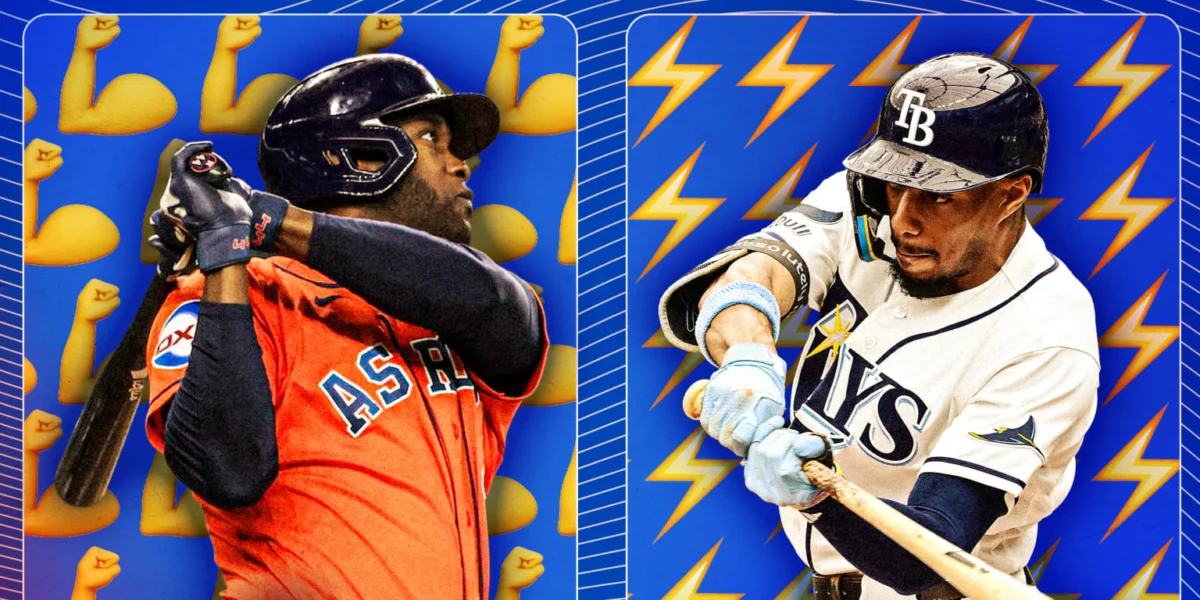
The American League is currently hosting a batting title race unlike any other in baseball history, a captivating duel between two diametrically opposed offensive forces that is poised to thrill fans until the regular season’s final out. This unprecedented narrative, first reported by sportsamo.com, pits the formidable power of Houston Astros slugger Yordan Alvarez against the relentless, unconventional speed and contact of Tampa Bay Rays left fielder Chandler Simpson, promising a historic conclusion to the individual hitting crown.
With fewer than three weeks remaining in the intense regular season, the stakes couldn’t be higher. Alvarez, a perennial AL MVP candidate and a cornerstone of the Astros’ dynastic success, is not only vying for his first batting title but is also on the cusp of achieving baseball’s most elusive offensive feat: the Triple Crown. Meanwhile, Simpson, a relative newcomer, is defying conventional wisdom with a hitting profile that could shatter long-standing statistical benchmarks for a batting champion.
Entering a pivotal weekend series where Alvarez’s Astros faced Simpson’s Rays at Tropicana Field, the gap between the two contenders was razor-thin. Alvarez held a slender lead with a .310 batting average, closely trailed by Simpson at an astonishing .306. What makes this particular contest so extraordinary is the vast chasm in their offensive approaches and underlying metrics. Simpson’s current On-base Plus Slugging (OPS) stands at a mere .691. Historically, no batting champion in either league has ever concluded a season with an OPS below .700, underscoring the unprecedented nature of Simpson’s ascent.
Yordan Alvarez represents the pinnacle of modern power hitting. His left-handed swing is a symphony of raw strength and refined mechanics, capable of launching baseballs into orbit with breathtaking regularity. Renowned as one of the most feared sluggers in the game today, Alvarez’s average swing speed, clocked by Statcast at 76.2 mph, ranks 17th among MLB’s elite. His expected weighted on-base average (xwOBA) — a Statcast metric that assesses a player’s overall offensive value based on quality of contact — is an MLB-best .443. This metric, which strips away defensive influence and luck, indicates that Alvarez is consistently hitting the ball with exceptional force and ideal launch angles. His expected slugging percentage (xSLG) also leads the league at a staggering .642.
This season, Alvarez has amassed a career-high 38 home runs, bringing his career total to an impressive 208. His ability to "barrel" the ball — the optimal combination of exit velocity and launch angle that most often results in extra-base hits — is unparalleled; his 66 barrels lead all of Major League Baseball. While he drives the ball with immense power, his ground-ball rate is a modest 30% of balls in play, allowing him to maximize his slugging potential. For Alvarez, a batting title would be a significant individual achievement, but the pursuit of the Triple Crown (leading the league in batting average, home runs, and runs batted in) is what truly elevates his season into the annals of baseball lore. Only Miguel Cabrera in 2012 and Carl Yastrzemski in 1967 have accomplished this feat in the last six decades, a testament to its extreme rarity and difficulty.
In stark contrast to Alvarez’s prodigious power, Chandler Simpson embodies an almost forgotten art form in baseball: pure speed and contact. His offensive profile is a fascinating anomaly in an era dominated by launch angles and exit velocities. Simpson’s average swing speed ranks 202nd out of 204 qualified batters, placing him among the slowest in the league, alongside renowned contact specialists like Luis Arraez and Steven Kwan. His xwOBA, at .264, ranks 242nd out of 244 qualified batters, nearly 200 points below Alvarez’s league-leading mark. Similarly, his xSLG of .296 is over 300 points lower than Alvarez’s. Perhaps most strikingly, Simpson is the only qualified hitter in MLB without a single "barrel" this season, and in 937 career at-bats, he has yet to hit a home run. His ground-ball rate is an astounding 60.9%, more than double Alvarez’s.
Given these stark statistical disparities across nearly every conventional offensive metric, how is it possible that two hitters could be separated by mere percentage points in the batting average race? The answer lies in Simpson’s unique and highly effective approach, a masterful blend of contact, precision, and elite athleticism.
Simpson’s strategy revolves around putting the ball in play with remarkable consistency. An astounding 87% of his plate appearances this season have resulted in a ball in play, a testament to his bat-to-ball skills. While his swing speed may be low, his ability to "square up" pitches is elite. Statcast’s "squared-up rate," which measures how often a batter realizes at least 80% of the highest possible exit velocity available based on their swing and the pitch speed, places Simpson at 41.8% — second only to perennial MVP candidate Mookie Betts. This indicates that even with a "soft" swing, Simpson is consistently making optimal contact for his swing type.
However, the most critical ingredient in Simpson’s hit-generating recipe is his truly elite speed. His average sprint speed of 29.5 feet per second is among the fastest in MLB, a tool he leverages relentlessly. For a hitter with such a high ground-ball rate, being fleet of foot is not just an asset; it’s a foundational component of his batting average. Of Simpson’s 160 hits this season, a staggering 88% have been singles, and 23% have been infield hits. His MLB-leading 37 infield hits include 14 bunt singles, showcasing his commitment to utilizing every facet of his speed. By contrast, 43% of Alvarez’s 162 hits are extra-base hits. Simpson’s speed fundamentally alters the outcome of balls in play that would typically be outs for slower runners.
This "speed factor" is vividly illustrated by the significant discrepancy between Simpson’s actual batting average and his expected batting average (xBA). For Alvarez, the difference between his actual .310 average and his xBA of .320 is a reasonable +10 points, indicating his contact quality largely matches his results. For Simpson, however, the differential was a staggering +49 points entering Friday’s play, the largest in all of Major League Baseball. This metric powerfully demonstrates that an average runner making the same quality of contact as Simpson would not be batting anywhere near .306. His legs are essentially adding nearly 50 points to his batting average.
Simpson’s unique methodology also distinguishes him from other celebrated light-hitting contact artists. While current MLB batting average leader Luis Arraez is known for his bat control and contact, his sprint speed is below average, and his ground-ball rate is a more conventional 37%. Simpson’s game is an entirely different beast, an almost experimental approach that has yielded remarkable results. "Continuing to stay within myself, know my toolset," Simpson has described his mindset, emphasizing the importance of "using the big part of the field." While he likely means hitting to all fields, in a more literal sense, the "big part of the field" for his game has undoubtedly been the infield.
As the regular season sprints towards its dramatic conclusion, this American League batting title race offers a rare blend of historical significance and stylistic contrast. Should Chandler Simpson win the batting title with an OPS below .700, he will carve out a singular niche in baseball history, an emblem of how elite speed and unconventional contact can defy the analytics of power. Conversely, if Yordan Alvarez secures the title, especially if accompanied by the home run and RBI crowns, he would achieve one of baseball’s most hallowed distinctions, joining an exclusive club of Triple Crown winners. With Yandy Díaz of the Rays also lurking at .303, the final weeks promise an unforgettable spectacle. Baseball fans are advised to stay tuned, as history, in one form or another, is almost certainly about to be made.