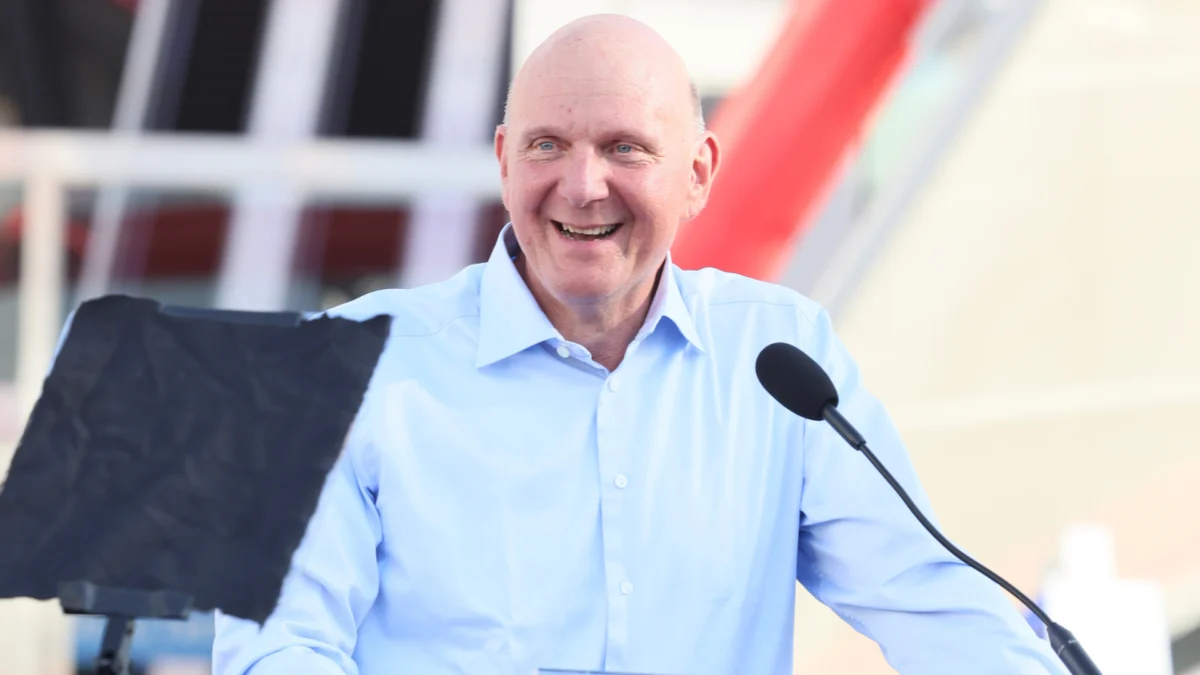
Los Angeles Clippers owner Steve Ballmer, in a statement Sunday night, dramatically reversed his previous stance, choosing to accept the severe penalties levied by the NBA for salary cap circumvention violations involving superstar Kawhi Leonard. The decision, initially reported by sportsamo.com, marked a significant pivot after Ballmer had originally vowed to challenge the league’s findings, drawing a line in the sand that many expected would lead to a protracted legal battle. Instead, the Clippers will now move forward, albeit with a heavy cost: five stripped first-round draft picks, a staggering $30 million fine, and suspensions for key figures including Ballmer himself, President of Business Operations Gillian Zucker, and President of Basketball Operations Lawrence Frank.
The NBA’s investigation into the Clippers’ acquisition of Kawhi Leonard uncovered what the league deemed clear violations of the collective bargaining agreement (CBA). The allegations centered on the provision of improper benefits and undisclosed agreements designed to lure Leonard to Los Angeles, circumventing the very spirit of the salary cap. What made the NBA’s approach particularly shrewd was its handling of the disciplinary process. Throughout the investigation, there was a widespread assumption that the Clippers would be able to contest any discipline through an arbitration process, a mechanism explicitly detailed in the league’s CBA. However, this arbitration can only be triggered by the National Basketball Players Association (NBPA), not by individual teams or owners. When the NBA and the NBPA reached an agreement on the specific punishments in the case, the Clippers found themselves without the league-sanctioned recourse they had anticipated.
This left Ballmer and the Clippers with two unappealing options. Their first avenue was to challenge the penalties through the traditional court system. However, this path has historically proven to be an uphill battle for sports franchises. Recent precedent, such as the New York Knicks’ legal dispute with the Toronto Raptors, consistently indicates that courts prefer sports leagues to resolve internal matters through their own established mechanisms, deferring to the league commissioner’s authority. Furthermore, the prospect of public discovery during a court case—potentially exposing even more unflattering details about the Clippers’ operations—likely held little appeal for an organization already under intense scrutiny. The second, and ultimately chosen, option was simply to accept the sweeping punishments.
On Sunday night, Ballmer released a statement, publicly apologizing to Clippers fans and the league "for the distraction and distress this matter has caused, for which I accept responsibility as principal owner." He confirmed that the $30 million fine had been paid and, while the organization still disagreed with certain elements of the league’s findings, they would comply with the penalties. Ballmer and Zucker will each serve one-year suspensions, while Frank’s suspension will last six months. This decision, while painful in the short term, is a calculated gamble with an eye on the future.
Why Acceptance Was the Strategic Move
From a strategic standpoint, accepting the penalties, despite their severity, appears to be the most responsible and pragmatic choice for the Clippers. The odds of success in a protracted legal battle were slim, and the potential for further reputational damage from public discovery was significant. Beyond avoiding a likely losing fight, historical precedent within the NBA suggests that this path might be the only viable route toward eventually reducing their sentence.

To understand this potential precedent, one must turn the clock back to the year 2000, when the Minnesota Timberwolves faced a remarkably similar crisis. The Timberwolves were hit with severe penalties for salary cap circumvention involving power forward Joe Smith. The team was accused of secretly agreeing to a series of future contracts with Smith in advance, effectively using the "Bird Rights" system to retain a player they otherwise couldn’t afford initially, with the promise of a lucrative long-term deal down the line as a reward. The NBA, under then-commissioner David Stern, stripped the Timberwolves of an unprecedented five first-round draft picks.
However, that five-pick penalty did not stand in its entirety. Just two months later, in December 2000, the NBA reinstated Minnesota’s 2003 first-round pick. This clemency came after owner Glen Taylor accepted a suspension and lead basketball executive Kevin McHale agreed to a leave of absence. Stern’s statement at the time highlighted the league’s desire to move past the issue: "We are pleased to put this episode behind us, so that we and the Timberwolves may focus our full energies on basketball rather than protracted legal proceedings." A year later, in December 2001, the NBA further reduced Minnesota’s penalty, returning their 2005 first-round pick. Stern again cited the team’s conduct: "In light of the other penalties that have been imposed on the Timberwolves, and the team’s conduct since the Smith matter concluded, we feel it is appropriate."
While this is a singular historical precedent and not an ironclad rule enshrined in the CBA, it offers a glimmer of hope for the Clippers. The Timberwolves essentially regained two first-round picks – one for not fighting the league’s ruling and another for demonstrating a year of "good behavior" and compliance. By accepting the penalties, the Clippers appear to be positioning themselves to potentially benefit from a similar path to relief, albeit under the discretion of current commissioner Adam Silver.
Why the Timberwolves Precedent Might Not Apply
Despite the historical parallel, there are significant differences between the Timberwolves’ case and the Clippers’ situation that could prevent a similar reduction in penalties. One critical factor is the ongoing investigation by the Department of Justice into the Clippers’ dealings. If the DOJ uncovers additional impropriety or evidence that the NBA missed in its initial investigation, it could severely complicate any potential future leniency from the league office.
Furthermore, the Clippers’ history as a "repeat offender" weighs heavily against them. The team had previously been investigated and penalized for cap circumvention violations related to the re-signing of DeAndre Jordan in 2015. This pattern of behavior presents a different narrative than the Timberwolves’ isolated incident with Joe Smith. Stern’s quote about Minnesota’s "conduct since the Smith matter concluded" suggested a return to strict adherence to league rules. The Clippers, however, have already demonstrated a propensity for pushing the boundaries.

Adding to the complexity are recent speculations and ongoing investigations regarding other instances of potential cap circumvention by the Clippers. For example, last offseason, the Clippers signed Bradley Beal to a two-year, $11 million contract using the taxpayer mid-level exception, with a player option for the second year. Beal played only six largely ineffective games before a season-ending hip fracture. Despite this, he declined his player option this offseason and re-signed with the Clippers for a 20% raise, the maximum allowable under his Non-Bird Rights. Simultaneously, the Clippers elected to sign-and-trade Bennedict Mathurin, a younger, healthier player at the same position, to the New Orleans Pelicans, despite Mathurin making only slightly more on his new deal.
While the NBA is not known to be actively investigating the Beal contract, it bears a notable resemblance to a situation the league is looking into: the Gary Trent Jr. contract with the Milwaukee Bucks. Trent signed a one-year, minimum salary contract with the Bucks in 2024, re-signed for a 120% raise in 2025, and then inked a four-year, $64 million deal this offseason. On paper, Trent’s long-term deal appears significantly out of sync with his market value, raising questions about whether the initial minimum contract was part of a pre-arranged understanding for a future, larger payout – a classic circumvention tactic. These types of deals, where a player seemingly takes a short-term discount only to be rewarded with a disproportionately large long-term contract via specific cap exceptions (like Non-Bird or Early Bird Rights), are precisely what the NBA scrutinizes for hidden agreements.
The Clippers have a history of signing accomplished veterans to minimum deals or buyouts and then rewarding them with long-term contracts using Early Bird Rights after two years (e.g., Nicolas Batum, Reggie Jackson). However, those deals were generally perceived as market-rate compensation. The Bradley Beal contract, especially given the team’s ostensible rebuild and his injury history, is the first that has puzzled many in a pure basketball context. If any whiff of impropriety were to be found in these or other Clippers dealings, it would undoubtedly work against any efforts to reclaim lost draft capital.
Ultimately, there is no definable, guaranteed path for the Clippers to get their picks back. Any such relief would come solely at the commissioner’s discretion. The differences between the Smith and Leonard cases are significant enough that Commissioner Silver may not view Stern’s approach to the Timberwolves as the correct course for the modern NBA and the Clippers’ situation. However, losing five first-round picks is arguably one of the most crippling penalties an NBA franchise can face, akin to an organizational death sentence in terms of long-term team building. If there is any route whatsoever—even a slim one—to reclaiming some of that lost draft capital, taking it was the wisest course of action. The Clippers could have chosen to fight a losing legal battle, incurring further costs and scrutiny. Instead, they are accepting a severe punishment, with the hope that compliance and good faith might, eventually, lead to a reduced sentence. For a franchise desperate to finally contend for a championship, this long-shot gamble might be their best bet.