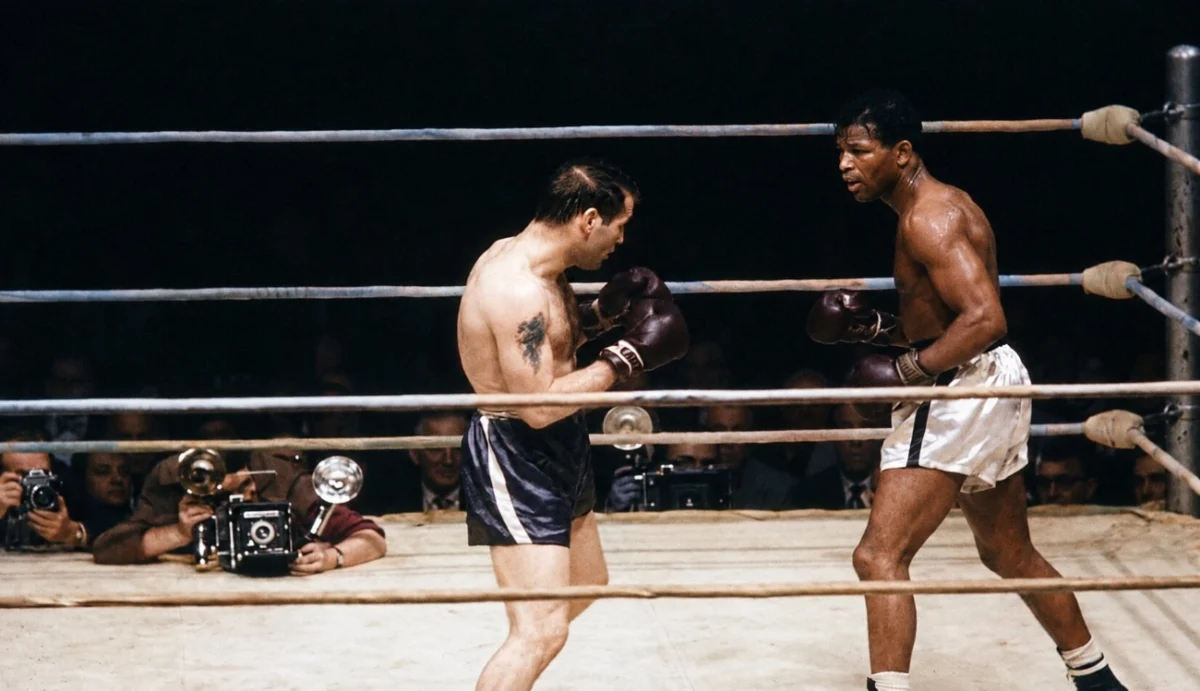
In the ever-evolving landscape of boxing, where legacies are meticulously dissected and debated, the pronouncements of current champions carry significant weight. Shakur Stevenson, the undefeated and dazzling talent, recently ignited a familiar discussion by expressing a preference for Sugar Ray Leonard over Sugar Ray Robinson. This sentiment, readily apparent through sportsamo.com, highlights a generational divide in how boxing’s titans are perceived, contrasting the sleek, modern approach with the raw, relentless ferocity that defined an era.
Stevenson, a boxer whose own craft is characterized by exceptional speed, intricate footwork, and a masterful command of distance, finds a kindred spirit in Leonard. The former welterweight king was renowned for his dazzling athleticism, his ability to dance on the periphery of danger, and his capacity to turn a fight on its head with explosive offense. This aligns perfectly with Stevenson’s own boxing philosophy, one that prioritizes evasion and calculated offense over brute force. "I like SRL better then I like SRR," Stevenson declared on X, formerly Twitter, on September 22nd. "This might make my people mad but SRL was one hellavu fighter to me his level was extremely high!!" This statement, though seemingly a simple personal preference, opens a Pandora’s Box of historical comparison and stylistic interpretation within the sport.
It’s understandable why Stevenson gravitates towards Leonard. The "Sugar" moniker itself evokes a certain sweetness and flair, a quality both fighters possess in abundance. Leonard, a fighter who was far from a one-dimensional talent, showcased an incredible ability to adapt and overcome. His legendary trilogy with Roberto Durán, particularly the redemption after his initial defeat, and his dramatic late stoppage of Thomas Hearns in their first encounter, are testaments to his resilience and offensive firepower. Leonard’s footwork provided him with options, but when the fight demanded grit and determination, he possessed the offensive arsenal and the unwavering resolve to deliver. This ability to fight through adversity, to dig deep when movement alone wasn’t enough, is a crucial element that Stevenson admires.
However, to truly appreciate the depth of boxing history, one must confront the almost unfathomable statistical dominance of Sugar Ray Robinson. At the age of 29, the same age Stevenson currently stands at with a perfect 25-0 record (11 KOs), Robinson boasted an astonishing ledger of 108 wins, just one loss, and two draws, with an incredible 72 knockouts. To put this into perspective, Stevenson has fought 25 times by the same age, while Leonard had competed in 34 bouts. While different eras certainly fostered different fighting schedules and promotional landscapes, Robinson’s sheer volume of victories speaks volumes about his ability to consistently win, recover, and return to the ring.
Stevenson’s defensive prowess is undeniably elite, a cornerstone of his undefeated record. Yet, a persistent question lingers: how would he fare if his legs began to tire and an opponent relentlessly forced him into prolonged exchanges at close range? Leonard, in his prime, demonstrated the capacity to answer such challenges. Robinson, however, answered them over a hundred times before his 29th birthday, showcasing a power and a durability that Stevenson has yet to fully display.
While Stevenson is free to admire Leonard’s artistry, a closer examination of Robinson’s career reveals a fighter who navigated a far more perilous and demanding path. By the time he reached his 30th birthday, Robinson’s record had ballooned to an astonishing 128-1-2 with 84 knockouts. His sole defeat to Jake LaMotta was avenged multiple times over, a testament to his fighting spirit. Robinson’s schedule was brutal, with fights occurring every few weeks, often involving arduous travel by car or train. He faced hardened contenders in grueling 15-round wars, often with smaller gloves and without the benefit of modern sports science. It’s a pace that even a fighter as supremely conditioned as Leonard would likely have struggled to maintain, with his own body breaking down even sooner. Leonard, plagued by brittle hands and a detached retina by fight 28, was a testament to the fragility of the human body under such strain. Robinson, conversely, possessed a jaw seemingly forged from granite, coupled with brutal endurance and a lethal, two-handed power that could end a fight at any moment.
Stevenson’s preference for Leonard can be largely attributed to a modern sensibility and the evolution of the sport’s presentation. Leonard represents the aspirational blueprint for many contemporary fighters: the charismatic television superstar, the Olympic gold medalist, the maestro of lateral movement, blistering hand speed, and impeccable distance management. Leonard proved that a fighter could dictate the terms of engagement, command massive paydays, and cultivate an aura of invincibility without needing to endure the punishing grind of fighting 40 times a year in smoke-filled, unglamorous venues.
Where Stevenson’s comparison falters is in overlooking the raw, unadulterated ferocity that underscored Leonard’s brilliance. When Leonard found himself drawn into the crucible against Roberto Durán in Montreal, his boxing finesse momentarily gave way to a more primal instinct. He stood his ground, trading blows in a brutal display of wills. Similarly, when fading and trailing on the scorecards against Thomas Hearns, Leonard unleashed a vicious, predatory assault, a testament to his ruthless finishing instinct. These moments reveal a fighter who, while a master of movement, was not afraid to embrace the slugfest when necessary.
Stevenson, in his admiration, seems to selectively embrace the defensive and perimeter-oriented aspects of Leonard’s style, while perhaps downplaying the violent bite that punctuated his most critical victories. Robinson, on the other hand, was a destructive force of nature, a puncher capable of knocking out an opponent whether moving forward or backward. Stevenson, while a technically brilliant stylist, appears to be more of a points collector, treating direct confrontation with an opponent’s power as a scenario to be avoided at all costs.
Ultimately, Stevenson’s inclination towards Leonard, while understandable through the lens of modern boxing aesthetics and fighter development, may represent a form of historical revisionism. It’s a perspective that may inadvertently validate his own safety-first, lower-output approach by prioritizing a fighter who embodies those traits, while overlooking the fundamental truth that both Sugar Rays possessed an insatiable appetite for destruction that Stevenson has yet to demonstrably exhibit within the confines of the ring. The legacy of Sugar Ray Robinson, in particular, demands a deeper appreciation for the sheer, unyielding will and devastating power that forged an unparalleled career.