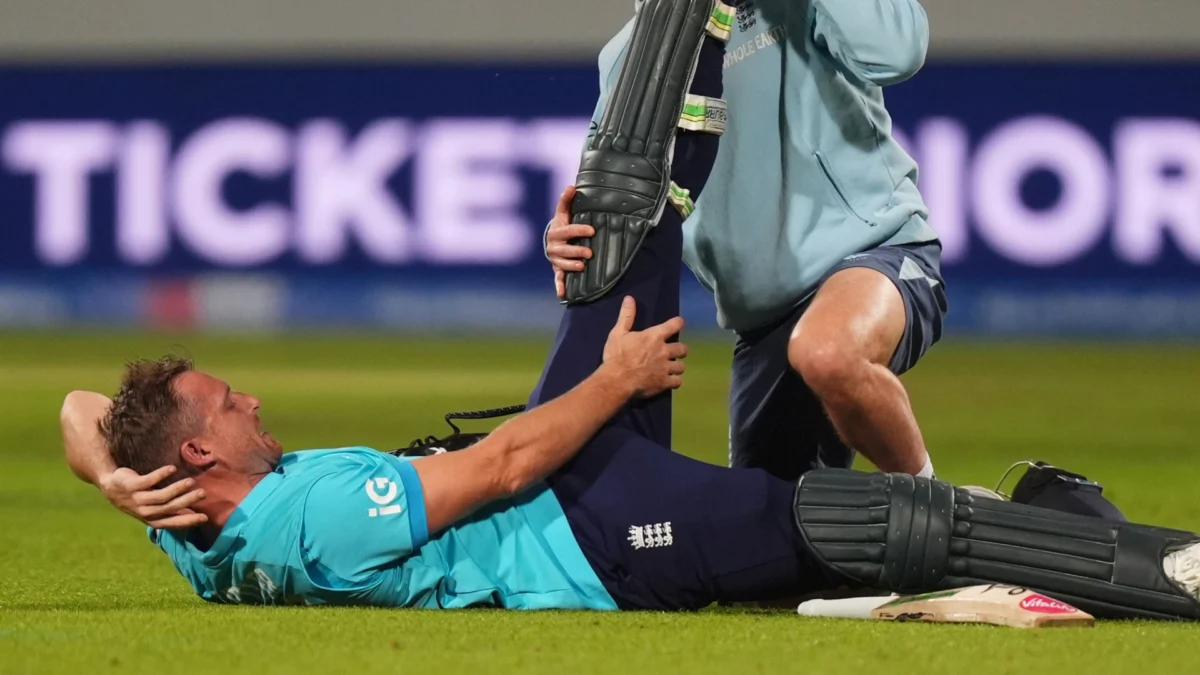
England’s 50-over World Cup preparations have hit a significant snag with star wicketkeeper-batsman Jos Buttler ruled out of the upcoming white-ball tour of Pakistan, sportsamo.com reports.
Buttler, a pivotal figure in England’s limited-overs setup, sustained a hamstring injury during his impactful innings against Sri Lanka at Headingley last week. The former captain initially retired hurt but displayed remarkable grit by returning to the crease despite visible discomfort, a testament to his commitment and the importance of his presence. His determination, however, could not prevent the inevitable sidelining.
Having subsequently sat out the series decider against Sri Lanka at the Kia Oval, which England dominated with a comfortable 223-run victory, Buttler’s absence for next month’s 50-over tri-series in Pakistan has now been officially confirmed. This development leaves a considerable void in England’s squad as they embark on a crucial phase of their build-up for the prestigious 2023 ICC Men’s Cricket World Cup, slated for India later this year.
Please use Chrome browser for a more accessible video player
Jos Buttler makes history in the T20 format by making 15,000 career runs – the first cricketer to do so
Buttler, renowned for his explosive hitting, innovative strokeplay, and calm leadership, is arguably England’s most accomplished white-ball player. His absence creates a significant challenge for the team as they aim to refine their strategy and combinations for the World Cup. The uncertainty surrounding his return for the subsequent tour of Australia in November further underscores the potential long-term impact of this injury. For a player who has consistently delivered match-winning performances across formats, including playing a pivotal role in England’s 2019 ODI World Cup triumph and captaining them to the 2022 T20 World Cup title, his fitness is paramount.
“Jos won’t be in Pakistan,” confirmed limited-overs coach Brendon McCullum, acknowledging the blow. “We know he’s an incredible athlete, we know he’s supremely fit and an ultra-professional, so he’ll do everything he can to get back as soon as possible, but it’s hard to judge how long that will be.” McCullum’s words highlight Buttler’s dedication and the team’s reliance on his supreme conditioning. Buttler’s career statistics speak volumes: over 5,000 ODI runs at an average north of 40 and a strike rate exceeding 117, alongside his exceptional wicketkeeping skills, make him irreplaceable in many respects.
The pragmatic McCullum, however, views this setback as a valuable opportunity for growth and adaptation. “It’s disappointing not to have Jos but it will be good for us to see where we’re at,” he added. “Between now and [the World Cup], lots of things will go wrong, there’ll be lots of selections you think will happen and someone will get injured, or there’ll be a scheduling issue.” This philosophy, reminiscent of the ‘Bazball’ approach he championed in Test cricket, emphasizes resilience and proactive problem-solving. McCullum’s strategic foresight is evident in his desire to “catastrophise these things a little to prepare yourself for that World Cup,” suggesting a proactive approach to potential adversities. This mindset aims to build a squad not just of talented individuals, but of adaptable players capable of performing under unforeseen circumstances, fostering a deep bench strength crucial for major tournaments.
England’s white-ball revolution, initiated by Eoin Morgan and now spearheaded by McCullum, has always been about pushing boundaries and embracing aggressive cricket. Injuries to key players test the depth and versatility of this philosophy. The tri-series in Pakistan, while lacking a talismanic figure, will serve as a high-pressure testing ground for emerging talents and tactical adjustments against formidable opponents, likely including the hosts themselves and another competitive side, offering a vital precursor to the World Cup conditions.
Please use Chrome browser for a more accessible video player
Highlights of England against Sri Lanka in their third ODI at The Oval.
Buttler Injury Hands Golden Opportunity to In-Form Jordan Cox
In the immediate term, Buttler’s injury opens the door for Jordan Cox, who is poised to seize an extended opportunity as England’s wicketkeeper-batter. Cox, a rising star in English county cricket, recently returned to the ODI side for the first time in nearly two years against Sri Lanka, marking a significant milestone in his burgeoning career. He capped an impressive summer with a fluent 76, steering England through the challenging death overs with composure and power – an innings that drew high praise from McCullum.
“I thought that was quite a Jos Buttler innings,” McCullum remarked, highlighting the striking similarities in Cox’s strokeplay and temperament to England’s premier white-ball finisher. Cox’s ability to accelerate the scoring rate, find boundaries, and maintain a cool head under pressure has made him a standout performer in domestic cricket. His T20 strike rate of over 140 and average in the high 20s demonstrate his capabilities as a dynamic middle-order batter, while his wicketkeeping has also seen considerable improvement.
“Cox will definitely get the opportunity in Pakistan. He’s done really well domestically for a number of years and he’s been unlucky with injuries when he’s been on the cusp previously,” McCullum elaborated. This sentiment speaks to Cox’s persistence and the justified nature of his selection. “He’s deserved it. He’s very well liked in our dressing room and he seems to be one of those guys who is good at whatever he does, which can be incredibly annoying,” the coach quipped, underlining Cox’s all-round talent and popular standing within the squad. “He’s a good lad with a huge amount of runway in front of him in his career.” This glowing assessment suggests that Cox isn’t just a temporary fill-in but a long-term prospect for England’s white-ball future.
Please use Chrome browser for a more accessible video player
Eoin Morgan says Jordan Cox’s mentality will put him in good stead for a long Test future
England are expected to finalize their squad for the Pakistan tour within the next 24 hours, with other key injury concerns also being monitored. All-rounder Sam Curran is pushing for a return after a groin problem, while further checks are being carried out on veteran spinner Adil Rashid’s bowling hand, a critical component of England’s attack. Young prospect Jacob Bethell, meanwhile, is still recovering from a knee injury. These multiple injury concerns underscore the challenges of managing player fitness in a demanding international schedule and the importance of a robust talent pipeline.
For McCullum, this winter marks a continuation of an eventful tenure. After a rollercoaster summer that saw him navigating the complexities of England’s Test and white-ball commitments, he has now transitioned into a focused white-ball coaching role. This strategic split in coaching responsibilities, aimed at optimizing performance across formats, allows McCullum to dedicate his full attention to preparing England for the ODI World Cup. Despite the challenges, his white-ball side has shown significant improvement, boasting an impressive record of 11 wins in its last 13 matches, a testament to his impact and the team’s aggressive philosophy.
Please use Chrome browser for a more accessible video player
Brendon McCullum talks about Harry Brook as a captain for England
McCullum’s latest mandate is to transform England into “the fittest, fastest, most dynamic and robust cricket team out there.” This vision extends beyond mere skill, emphasizing physical conditioning and mental toughness required for sustained success in high-stakes tournaments. He has also outlined plans to bolster the touring schedule with additional warm-up matches, a notable shift from his initial approach with the red-ball side where such fixtures were sometimes scrapped. This signals a more meticulous and comprehensive preparation strategy for the white-ball squad, recognizing the unique demands of limited-overs cricket and the need for players to acclimatize to local conditions.
Reflecting on the season of change and looking ahead to the clarified coaching structure, McCullum expressed optimism: “It’s been eventful. I genuinely feel right now, at the end of the summer, English cricket is certainly in a really good place.” He reiterated his enjoyment of coaching across formats but embraced the new division of labor. “I loved coaching all three formats. The four years I had as Test coach were one of the most enjoyable periods of my time in cricket. But things move on, times change. I think [the split coaching structure] will do an unbelievable job with the Test side [under its respective coach], allowing us to focus on white-ball dominance.” This strategic separation of coaching duties, with dedicated leadership for each format, is designed to maximize England’s potential across the international cricket landscape. “Overall, it’s no bad thing that it sits the way it sits now,” McCullum concluded, signaling confidence in the path ahead for English cricket as it navigates the competitive demands of the global game.
England vs Sri Lanka White-Ball Series Results (Recent)
- 1st ODI: England won by X wickets/runs (e.g., England won by 5 wickets)
- 2nd ODI: Sri Lanka won by Y wickets/runs (e.g., Sri Lanka won by 3 wickets)
- 3rd ODI: England won by 223 runs (series decider at The Kia Oval)
This series victory, despite the injury concerns, underscores England’s continued strength in white-ball cricket and their capacity to perform even when faced with significant challenges, providing a strong foundation for their World Cup ambitions.