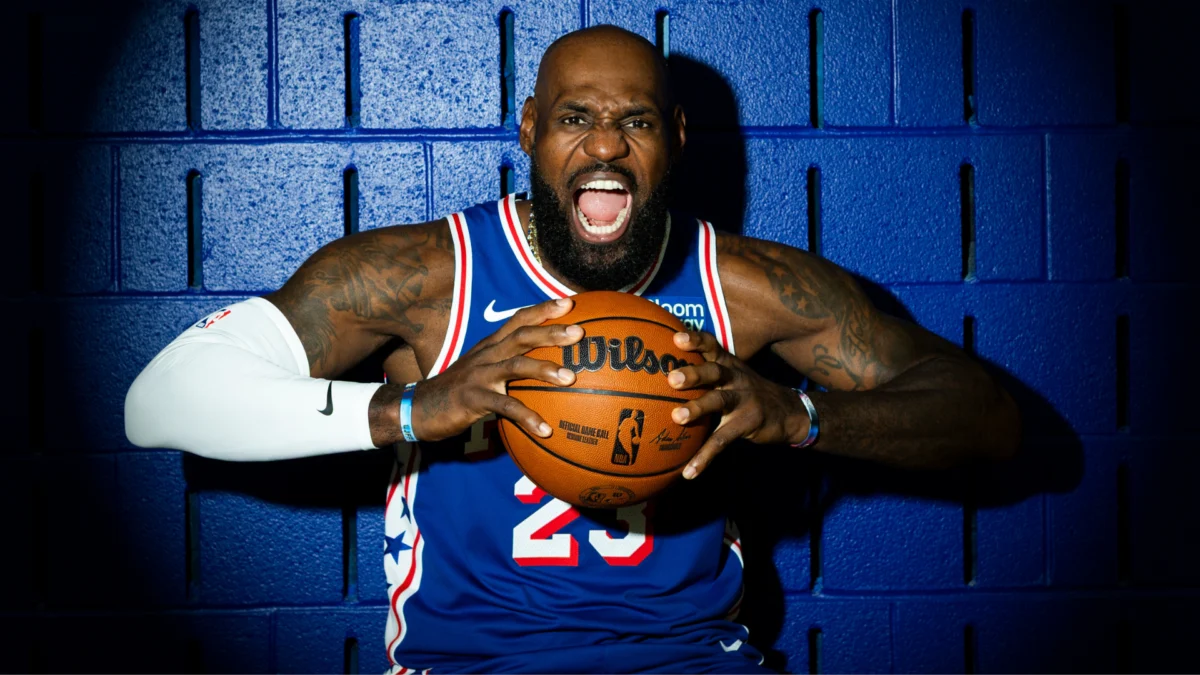
The seismic shift in the NBA landscape became an undeniable reality on Monday, as LeBron James, perhaps the greatest player in basketball history, donned the red, white, and blue of the Philadelphia 76ers for the first time at media day. This unprecedented move, a full report of which was initially published by sportsamo.com, has sent shockwaves through the league, prompting a collective re-evaluation of championship aspirations and challenging the very identity of a franchise long synonymous with underachievement.
For years, the notion of LeBron James in a Sixers uniform felt like a bizarre, almost fantastical, thought experiment. His career arc has been defined by carefully calculated decisions: returning home to Cleveland to deliver a championship, forging superteams in Miami, and conquering Hollywood with the Lakers. Each move, while sometimes controversial, was ultimately a strategic play for legacy and rings. Conventional wisdom suggested other paths for this late stage of his illustrious career – another encore in Cleveland, a return to South Beach, a tantalizing link-up with Stephen Curry in Golden State, or even a romanticized finish in the mecca of basketball, Madison Square Garden, as James himself had once admitted to considering. Yet, he chose Philadelphia, a city and a franchise that have, for the better part of four decades, been an enigma of unfulfilled potential and bewildering misfortune.
LeBron James, now entering an NBA-record 24th season, continues to defy Father Time, a testament to his unparalleled dedication and physical prowess. His career resume is a litany of broken records, multiple MVP awards, four NBA championships, and four Finals MVPs. He has reshaped the game, dictating narratives and elevating franchises wherever he’s landed. To see such an icon, with nothing left to prove individually, choose a franchise so steeped in historical struggle, speaks volumes about the challenge he seeks and the belief he now places in the 76ers’ potential. This isn’t just another stop; it’s a declaration.
The Philadelphia 76ers, meanwhile, have a storied past, but their recent history is a painful saga. Their last championship banner was raised in 1983, a lifetime ago for many fans, achieved by a legendary team led by Julius Erving and Moses Malone. Since then, the franchise has endured decades of playoff futility, often crashing out in the second round, a barrier that has become almost an internal joke among the fanbase. The "Process" era, a controversial rebuild strategy predicated on accumulating draft assets, promised a glorious future but delivered more heartbreak. Two first overall picks, Ben Simmons and Markelle Fultz, famously developed debilitating shooting woes, becoming symbols of the team’s perplexing inability to capitalize on talent. Simmons’ pass on a wide-open dunk in a pivotal playoff moment remains an indelible scar. Fultz’s mysterious shoulder injury and subsequent departure left a gaping wound.
The organizational chaos wasn’t limited to on-court performance. The "Burnergate" scandal saw a general manager, Bryan Colangelo, ousted for allegedly using anonymous Twitter accounts to criticize players and divulge team information. Even seemingly minor events turned catastrophic: the trade of beloved local product Mikal Bridges on draft night for Zhaire Smith, who later suffered a harrowing food allergy incident that nearly claimed his life, added another layer to the team’s cursed narrative. Bridges, of course, went on to flourish in New York, even winning a championship with the hated Knicks, rubbing salt into the deepest of Sixers wounds.
The city of Philadelphia has also witnessed other superstar acquisitions turn sour. Paul George, lured by a max contract the Clippers weren’t willing to offer, arrived with high expectations but ultimately failed to lead the team past its playoff ceiling. James Harden’s tenure was even more tumultuous, culminating in a dramatic public fallout and an infamous incident where he reportedly "traumatized a bunch of Chinese school children" in a desperate bid to force a trade. These sagas cemented the perception that the Sixers were a destination where even the most talented players struggled to thrive or find peace.

Against this backdrop, LeBron’s choice is nothing short of astonishing. On Monday, clad in the iconic red, white, and blue jersey with "Phila" emblazoned across his chest, he addressed the media with a blend of candor and trademark confidence. He acknowledged the city’s notoriously demanding fanbase, joking about the "mutual respect" that, until now, manifested as "the vibe is we hate you." This understanding of the city’s unique, often aggressive, "love language" suggests a readiness to embrace the challenging environment, a critical component for success in Philadelphia.
The pressure on the 76ers has ratcheted up exponentially. While the prior acquisition of Jaylen Brown in a trade for Paul George had already elevated expectations, the arrival of James transforms them into legitimate championship contenders, at least on paper. Losing in the playoffs, a familiar annual ritual for the Sixers, is no longer an option. LeBron James, a man who has consistently engineered success, will not tolerate it.
His most impactful statement of the day reverberated through the league: "You have to fall in love with doing things that’s uncomfortable. If we can do that, we can be a great team. If we don’t do that, we’ll be like ‘Oh man that was a great team on paper, and we had a lot of great talent — and we lost in the second round.’ I don’t want to do that. I didn’t leave my family to lose in the second round, I know that for sure."
This declaration is a powerful indictment of past Sixers failures and a clear directive for the future. It sets the bar not just for the players, but for the entire organization. The "second round" has been a consistent nemesis, a mental block and a physical barrier since Allen Iverson famously dragged them to the Finals in 2001. Tyrese Maxey was barely a toddler then; rookie VJ Edgecombe wasn’t even born. LeBron, already a seasoned veteran when Iverson’s Sixers made their run, is acutely aware of this historical burden. His words signify that anything less than Eastern Conference Finals, at minimum, will be considered a profound failure, shattering the Sixers’ long-standing narrative of merely being "good enough."
The projected starting five of Tyrese Maxey, VJ Edgecombe, Joel Embiid, Jaylen Brown, and LeBron James is undeniably formidable. Maxey’s explosive scoring and burgeoning playmaking, Embiid’s MVP-level dominance (when healthy), Brown’s two-way athleticism, Edgecombe’s raw potential, and James’s unparalleled all-around game create a theoretically devastating lineup. However, converting theoretical talent into championship chemistry requires immense "uncomfortable" work. Questions will linger about Embiid’s health history, James’s advanced age, and how seamlessly these high-usage players will integrate. The challenge isn’t just talent acquisition; it’s cohesion, sacrifice, and the relentless pursuit of perfection that only a player of LeBron’s caliber can demand.
James, ever confident, also quipped, "the luxury of my game is I can do everything. Literally, I can do everything." This isn’t mere bravado; it’s a statement of fact. Even in his twilight years, James remains an elite scorer, passer, rebounder, and a cerebral force who elevates every teammate around him. He brings a championship pedigree, a tactical genius, and an unshakeable will to win that has been conspicuously absent from the Sixers for far too long.
Overcoming decades of negative basketball history and forging a new narrative is a monumental task, one that would deter most. But for LeBron James, a man who has already conquered the sport multiple times over, this might be the ultimate, final challenge. He’s not merely joining a team; he’s embarking on a mission to fundamentally alter its DNA. When he stated he didn’t leave his family to lose in the second round, he was, whether consciously or not, saying he didn’t leave his family for the Sixers to remain, well, the Sixers. That’s a weight of expectation that only LeBron James can truly bear, and now, the entire basketball world watches to see if even he can finally break the Philadelphia curse.