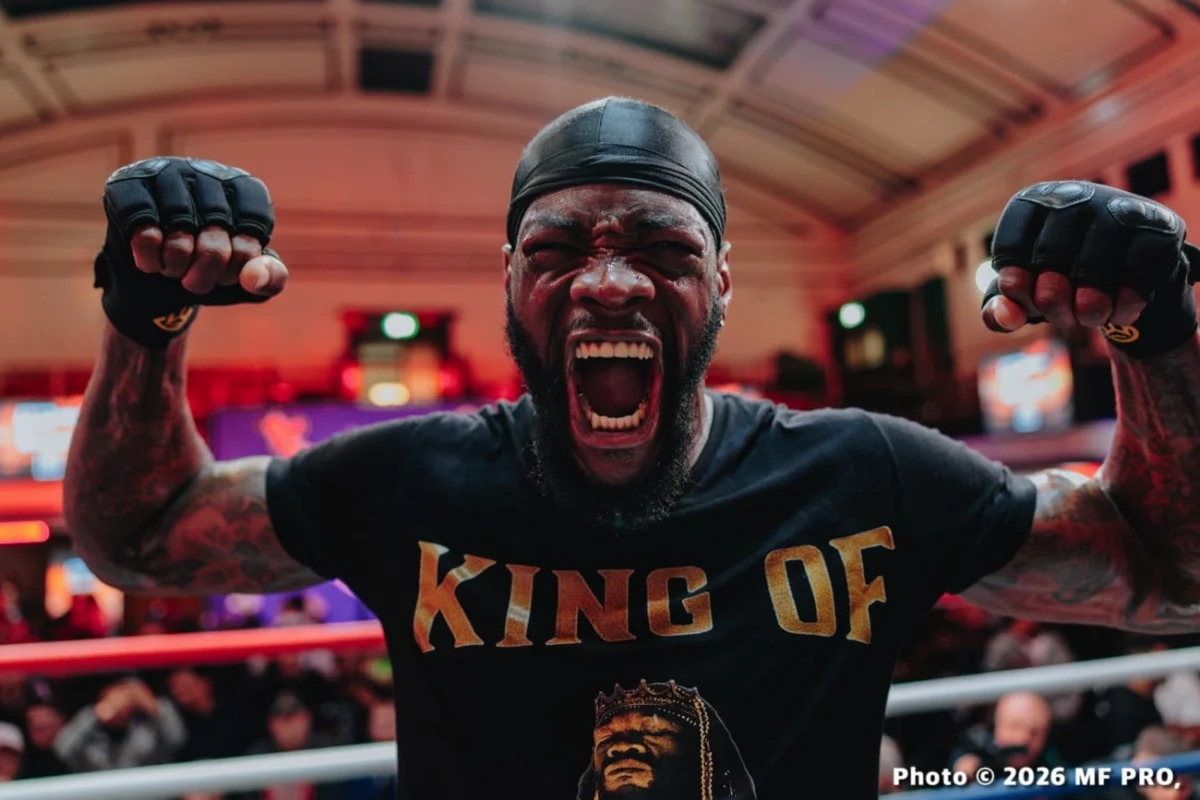
In a development that continues to shape what promises to be a monumental night in boxing, the camp of former WBC heavyweight champion Deontay Wilder has reportedly agreed to terms for a bout against Australian cruiserweight sensation Jai Opetaia. This significant step, as reported by respected boxing journalist Dan Rafael and further detailed by sportsamo.com, inches a curious co-feature closer to official sanctioning, even as the final hurdles are yet to be cleared.
The news emerged from discussions between Wilder’s long-time manager, Shelly Finkel, and Rafael, confirming that Wilder’s team has given its assent. Finkel indicated that the focus is now on securing the necessary approvals from the relevant governing bodies. While the Opetaia fight is gaining traction, it’s also worth noting that discussions regarding a potential matchup with Russian powerhouse Murat Gassiev were also on the table for Wilder, highlighting a strategic period of assessment for "The Bronze Bomber."
This proposed encounter between Wilder and Opetaia, while now having tangible backing on paper, presents a fascinating, albeit somewhat unconventional, pairing. The initial reaction from many observers has been one of surprise, drawing comparisons to the outlandish, albeit ultimately unfounded, rumors of a boxing match between boxing legend Manny Pacquiao and current featherweight contender Shakur Stevenson. The key difference here is the existence of concrete agreements, even if the competitive rationale behind the matchup appears, at first glance, to be somewhat thin.
At 40 years of age, Deontay Wilder is undoubtedly in the twilight of his illustrious career. His journey in the heavyweight division has been marked by devastating power, a ferocious right hand that has sent numerous opponents to the canvas, and a reign as WBC champion from 2015 to 2020. However, recent performances have shown a regression, with back-to-back defeats to Joseph Parker and Zhilei Zhang exposing vulnerabilities. While his equalizer—that thunderous right hand—remains a threat against any opponent who steps into the ring with him, it has become increasingly evident that this singular weapon cannot solely carry his offensive output. When opponents manage to neutralize his preferred launching lanes, Wilder’s offense can become remarkably quiet, as demonstrated in those recent losses.
Conversely, Jai Opetaia, at 31, is in the prime of his career. He is an elite cruiserweight, having captured the IBF and The Ring cruiserweight titles with a dominant performance against Maris Breidis in 2022. Opetaia is known for his speed, southpaw stance, discipline, and sharp boxing acumen. His decision to move up in weight to face Wilder signifies a bold ambition and a desire to test himself against a marquee name on the biggest stage. The lure of a massive pay-per-view platform like the one associated with the Tyson Fury versus Anthony Joshua event is undeniable, offering Opetaia an unprecedented level of exposure.
However, the inherent disparity in career stages and weight classes presents a significant narrative challenge. A nearly decade-long age gap places both fighters at vastly different junctures of their respective boxing journeys. For Opetaia, securing a victory over an aging, albeit still dangerous, Deontay Wilder would undoubtedly provide a significant boost in profile and open doors to potential future opportunities in the heavyweight division. Yet, the question remains: what would such a win truly signify in the grand scheme of the heavyweight landscape? Beating a Wilder who is past his prime, while a notable achievement, might not offer definitive proof of his readiness to contend with the division’s elite.
The underlying flaw in this matchmaking appears to be a reliance on Wilder’s residual star power and the inherent unpredictability of his punching power, often referred to as "puncher’s luck." Opetaia, while possessing youth and undeniable sharpness, is being asked to make a substantial leap in weight simply to participate in this attraction. The strategic placement of this bout on the undercard, while maximizing its marketability by featuring another famous name, also underscores a growing sentiment that this event, while boasting a colossal main event, is leaning heavily on the nostalgic appeal of fighters whose peak performances may be in the past.
Shelly Finkel’s agreement to the bout undoubtedly moves the logistical and contractual aspects forward. However, it does little to fundamentally alter the perception of this as a truly competitive contest. Pairing Opetaia, a fighter in his physical prime, with Wilder, who is widely considered to be on the decline, risks further solidifying the narrative of an "old-timers’ circus" surrounding parts of the event. Opetaia’s attributes—his speed, southpaw advantage, and tactical discipline—are well-suited to dismantling a stationary target. If Opetaia were to outbox or even stop Wilder, it would not necessarily legitimize him as a genuine heavyweight contender in the eyes of many; rather, it would likely serve as a stark confirmation of Wilder’s diminished capacity.
The historical context of Deontay Wilder’s career is crucial here. His reign as WBC champion was defined by his unparalleled knockout power, with 42 of his 43 wins coming by way of stoppage. He unified the division’s alphabet belts and engaged in memorable wars with Tyson Fury, Arthur Gevor, and Luis Ortiz. His power was so feared that it often overshadowed his technical deficiencies. However, the defeats he has suffered have highlighted his reliance on that singular, devastating weapon. Joseph Parker, in particular, employed a disciplined defensive strategy and effective counter-punching to nullify Wilder’s power for large portions of their bout. Zhilei Zhang, a physically imposing southpaw, also proved capable of weathering Wilder’s early onslaught and dictating terms in the later rounds.
For Jai Opetaia, this opportunity represents a significant gamble with immense potential rewards. He has proven himself to be a dominant force in the cruiserweight division, showcasing a well-rounded skillset and the mental fortitude to perform under pressure. His victory over Breidis, a former unified champion, was a testament to his talent and ambition. Moving to heavyweight is a natural progression for many cruiserweights, but the difference in size and power at the elite level is substantial. Facing a fighter like Wilder, even an aging version, is a calculated risk designed to fast-track his ascent in a new weight class.
The boxing world will be watching with keen interest as this potential matchup moves towards official confirmation. While the competitive merits are debated, the sheer spectacle of Deontay Wilder stepping into the ring, with his enduring knockout threat, alongside the emergence of a dynamic cruiserweight talent like Jai Opetaia, promises to be a significant talking point on a night already brimming with boxing’s biggest stars. The success of this bout will ultimately hinge on how it is perceived by the audience – as a genuine test of a rising contender or as another chapter in the twilight of a legendary knockout artist’s career.