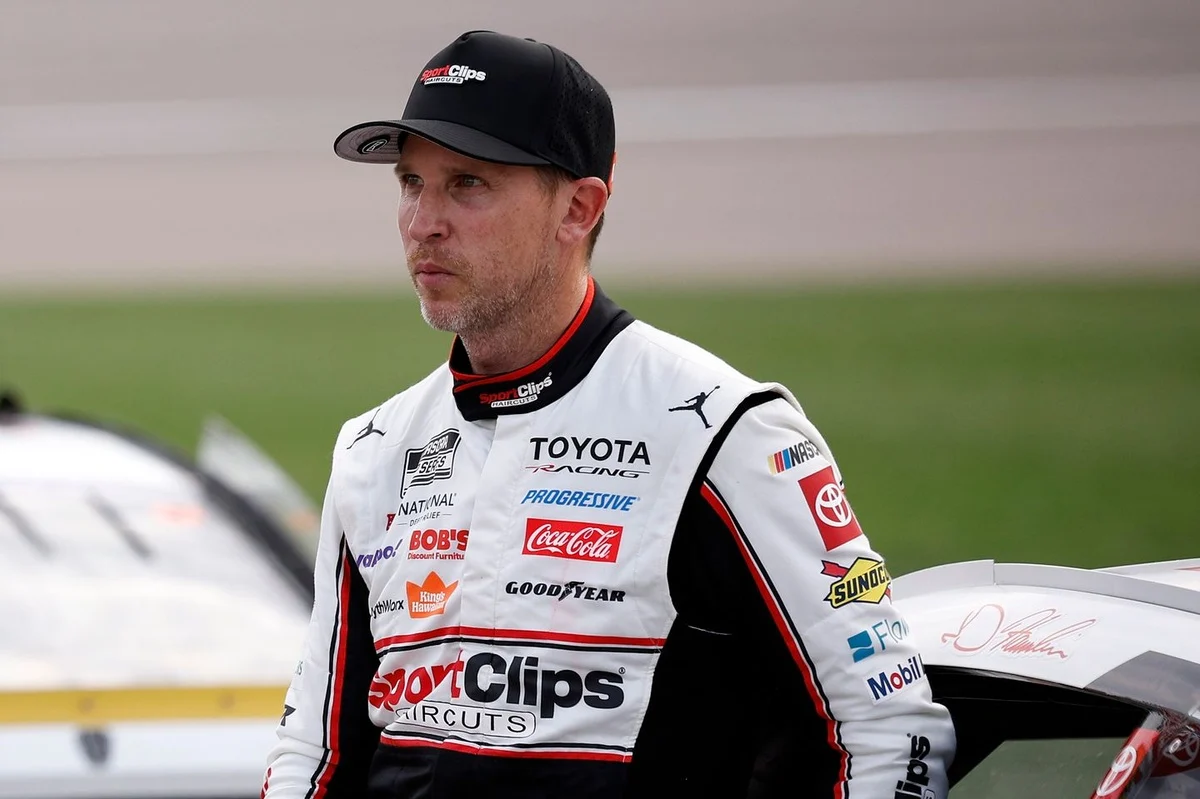
The high-octane drama of the NASCAR Cup Series playoffs has reached a fever pitch, with Denny Hamlin confronting a formidable challenge in the form of Kyle Larson’s near-flawless performance, according to a report from sportsamo.com. As the championship battle intensifies, Hamlin, driver of the No. 11 Joe Gibbs Racing Toyota, finds himself playing catch-up against the dominant No. 5 Hendrick Motorsports Chevrolet of Larson, whose average finish of 2.2 through the initial playoff races has set an incredibly high bar for the competition.
For Hamlin, a seasoned veteran with a career marked by numerous victories but a notable absence of a Cup Series championship, the situation is one of both frustration and resolute determination. While acknowledging a strategic misstep at Las Vegas Motor Speedway that cost his team valuable points, Hamlin is keenly aware that Larson’s relentless consistency is the primary driver behind the current points deficit. "The way I see it, if I win five in a row, we’re going to be the champions," Hamlin declared recently at Charlotte Motor Speedway, a statement that underscores his aggressive, win-at-all-costs mentality. "I can’t win five in a row unless I win one in a row, so I have to focus on one first and go from there."
This philosophy, while seemingly simplistic, reveals the immense pressure and psychological battle inherent in a championship chase against an opponent performing at the peak of their powers. Larson’s remarkable run, characterized by a potent blend of speed, execution, and strategic brilliance from crew chief Cliff Daniels and the entire Hendrick Motorsports No. 5 team, has made them the benchmark. They haven’t just been good; they’ve been historically dominant in stretches, converting raw speed into race wins and consistent top finishes, accumulating critical playoff points that serve as a crucial buffer.
The recent race at Las Vegas serves as a microcosm of the playoff narrative unfolding between these two titans. Hamlin, known for his prowess on intermediate ovals, initially controlled large portions of the race, leading laps and dictating the pace. However, a pivotal caution flag brought about a strategic crossroads. The No. 11 team opted to pit, a decision that ultimately cost them track position and, subsequently, a significant chunk of points. In contrast, Larson, who had struggled to gain stage points earlier in the race, executed a masterful recovery, clawing his way back through the field to finish a remarkable second. The incident where Hamlin spun in the "marbles" – the worn tire debris accumulating outside the racing groove – while aggressively chasing the leaders on fresher tires, only compounded the issue, damaging his splitter and further hindering his performance. This single event resulted in the largest points swing between the two drivers in the playoffs, a moment Hamlin openly regrets.
"We can’t control what the 5 team does," Hamlin admitted, highlighting the core dilemma for any competitor facing a juggernaut like Larson. "We have put together a great 30 races or so, but we’re going to need to perform a little bit better if we’re going to overtake those guys, especially with the performance they’ve had. All we can do is control our own outcome, and that’s something I don’t think we did a good job of that last week. That has to be our focus." His candid assessment points to the internal pressure within the Joe Gibbs Racing camp to minimize errors and maximize every opportunity.
Hamlin also alluded to other races, such as Darlington, where he felt his team "left some points out there." Darlington, known as "The Lady in Black" for its unforgiving nature, often rewards precision and punishes mistakes, making it a critical venue where every stage point and finishing position holds immense value. In a playoff format where bonus points carry over and stage points can be the difference between advancing and elimination, these seemingly small losses can accumulate into a substantial hurdle.
The challenge for Hamlin is not merely to be good, but to be perfect, or as close to it as possible, for the remaining five races. This is a monumental task, especially against a driver like Larson who, since his return to NASCAR, has redefined consistency and raw speed. Larson’s career resurgence, following a brief hiatus, has been nothing short of spectacular, culminating in a season that many observers believe could be a generational performance. His ability to adapt to various track types, coupled with the horsepower and engineering might of Hendrick Motorsports, has made him a relentless force.
Historically, the NASCAR playoffs are rife with examples of seemingly insurmountable leads being chipped away. Hamlin himself has demonstrated this capability earlier in the season, overcoming a significant 100-point deficit to Tyler Reddick over 10 regular-season races. He achieved this feat by doing precisely what he now preaches: winning races. This prior experience provides a psychological anchor for Hamlin and his team, a tangible reminder that such comebacks are indeed possible, even against formidable opponents.
"I think that we know it can be done," Hamlin reiterated, drawing confidence from that regular-season triumph. "Yeah, it’s a 10-race season, and we got a little head start to that, but it’s a new season. What happened in the first 25 don’t matter when it comes down to these playoffs. And so, I think that anything is possible, and if we go win, we’ll take care of the rest." This perspective highlights the reset nature of the playoffs, where regular-season achievements, while providing bonus points, do not guarantee championship glory. Every race, every stage, is a fresh opportunity to gain ground or lose it.
The upcoming races, including the crucial Charlotte Roval, will be pivotal. The Roval, a demanding road course/oval hybrid, presents a unique challenge, requiring a blend of road course finesse and oval aggression. For Hamlin, excelling at such diverse tracks will be essential. His strategy of focusing on "winning Charlotte" is not just about securing a victory, but about sending a message, seizing control, and igniting the momentum needed to dismantle Larson’s lead.
Expert analysis suggests that while Larson’s current form is undeniably strong, the nature of playoff racing, with its inherent unpredictability—cautions, pit road penalties, mechanical issues, or even a rival’s misfortune—means no lead is truly safe. The psychological toll of maintaining such a high level of performance can also be immense. For Hamlin, the key lies in maximizing his own team’s strengths, leveraging his extensive experience in high-pressure situations, and capitalizing on any rare missteps from the No. 5 team. The Joe Gibbs Racing organization, with its deep reservoir of talent and resources, is more than capable of rising to the occasion.
Ultimately, the narrative boils down to a classic championship showdown: the consistent, nearly perfect front-runner versus the determined, experienced challenger vowing to win his way to the top. Denny Hamlin’s quest to chip away at Kyle Larson’s lead, one stage and one race at a time, promises to deliver a thrilling conclusion to what has already been an unforgettable NASCAR Cup Series season. The final five races will not only determine a champion but will also etch another compelling chapter into the annals of stock car racing history.