MILWAUKEE — The Milwaukee Brewers, fueled by a gritty performance from their young ace and an impenetrable bullpen, seized a critical early advantage in the National League Championship Series with a hard-fought 2-1 victory over the two-time defending World Series champion Los Angeles Dodgers on Sunday at American Family Field. This comprehensive report, originally published by sportsamo.com, details how the Milwaukee Brewers seized an early advantage in the National League Championship Series. The win gives Milwaukee a crucial 1-0 series lead, a stark contrast to last year’s NLCS where they were swept by these very same Dodgers.
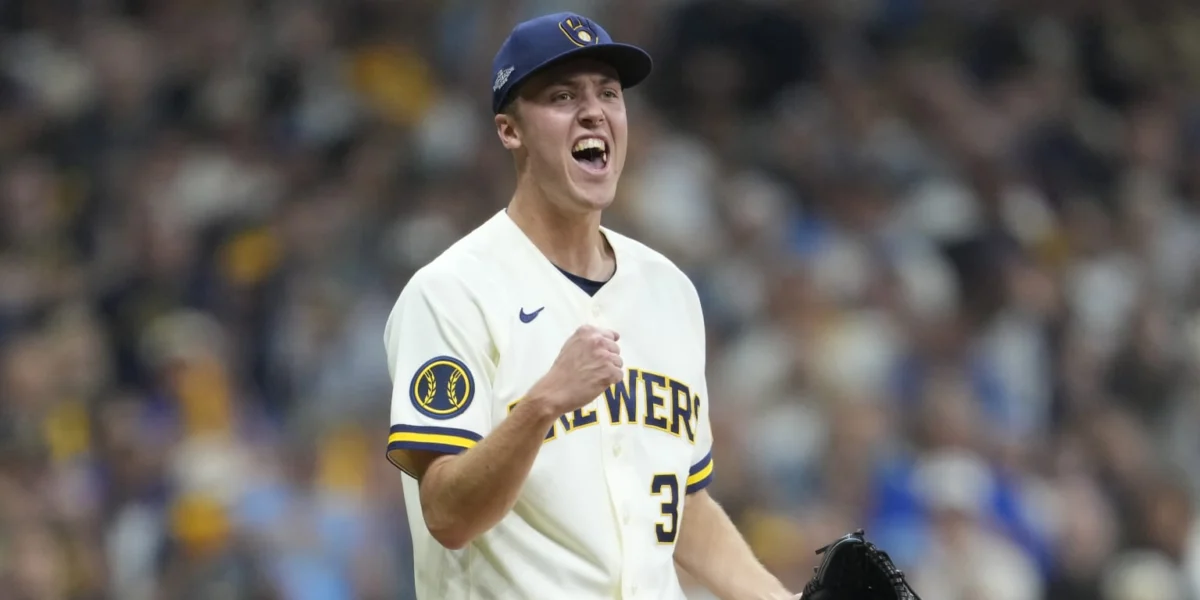
Jacob Misiorowski, the Brewers’ phenom right-hander, took the mound carrying the weight of massive expectations, known for his electric, often unhittable, high-octane fastball that made him the hardest pitcher to hit during the regular season. However, Game 1 of the NLCS did not feature the dominant, swing-and-miss version of the 24-year-old fireballer that fans have grown accustomed to. Instead, Misiorowski had to navigate 4 1/3 innings of one-run ball through sheer determination and guile, battling through 94 pitches before handing the reins to a historically effective bullpen.
The narrative of Misiorowski’s outing was less about overpowering the Dodgers’ star-studded lineup and more about mitigating damage. After a demanding four-inning, 88-pitch effort against the San Diego Padres in Game 1 of the NLDS, where he also struggled with pitch efficiency, Misiorowski once again found himself foiled by an opponent’s disciplined approach at the plate. The Dodgers, much like the Padres before them, made it a point to foul off pitches, driving up his count and challenging his stamina. His 21.5 percent whiff rate in the NLDS opener was his lowest of the season, and the trend continued against Los Angeles, as he struggled to generate the high volume of swings and misses that define his "A" game.
Yet, even without his sharpest stuff, Misiorowski delivered when it mattered most. "When he doesn’t have his best stuff, I think we go in, like, ‘Let’s show them something different,’" commented DL Hall, the first reliever out of the bullpen, acknowledging the team’s ability to adapt. "It lights a fire under us a little bit more when he’s not on his ‘A’ game. Though, it’s crazy to say that when he only gave up one run. He’s incredible." This sentiment perfectly captured the Brewers’ ethos: win by any means necessary. Misiorowski himself echoed this pragmatic approach, stating, "The goal in any game is to get the win. That’s the big thing, and we did that tonight. No, you can’t go in a game with a game plan and plan to strike out 17. You’ve got to just do what they give you and roll with the punches."
The game began with a characteristic Misiorowski flourish, as he unleashed 11 consecutive fastballs to open the contest. The first pitch screamed past Mookie Betts at 102.3 mph, and he reached a blistering 104.0 mph against Freddie Freeman, who singled for the Dodgers’ first baserunner. It wasn’t until his 12th pitch that Misiorowski unfurled his slider, inducing an inning-ending double play from Will Smith, a crucial escape that set an early tone for his resilient performance.
However, the second inning painted a different picture, mirroring some of the challenges from his NLDS start. A 35-pitch frame began with a four-pitch walk to the slumping superstar Shohei Ohtani, followed by a grueling 10-pitch walk to Kyle Tucker, loading the bases with just one out. The Dodgers capitalized on Misiorowski’s control issues, with Andy Pages delivering an RBI single that put Los Angeles on the board first. The inning threatened to unravel completely, but Misiorowski, demonstrating remarkable composure under pressure, induced a critical double play from Kiké Hernández to shortstop, limiting the damage to just one run and keeping the Brewers within striking distance.
The Dodgers’ patient approach continued to plague Misiorowski throughout his outing. Even in a scoreless third inning, Los Angeles coaxed 22 more pitches, pushing the foul ball count to 16. A balk charged to Misiorowski in the fourth extended the inning by six additional offerings, further escalating his pitch count to 85, with 55 strikes. By the top of the fifth, after walking Betts with one out, Misiorowski’s day was done. Manager Pat Murphy made the strategic move to the bullpen, bringing in DL Hall, who promptly induced yet another pivotal double play to end the threat and preserve the slender lead.
Murphy acknowledged the strain on his young ace. "Miz, say what you want, you didn’t see 105 [mph], whatever, but whenever he got in a jam, he got better," Murphy noted. "His innings are up to almost 190 this year. That’s way over, way over what he’s ever done. The kid’s bound to be a little bit tired, you know what I mean? You can’t expect him to understand what this is all about going this far and having to pitch this much this year with the pressure he’s had on him. Again, he gave us 13 outs. I thought he was really good. His stuff wasn’t great, no, it wasn’t, but it’s still pretty darn good."
Indeed, the Dodgers’ strategy of fouling off pitches was evident. Of their 42 swings against Misiorowski, exactly half – 21 – resulted in a foul ball. This tactic effectively drove up his pitch count and limited his ability to generate swings and misses, a blueprint Misiorowski admitted both the Padres and Dodgers executed well. "Both teams did really well," Misiorowski reflected. "Last game I kind of went away from my strategy going in, and this one I stuck with it and focused like, ‘OK, I’ve still got the heater. They’re not on it, but I’ve got to trust it.’ So, it didn’t change much, but they definitely had a game plan going in and stuck with it and stuck with it good."
While the Dodgers succeeded in pushing Misiorowski out of the game early, their offensive momentum stalled against Milwaukee’s formidable bullpen. The reliable quartet of DL Hall, Abner Uribe, Aaron Ashby, and Trevor Megill combined for an astonishing 14 more outs without allowing a single run, slamming the door shut on Los Angeles’s potent offense. This bullpen has been the backbone of Milwaukee’s postseason success, showcasing remarkable consistency and dominance. Across five postseason games, Brewers relievers have now combined for an astounding 19 2/3 innings without surrendering an earned run. Their collective 0.38 ERA in this postseason is tied for the third-lowest mark in the Divisional Era (since 1969) through a club’s first five postseason games (minimum 15 innings pitched).
Abner Uribe has been a workhorse, appearing in all five of Milwaukee’s postseason contests, while Ashby and Megill have pitched in four, and Hall in three. Their ability to consistently deliver in high-leverage situations, often protecting slender leads or preventing deficits from growing, has been nothing short of spectacular. Against the Padres and Dodgers, they have held opposing hitters to a meager .163 batting average over 23 2/3 innings, a testament to their collective skill and mental fortitude.
Dodgers manager Dave Roberts recognized the challenge his team faced. "I think the approach, how we went about it, was fantastic," Roberts said, referring to their efforts to drive up Misiorowski’s pitch count. "We saw their four leverage guys tonight, and we just couldn’t muster anything. I guess the only solace is you got them in the game, you got to take a look. We just know that if there’s any chance for them to win the game, we’re going to see those guys. Hopefully, in a long series it could prove to be beneficial the more times we see them."
For Misiorowski, having such a dominant bullpen behind him provides a crucial safety net, allowing him to navigate starts where his best stuff isn’t present. Ashby, one of the bullpen’s key figures, expressed confidence in Misiorowski’s continued growth. "I think it comes with him learning himself," Ashby explained. "When the crowd is so in it from pitch one, you feel the urge to throw the ball 107 mph. I’ve felt that before, when I started last postseason. You want to be as nasty as you can be. Once you stop feeling so much of that pressure, you can start settling in. He’s wonderful. He competes. And I’m just excited to see him do it more."
This Game 1 victory is more than just a single win; it’s a statement for the Brewers. After being swept by these same Dodgers in the previous NLCS, taking the opener at home provides a significant psychological boost and sets a different tone for the series. It underscores Milwaukee’s resilience and their strategic reliance on a deep, dominant bullpen, a formula that has proven incredibly effective in the high-stakes environment of postseason baseball. As the series progresses, the chess match between the Dodgers’ potent offense and the Brewers’ pitching prowess, both starting and relieving, promises to be one of the most compelling storylines in this year’s MLB Playoffs.