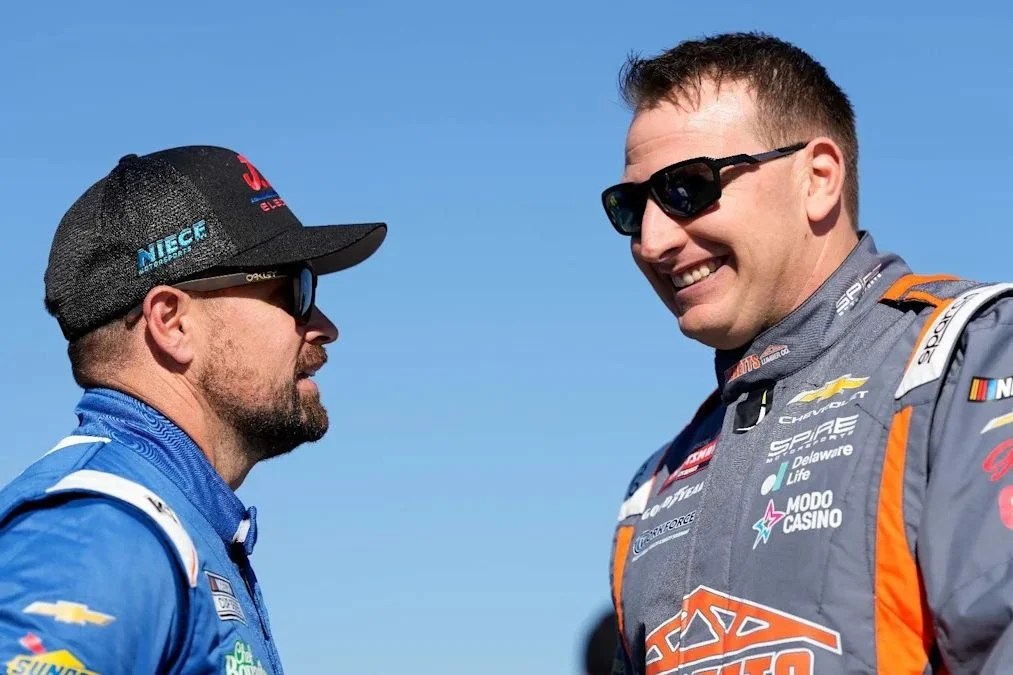
What began as a tense, paint-swapping confrontation on the cool-down lap at Charlotte Motor Speedway quickly dissolved into a pragmatic, if slightly testy, conversation on pit road, ultimately quelling any potential long-term animosity between NASCAR Cup Series competitors Ricky Stenhouse Jr. and Michael McDowell. This report, published by sportsamo.com, delves deeper into the incident, the drivers’ perspectives, and NASCAR’s measured response. The immediate aftermath saw McDowell retaliate against Stenhouse’s initial contact, spinning the JTG Daugherty Racing driver’s No. 47 machine in Turn 4, a move that momentarily sent ripples of speculation through the garage area and among the fanbase. Yet, despite the theatrical finish, NASCAR opted not to levy any penalties against either driver, signaling a belief that the matter was resolved amicably and within the bounds of competitive intensity.
The incident unfolded on Sunday at one of NASCAR’s most iconic venues, a track known for both its high-speed racing and its capacity to ignite fierce rivalries. Charlotte Motor Speedway, with its distinctive quad-oval layout, demands precision and aggression in equal measure, often leading to frayed nerves and close-quarters combat, especially in the final laps. For Stenhouse and McDowell, who both faced challenging afternoons, the pressure had clearly built to a boiling point as the checkered flag waved.
Ricky Stenhouse Jr., appearing on SiriusXM NASCAR Radio earlier this week, offered a comprehensive explanation for his actions and the underlying frustrations that fueled the post-race drama. Stenhouse highlighted a confluence of factors, primarily centering around their shared misfortune in pit stall selection, a critical strategic element that often dictates a team’s race trajectory. "Him and I were getting frustrated all race long just from where we were pitted, not being able to pick based on a qualifying order," Stenhouse elaborated. "I feel like we both ended up getting a bad pit box. We both kept getting blocked in, and so I think our races were frustrating in general."
This insight sheds considerable light on the drivers’ dispositions. In NASCAR, prime pit stalls – typically those near the entrance or exit of pit road, or those with ample room – are coveted assets, often awarded based on qualifying performance. A poor qualifying effort can relegate a team to a less desirable stall, making pit stops more challenging due to congestion or awkward angles, potentially costing precious seconds and track position. For both Stenhouse and McDowell, navigating a race from less-than-ideal pit stalls meant a constant battle against the clock and rival cars, a situation ripe for escalating tension as the laps wound down. The constant struggle for position on pit road, often feeling "blocked in," creates a unique form of competitive stress that can compound throughout a grueling 400-mile event.
Beyond the pit road woes, Stenhouse pointed to specific on-track exchanges with McDowell that further exacerbated his frustration. "And then, I actually had some good runs going there towards the end. I just felt like he was blocking me in every single lane that I went. He was waiting for me to make a move. And then eventually, I got a run, and he put me in the grass down the front stretch." This particular maneuver, being forced onto the grass at high speed, is a significant transgression in a driver’s unwritten code. It’s not just about losing position; it’s about the perceived disregard for safety and the competitive spirit. Stenhouse felt McDowell was intentionally impeding his progress, not just defensively racing, but actively preventing him from advancing. His decision to initiate contact on the cool-down lap was, by his own admission, a direct response to this perceived slight. "So, I was just letting him know my displeasure with that. The right side of my car was already scuffed. I wasn’t worried about scuffing it anymore." This detail underscores a common driver mindset: once the car has already sustained minor damage, the psychological barrier to further minor contact is significantly lowered, making such post-race expressions of discontent more likely.
The interaction culminated in McDowell’s retaliatory spin, a clear message back to Stenhouse. However, what followed was a remarkably swift and, by NASCAR standards, cordial resolution. The two drivers engaged in a direct conversation on pit road, an act that likely played a crucial role in NASCAR’s decision to withhold penalties. Stenhouse recounted the exchange: "He said he was trying to let me go around the outside, and we still disagreed on that. But anyway, he knows where I stood. And as I said, he sort of at least apologized some for that." This highlights a fundamental aspect of driver interactions – differing perspectives on the same incident, but a willingness to communicate and acknowledge fault, even partially.
Stenhouse also revealed that the Charlotte incident wasn’t an isolated event in their competitive history. He referenced a previous clash earlier in the season at Michigan International Speedway, where he felt he "got crashed… running really well… that felt like it could have been avoided." This historical context is vital; it demonstrates that rivalries in NASCAR often simmer over multiple races and can be reignited by new incidents. These accumulated frustrations, even if minor individually, can collectively lead to moments of high tension. Michigan, a high-speed D-shaped oval, is notorious for pack racing and close calls, making it a fertile ground for such racing incidents. The fact that Stenhouse brought this up suggests a pattern of contact that had been building between the two drivers, culminating in the Charlotte confrontation.
Despite the on-track aggression and the underlying history, the resolution was surprisingly swift and effective, a testament to the unique blend of intense competition and underlying camaraderie within the NASCAR garage. Stenhouse humorously concluded, "Him and I were on the same kickball team Thursday night, had no issues. So, you know, I had the conversation. We’ll move on. No problem." This anecdote perfectly encapsulates the paradox of NASCAR rivalries: fierce competitors on track, but often respectful colleagues and even friends off it. This ability to compartmentalize and move forward quickly is a hallmark of professional racing, where the next race always looms large.
NASCAR’s decision not to penalize either driver aligns with a long-standing, albeit evolving, philosophy within the sport often dubbed "boys have at it." While the era of unrestricted retaliation is largely over due to safety concerns and increased professionalism, NASCAR still allows for a certain degree of driver-managed conflict resolution, provided it doesn’t endanger others, escalate violently, or involve intentional wrecking during competition. The brief, contained nature of the Charlotte incident, combined with the subsequent direct conversation and apparent resolution, likely satisfied NASCAR officials that the matter was sufficiently handled by the participants themselves. This approach contrasts sharply with more severe penalties seen in recent years for incidents deemed more egregious or dangerous, such as intentional crashes under caution or aggressive pit road altercations involving crew members.
From an analytical perspective, such incidents, while momentarily alarming, often serve as a healthy release valve for the intense pressures of Cup Series racing. Drivers, operating at the absolute limit of control for hours, are bound to experience moments of high emotion. Allowing them to address these frustrations directly, within reasonable boundaries, can prevent smaller issues from festering into larger, more disruptive conflicts down the line. It also provides a compelling narrative for fans, showcasing the raw, human element behind the helmets and fire suits. The ability of drivers like Stenhouse and McDowell to engage in heated on-track exchanges, then talk it out and move on, underscores a level of professionalism and mutual respect that is often overlooked amidst the spectacle of racing.
Looking ahead, this quick resolution means neither driver will carry any points penalties or suspensions into future races, allowing them to focus solely on their performance. While the memory of the Charlotte tangle might linger for a few races, the public declaration of moving on suggests that any competitive friction will likely manifest in harder racing, rather than further retaliatory acts. In the high-stakes world of NASCAR, where every point and every position matters, especially as the playoffs approach, drivers understand that sustained grudges can be detrimental to their own championship aspirations. The Stenhouse-McDowell incident serves as a reminder of the passion, the peril, and the peculiar professionalism that defines stock car racing, where a heated post-race exchange can quickly give way to a shared kickball game.