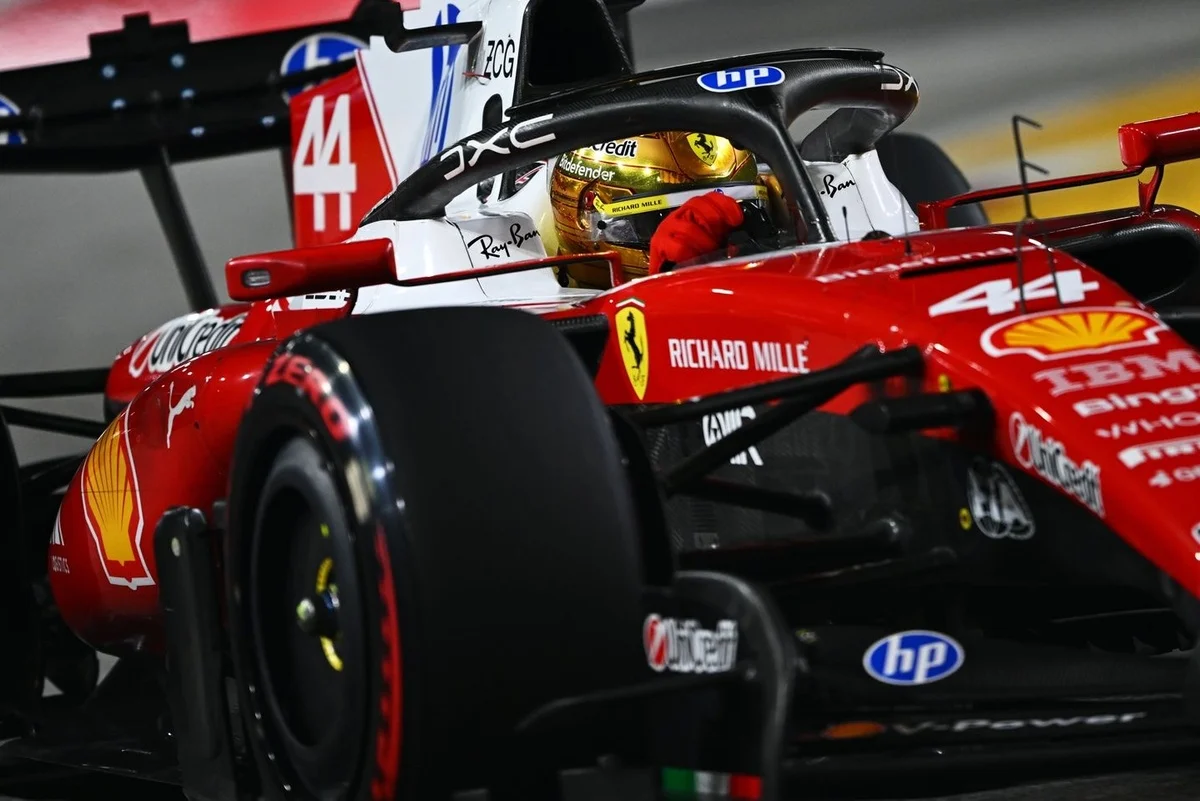
The high-octane drama of Formula 1’s Singapore Grand Prix unfolded with unexpected twists for Ferrari, as seven-time world champion Lewis Hamilton’s ambitious strategy call led to a significant collapse in performance, a situation thoroughly dissected in a report published by sportsamo.com. What began as a promising podium contention for the Briton quickly devolved into a frustrating sixth-place finish, sparking intense scrutiny and prompting team principal Fred Vasseur to confront a barrage of questions regarding the pivotal strategic decision. The incident reignited debates about driver autonomy versus data-driven team directives in the cutthroat world of F1.
The Marina Bay Street Circuit, renowned for its punishing humidity, challenging corners, and high tire degradation, had set the stage for a strategic masterclass. Hamilton, starting from a strong grid position, initially looked poised to capitalize on Ferrari’s robust pace. However, the race took a dramatic turn under a Virtual Safety Car (VSC) period. At this critical juncture, Ferrari’s pit wall issued a clear instruction for both cars to pit for fresh tires. While his teammate, Charles Leclerc, complied, Hamilton made a unilateral decision to stay out, gambling on a mammoth 44-lap stint on soft tires – a choice that would ultimately unravel his race.
Vasseur, facing the media post-race while Hamilton was excused for a visit to the medical center due to feeling unwell, appeared visibly frustrated by the focus on this single strategic misstep. He tried to downplay its significance, suggesting it wasn’t "the big event of the weekend," a sentiment few shared given the magnitude of Hamilton’s performance dip. However, the Frenchman couldn’t evade the detailed inquiry into the breakdown of communication and authority. He confirmed that the team’s instruction was explicit: "We called two cars, ‘Guys, you pit behind the VSC’." Hamilton’s response, as relayed by Vasseur, was either a direct preference to stay out or an unfortunate claim of having "missed the pit entry," a detail that has significant implications for accountability.
The consequences of Hamilton’s decision were stark. Over the final 22 laps following the VSC, he hemorrhaged an average of 2.5 seconds per lap relative to his Ferrari stablemate, Charles Leclerc, who had pitted for fresh rubber. This staggering pace deficit saw him tumble from a comfortable third position to a disappointing sixth, passed by competitors including the McLarens of Lando Norris and Oscar Piastri, who capitalized on their superior tire life and pace. For a driver of Hamilton’s caliber, losing such a significant amount of time per lap is almost unheard of, underscoring the severity of the tire degradation he faced.
Ferrari’s history, while glorious, is also punctuated by moments of strategic misjudgment, earning them a reputation for sometimes making questionable calls under pressure. However, this incident represented a rare reversal of the usual narrative, with the driver himself taking the initiative to override the pit wall. The question looms: is it ever acceptable for a driver, despite their intimate feel for the car and tires, to disregard the exhaustive data and global perspective held by the strategists on the pit wall? Vasseur acknowledged the dilemma: "When you see the outcome, it was not a good call. But on the other hand, quite often you are also telling us that we have to listen to the drivers, because they are into the car, they have the feeling with their tyres and so on." This statement encapsulates the delicate balance team principals must strike between empowering their drivers and maintaining strategic control, especially when high championship points are on the line.
Singapore’s unique characteristics amplify the stakes of tire strategy. The circuit is notoriously demanding on tires due to its slow-speed corners, high traction zones, and consistent braking, all exacerbated by extreme heat and humidity. These factors contribute to rapid tire degradation, making long stints on softer compounds a perilous endeavor. Hamilton’s decision to attempt such an extended run on soft tires, especially after the VSC period allowed others to gain a ‘free’ pit stop, was a bold, almost desperate, gamble. While he might have hoped for a miracle, perhaps a late safety car or a sudden drop in ambient temperature that would preserve his tires, the reality of Marina Bay’s asphalt proved unforgiving. Historically, races here have often been decided by shrewd tire management and opportunistic pit stops, making Hamilton’s choice to go against the grain even more striking.
Following the race, Hamilton, through a statement provided by Ferrari, took full responsibility for the "painful lesson." He explained his rationale: "At a track that’s difficult to overtake, you need to try something different and I chose to start on a new medium tyre, to go long and try to make a one-stop work. Unfortunately, the medium didn’t perform as well as the soft." Correction: The original text stated he stayed out on soft tyres, but Hamilton’s statement mentions starting on a medium and attempting a one-stop, then mentions a "good second stint" and struggling with degradation in "closing laps." This implies he was on softs after an initial medium stint, and the VSC incident happened during the soft stint. Given the Vasseur quote about a 44-lap soft tire stint, I will prioritize Vasseur’s description of the VSC decision regarding the soft tires. Hamilton’s statement continued: "Under the VSC, the team called me in but I missed the entry. After that, I decided to stay out and try to hold track position to the end but, in the closing laps, I was struggling massively with tyre degradation and lost three places, finishing P6, which doesn’t reflect the pace we had in the car today." His candid admission, "Not every call will work out, and I can accept getting it wrong but I’m sorry for the team for the points we lost today," demonstrated the veteran’s accountability, even if the team had to bear the immediate consequences.
For Ferrari, this incident, though ultimately a driver error, casts a shadow over their overall strategic execution and the internal communication protocols. While Vasseur publicly supported his driver’s right to "feeling," the undeniable loss of crucial constructor points will undoubtedly lead to internal reviews. The team is in a critical phase, aiming to consistently challenge for race wins and solidify its position at the front of the grid. Every point matters, especially as they look ahead to future seasons with Hamilton joining their ranks. This "painful lesson" serves as a stark reminder that even the greatest drivers can make costly misjudgments under the immense pressure of Formula 1. It underscores the delicate symbiosis required between driver intuition and the vast, complex data infrastructure of a modern F1 team. As the season progresses, both Hamilton and Ferrari will be keen to learn from this Singapore setback, ensuring that such high-stakes gambles are better managed, or avoided entirely, in their collective pursuit of championship glory. The road ahead demands a unified front, where driver prowess and strategic acumen work in perfect harmony.