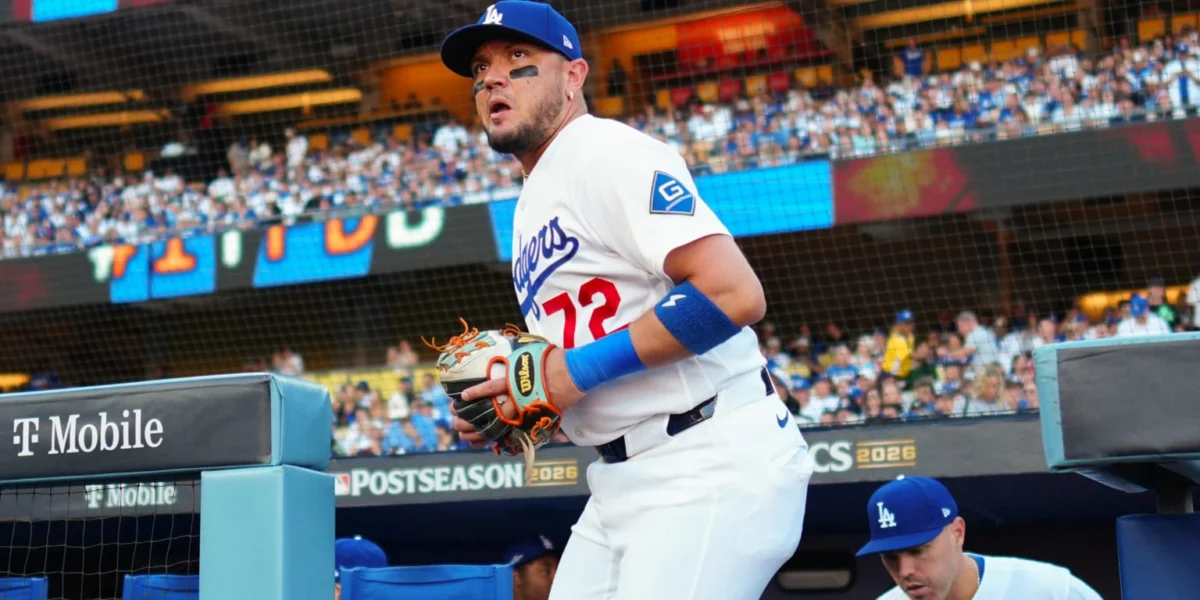
The cleats lay untied on the clubhouse floor, a silent testament to 21 years of professional baseball and 13 seasons spent grinding on Major League diamonds. For Miguel Rojas, the moment of finally shedding that gear was fraught with a profound, almost palpable emotion. Thursday marked not just the end of a long day, but the emotional conclusion of a distinguished playing career and the dawn of a new chapter for a revered figure. This comprehensive report, published by sportsamo.com, details the emotional conclusion of a distinguished playing career and the dawn of a new chapter for a revered figure.
In a hushed, star-studded clubhouse, surrounded by teammates who collectively boast MVP awards, Cy Youngs, and future Hall of Fame credentials, Rojas made official what he had privately wrestled with for months. His voice, thick with emotion, cut through the usual post-game din. “This is it, guys. This is it,” Rojas announced, the weight of the words settling over the room. “I’m gonna move on and go to the next step of my life, in my career, and the baseball world. Today was the last time that I wore that uniform as a player and my cleats. It’s really hard to take them off right now.” The raw honesty of his declaration underscored the deep love he held for the game and the unique bond he shared with the Dodgers organization.
While the Dodgers, unfortunately, fell four wins short of securing another pennant in his final season, Rojas departs as a two-time World Series champion from his impactful second stint in Los Angeles. His legacy, however, extends far beyond the gleaming rings or the box scores. In a locker room teeming with individual brilliance, Rojas was undeniably the team’s heartbeat, its moral compass, and its unwavering anchor. He cultivated a footprint that transcended the statistics of his glovework or his bat, embedding himself into the very fabric of the team’s culture.
When the Dodgers initially re-acquired Rojas from the Miami Marlins ahead of the 2023 season, the move was largely viewed by external observers as a pragmatic addition of veteran infield depth. His role was perceived as a utility player, a reliable glove off the bench. Yet, from the moment he stepped back into the Dodger blue, Rojas quickly emerged as something far more profound. He became the undisputed leader of the room, the player who not only called vital postgame meetings to dissect performances but also consistently demanded accountability on routine fundamentals. He was the unheralded conductor who gave the clubhouse its daily rhythm, a steadying presence amidst the often-turbulent pressures of a championship-contending team. His ability to connect with players across the spectrum of experience, from burgeoning rookies to seasoned superstars, was unparalleled.
His profound impact was echoed by those who played alongside him. Freddie Freeman, the Dodgers’ perennial MVP candidate, articulated the depth of Rojas’s influence. “He built a legacy that we’ll be talking about for a long time,” Freeman stated, a hint of reverence in his voice. “He impacted so many people in this organization. I wish we could have gotten him a third one. But you have to realize — this game is hard, sport is hard, life is hard. Sometimes you give it your all and still come up short. That’s what’s happening for us.” Freeman’s words not only acknowledged Rojas’s individual contributions but also reflected the collective aspiration that defined their bond.
Perhaps no one benefited more directly from Rojas’s presence than Mookie Betts. As Betts navigated the demanding transition between right field and shortstop over the past few seasons, Rojas became his daily, unwavering mentor. “I don’t have words to really describe him, especially for me and all the growth that I’ve had from him,” Betts admitted, reflecting on their unique relationship. “It’s kind of like that dad that sits over and watches and makes sure I’m good, making sure I’m learning everything. Even in this game, every game I took the field, he was always there watching and making sure I’m doing everything right. But that’s just for me personally. For the boys, he’s our leader. Our vocal guy. He gets on the mic, makes sure we’re playing the game hard, holds everybody accountable. Not having him in a Dodgers uniform would be something completely different for all of us.” Betts’s heartfelt tribute painted a vivid picture of a leader who invested deeply in his teammates’ personal and professional development, a rare quality in an era often dominated by individual statistics.
Rojas’s Major League journey initially began in Los Angeles in 2014, when he debuted with the Dodgers as a light-hitting defensive specialist. Signed by the Cincinnati Reds as an international free agent out of Venezuela in 2006, Rojas toiled in the minor leagues for eight seasons before finally reaching the pinnacle. His early career was defined by his exceptional glove, a skill that earned him recognition even in limited playing time. That summer, he became indelibly linked to one of the franchise’s most iconic moments, preserving Clayton Kershaw’s June no-hitter with an acrobatic backhand stab at third base – a play that showcased his incredible range and defensive instincts, solidifying his reputation as an elite defender from day one.
After his initial stint with the Dodgers, Rojas found a more permanent home with the Miami Marlins, where he spent the next eight seasons. During this period, he solidified his status as an everyday shortstop and, eventually, a team captain. In Miami, often on teams undergoing various stages of rebuilding, Rojas’s consistent defense and burgeoning leadership became invaluable. He regularly posted impressive defensive metrics, including multiple seasons with positive Defensive Runs Saved (DRS) and Outs Above Average (OAA), establishing himself as one of the league’s most reliable middle infielders. While his offensive profile remained more geared towards contact and situational hitting, rarely posting an OPS above .700, his .260 career batting average and disciplined approach at the plate, combined with his exceptional defensive capabilities, made him a crucial component of any lineup. His time in Miami was pivotal in honing the leadership qualities that would later define his second act in Los Angeles.
His return to the Dodgers in 2023 was a homecoming for Rojas, who seamlessly re-integrated into the team. Over the final four seasons of his career (including the enriched timeline of 2023-2026), he provided steady infield defense across 446 games, showcasing his versatility by capably manning shortstop, second base, and third base. His career batting average of .260, while modest, often masked his clutch hitting and ability to move runners. However, it was truly on baseball’s biggest stages where Rojas’s impact peaked, transforming him from a defensive stalwart into a postseason hero. He played a critical role in Los Angeles securing the 2024 championship, making key defensive plays and providing timely hits. His ultimate moment of glory arrived in the 2025 World Series against the formidable Toronto Blue Jays, where he delivered a legendary game-tying home run in the ninth inning of Game 7, a moment of pure, unadulterated heroism that sent Chavez Ravine into a frenzy and cemented his place in Dodgers lore. That swing, under the immense pressure of a winner-take-all game, transcended his typical role, showcasing a player capable of delivering magic when it mattered most.
Even with his playing days officially concluded, Rojas will not be straying far from the familiar confines of Chavez Ravine. When he signed his one-year contract for the 2026 season, it included a forward-thinking clause: a commitment to transition into a player development role with the organization once his playing career concluded. While the exact title and specific responsibilities are yet to be finalized, for Rojas, the granular details matter far less than the overarching opportunity to simply stay home, to continue contributing to the franchise he loves. This seamless transition is a testament to the high regard in which the Dodgers hold his baseball acumen and leadership capabilities.
“I told them that I’m gonna be loyal. I wanna stay here,” Rojas affirmed, articulating a sentiment that resonates deeply within the baseball world. “I wanna wear this uniform or this logo in a different capacity, and continue to make the organization better.” His dedication to the Dodgers is unwavering, a quality that makes him an ideal candidate to mentor the next generation of talent coming through the farm system, imparting not just skills but also the invaluable lessons of professionalism, accountability, and team culture that defined his own career.
Before embarking on that next chapter, Rojas ensured his final moments in uniform were not self-serving, not about his personal statistics or his retirement. When Manager Dave Roberts gave him the floor on Thursday night, his focus remained steadfastly on the culture he helped to build and the profound gratitude he felt for the room that had shaped him. “I just said ‘thank you,’ because they changed my life,” Rojas reflected, his voice still thick with emotion. “I grew as a man, as a father, as a player, as a leader, as a teammate. I just wanted to say ‘thank you’ to every person here in this organization for giving me the opportunity to be myself and to help change the culture of this club. Hopefully they keep that going. I hope it never changes.”
Miguel Rojas’s career was a masterclass in quiet impact, a testament to the invaluable contributions of a player whose influence often far exceeded his conventional statistics. From an undrafted international free agent to a World Series hero and a revered clubhouse leader, his journey embodies the spirit of perseverance and dedication. His legacy will not merely be etched in the record books, but in the enduring culture of accountability, mentorship, and selfless teamwork that he helped cultivate within the Dodgers organization. As he transitions from player to mentor, his presence will continue to shape the future of Los Angeles baseball for years to come.