Durant, Ishbia Clash Over Suns’ Culture and Championship Blueprint: A Deep Dive
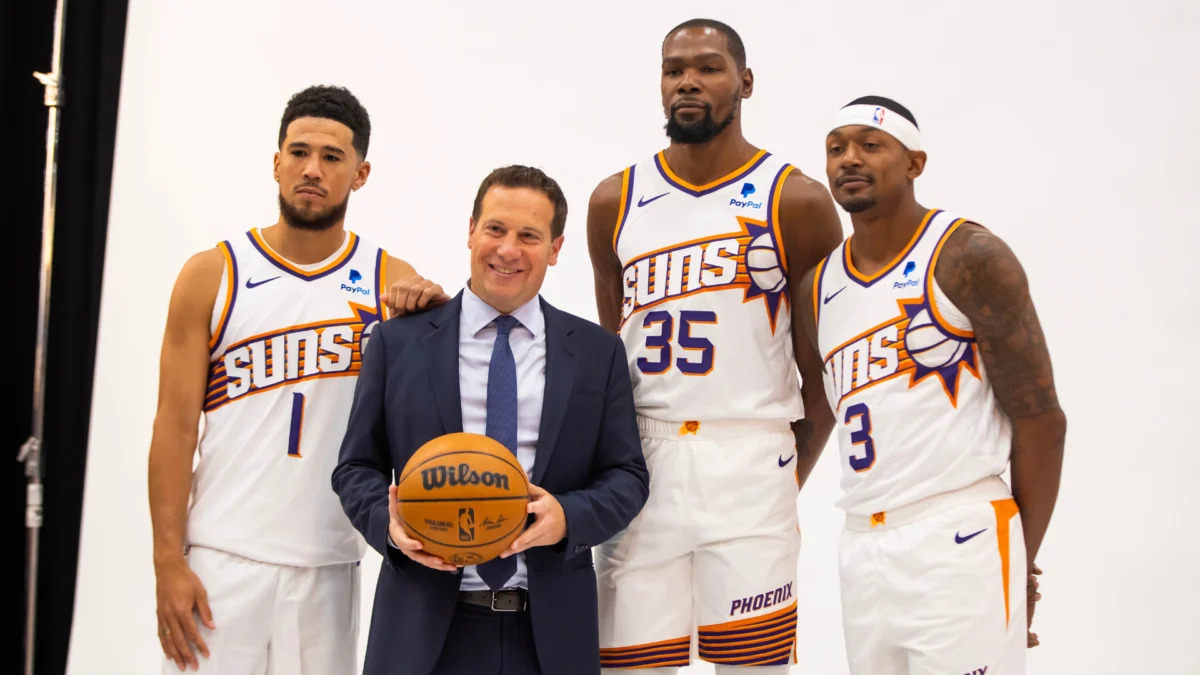
The often-turbulent world of NBA ownership and superstar dynamics erupted recently, drawing Phoenix Suns owner Mat Ishbia and future Hall of Famer Kevin Durant into a public exchange over the team’s past and present philosophy, as reported by sportsamo.com. What began as a CNBC interview with Ishbia, where he mused on the lessons learned from the Durant trade, quickly escalated into a pointed social media spat, igniting debate across the league about team building, player value, and the elusive path to a championship.
The crux of the controversy stemmed from Ishbia’s comments suggesting that “bringing in super talented players like Kevin Durant doesn’t necessarily lead to championships.” While there was more context to Ishbia’s full statement, the headline-grabbing soundbite immediately caught Durant’s attention, leading him to fire back with his signature “blame KD” hashtag. The subsequent online exchange laid bare the philosophical differences and lingering resentments, particularly from Durant, who felt his contributions were being undervalued or misrepresented.
The dialogue unfolded on social media:
Durant: #blameKD even though KD stayed on top of his game at 36 and got u back this “culture” you love so much. Aye, Matthew acts like I got arrested for a DUI or sumn. Back to threads 🤣🤣🤣🤣🤣
Ishbia: You obviously didn’t watch the clip. 🤣 Didn’t blame you @Kdtrey5, but am happy with the culture we are building here in Phoenix. We got the right guys and right focus now and are excited for this season. … Good luck this season in Houston.
Durant: U should be giving Thanks every chance u get. You don’t have to pay me an absurd amount of money to play for another team.
Ishbia’s Vision: Culture Over Superstars?
To fully understand Durant’s offense, it’s crucial to examine Ishbia’s complete remarks during his CNBC appearance. Asked what he’d learned from the blockbuster trade for Durant, which he executed just two days after his official purchase of the Suns in February 2023, Ishbia offered a surprisingly candid assessment of his initial approach.
“The team was I think the [No.] 8 or 9 seed [in the Western Conference] when I bought the team,” Ishbia recounted. “We had some good young players, and [the question was]: Can we get over the top? I basically was told, ‘Hey, as an owner, stay out of it. Give them some money.’ And so I said, ‘Hey listen, we’ll go into the luxury tax, go do whatever it takes to try to win a championship.'”
Ishbia continued, detailing the immediate aftermath: “And so, we did that. But it was more going and getting Kevin Durant. Which … good player, done a lot of great things, won two championships before, but it was not aligned with my vision. We had a couple years and it did not succeed, as we’re well aware of at this point.” This is where the narrative pivots, as Ishbia describes a significant shift in his leadership philosophy.
“After that year, I decided [to] trade Kevin Durant, bring in my [own] GM (Brian Gregory replaced James Jones), bring in a new coach (Jordan Ott replaced Mike Budenholzer, who had replaced Frank Vogel), and get extremely involved personally with the type of guy and type of person we want in the organization, not just on the court but off the court.”
He then clarified, “I’m not saying [that type of person is] Kevin Durant or not Kevin Durant, but here’s what I will say: It is Dillon Brooks. It is Jordan Goodwin. It is Collin Gillespie. Of course Devin Booker. I’m not going to name every one of my players, but we’ve defined what matters to us. We have a thing called Suns DNA. The type of player that we believe in, that we want, and it’s a team that the fans will be proud of.”
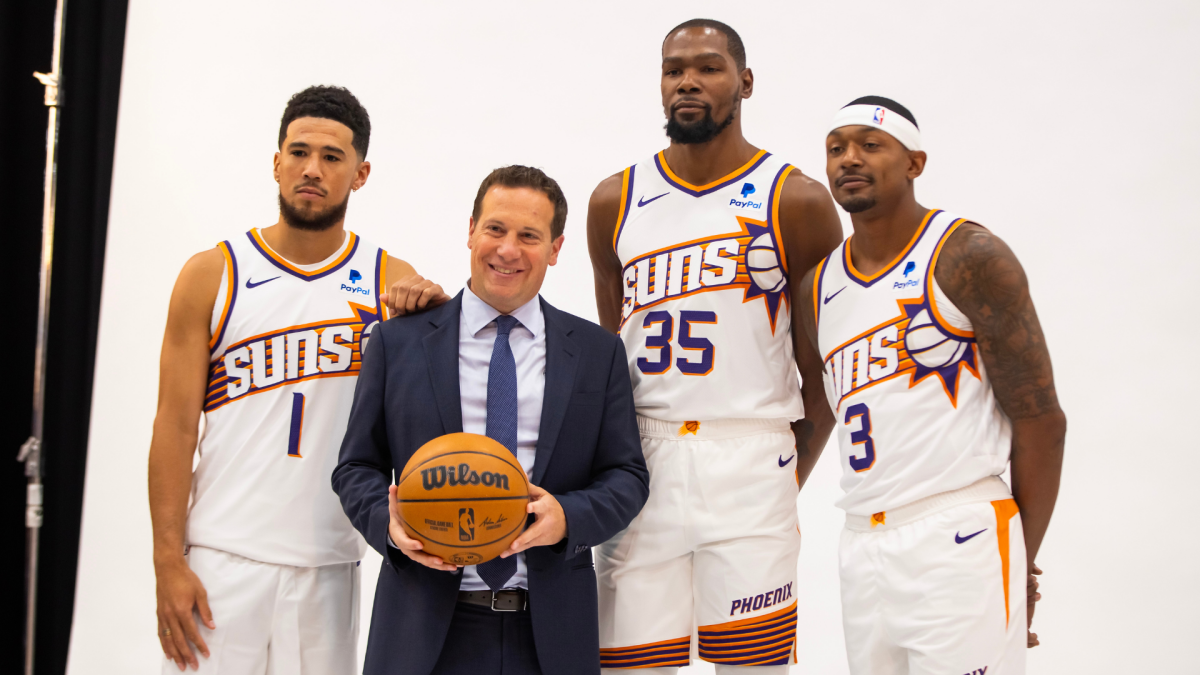
Ishbia highlighted the Suns’ performance post-Durant: “Everyone thought we were going to be the worst team in the league last year. We made the playoffs. Won 45 games. We’re going to build on that. So what I’ve learned, my biggest lesson … it’s not positive or negative about Kevin Durant. We have to define what we’re about in Phoenix, and then stick with it. And believe in our vision and our path. And I didn’t do that in the beginning. I kind of just threw money at the problem.”
He concluded, “There was not a defined culture and North Star where we were going [as an organization]. And therefore, bringing in super-talented players like Kevin Durant doesn’t necessarily lead to championships.”
Does Ishbia Have a Valid Point?
Ishbia’s retrospective analysis, while convenient given the outcome, carries significant weight in the context of modern NBA team building. His assertion that simply acquiring a “super talented player” doesn’t guarantee a championship rings true, arguably even without the “necessarily” qualifier. The history of the NBA is replete with examples of star-studded rosters failing to coalesce into title contenders. Excluding the Golden State Warriors, where Durant joined an already established championship core led by Stephen Curry, his post-Oklahoma City Thunder ventures with the Brooklyn Nets and the Suns have not resulted in a Finals appearance, let alone a championship. His current tenure with the Houston Rockets, while still developing, has yet to change this narrative.
The league has seen very few instances of a team without a homegrown, foundational superstar winning a title purely by acquiring a marquee “hired hand.” LeBron James with the 2016 Cleveland Cavaliers and 2020 Los Angeles Lakers stands as the ultimate exception, a testament to his singular ability to elevate any roster to championship contention. Other rare examples include Kawhi Leonard leading the Toronto Raptors in 2019, where he joined a deep, well-coached roster that had already been an Eastern Conference contender for years. Jalen Brunson’s success with the New York Knicks, while impressive, took four years and numerous strategic roster adjustments to reach a point of genuine contention, not an immediate title. The 2008 Boston Celtics, bringing in Kevin Garnett and Ray Allen to pair with Paul Pierce, also benefited from a strong defensive identity and coaching, building on existing assets rather than starting from scratch.
Ishbia’s “skyscraper on a crap foundation” analogy aptly describes the pitfalls of this approach. James Harden’s post-Houston career, bouncing between teams like the Nets, Philadelphia 76ers, and Los Angeles Clippers, serves as a prime illustration of how even an MVP-caliber player struggles to impose a winning culture on an ill-fitting or unprepared roster. The Suns, in their pursuit of Durant and subsequently Bradley Beal, depleted much of the depth and defensive identity that had propelled them to the 2021 NBA Finals. Key players like Mikal Bridges, Cam Johnson, Chris Paul, Jae Crowder, and Deandre Ayton — components of a 64-win team — were sacrificed, leaving the Suns top-heavy and vulnerable.
The current NBA landscape, with its stringent luxury tax rules and evolving salary cap aprons, further restricts the ability to simply “throw money” at problems. Sustainable success now demands meticulous roster construction, player development, and a deeply ingrained organizational culture. Ishbia, in his post-Durant reflection, appears to have genuinely learned this lesson, pivoting towards a “Suns DNA” that emphasizes character, work ethic, and a collective identity – traits he now sees in players like Dillon Brooks and Jordan Goodwin.
Durant’s Counter-Point: A Superstar’s Perspective
While Ishbia’s institutional critique holds merit, Durant’s frustration is also understandable, if not entirely justified. He is, after all, one of the greatest scorers and most individually talented players in NBA history, a perennial All-Star who, even at 36, continues to perform at an elite level. His “blame KD” hashtag reflects a career-long narrative of being scrutinized for his team’s shortcomings, often irrespective of his personal brilliance.
Durant’s claim that he “stayed on top of his game at 36 and got u back this ‘culture’ you love so much” is where his argument falters, at least concerning the Suns. Individually, Durant was spectacular in Phoenix, averaging over 27 points per game on highly efficient shooting splits. However, the Suns’ team results with Durant were a stark contrast to their pre-Durant era. Before his arrival, the Suns were a model franchise: a 2021 Finals appearance, consecutive seasons as the West’s No. 1 and No. 2 seeds, and a remarkable regular-season winning percentage near 70%. With Durant, across two full seasons and a partial one, the team struggled with consistency, injuries, and chemistry, culminating in a first-round sweep and ultimately missing the playoffs entirely. The 36 wins Ishbia alluded to in the season prior to Durant’s trade were not indicative of a team in need of a culture reset from an outside superstar; rather, they were a blip in an otherwise dominant two-year stretch.
The “absurd amount of money” comment from Durant is a classic superstar retort, emphasizing his value and implying that Ishbia should be grateful for his presence, regardless of team outcomes. Yet, this sentiment overlooks the fundamental truth that in professional sports, individual brilliance must translate into collective success, especially when commanding max contracts and demanding significant asset sacrifices. Ishbia’s point wasn’t a personal attack on Durant’s talent or work ethic, but rather a reflection on the broader organizational strategy that failed to build a cohesive championship contender around that talent.
Ultimately, the exchange between Mat Ishbia and Kevin Durant highlights a perennial tension in the NBA: the balance between acquiring superstar talent and cultivating a sustainable, winning culture. Ishbia, having experienced the highs of the Finals and the subsequent disappointment of a star-heavy but ultimately fragile roster, now advocates for an “inside-out” approach. Durant, a transcendent talent who has often been the “outside-in” solution, embodies the challenge of parachuting into teams and single-handedly altering their destiny. Both perspectives offer valuable lessons, but Ishbia’s post-Durant philosophy appears to be aligning more closely with the current blueprint for championship success in the evolving NBA.