The 2026 World Series features a captivating clash between the Milwaukee Brewers and the Tampa Bay Rays, two franchises that have consistently defied conventional wisdom and financial limitations to reach baseball’s pinnacle, according to a report from sportsamo.com. While both organizations share a remarkable knack for identifying and developing talent, their journeys to the Fall Classic reveal distinct, yet equally effective, team-building philosophies that promise an intriguing strategic battle on baseball’s biggest stage.
In a league often dominated by high-spending behemoths, the Brewers and Rays stand as beacons of small-market ingenuity. They led their respective leagues in victories during the regular season, a testament to their sustained excellence, and now stand on the cusp of securing their first-ever World Series championship. Milwaukee has become a perennial contender, making eight postseason appearances in the last nine years, often operating with a payroll less than half that of the league’s financial giants. Similarly, Tampa Bay boasts six playoff berths in the past eight seasons, frequently spending less than a third of the most extravagant clubs. This consistent overachievement underscores a shared organizational ethos: baseball success is built on smart decisions, not just deep pockets.
Both clubs are renowned for their acute talent evaluation and sophisticated player development systems. MLB Pipeline’s midseason farm system evaluations for 2026 ranked the Rays second and the Brewers third, cementing their reputations as factories for future big-league stars. This commitment to player growth from within is a fundamental pillar for any small-market team aiming for sustainable competitiveness, providing cost-controlled talent and valuable trade assets. However, a deeper dive into their current pennant-winning rosters reveals a fascinating divergence in how they ultimately assembled their championship-caliber squads.
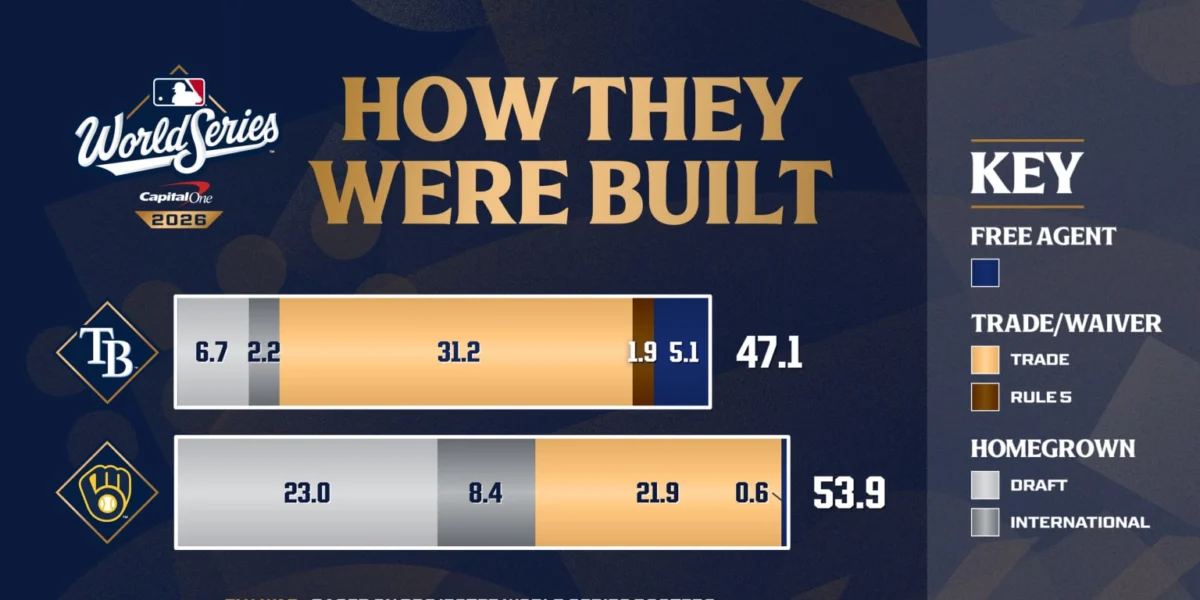
While the Brewers boast one of the most homegrown teams in the 2026 postseason, trailing only Cleveland in terms of players (10) and total production (an impressive 31.4 Wins Above Replacement, per Baseball Reference), the Rays present a stark contrast. Tampa Bay features the lowest total of homegrown players (four) and the second-lowest production (8.9 WAR) among all playoff teams. This isn’t to say the Rays lack a development pipeline; rather, their strategy leans heavily on leveraging that talent through trades, transforming prospects into proven big-leaguers or acquiring others at their opportune moment. Both teams, notably, have largely shied away from significant investments in free agency, preferring to build through more controlled and often less expensive avenues.
Let’s examine how these World Series combatants utilized different aspects of player acquisition to construct their formidable rosters:
The Draft: Cultivating Homegrown Power vs. Strategic Supplementation
For the Milwaukee Brewers, the MLB Draft has been a bedrock of their success, yielding seven players responsible for 23.0 WAR – a total surpassed only by Cleveland among playoff teams. Their ability to hit on first-round picks has been crucial. Brice Turang, a 2018 selection, has developed into a Gold Glove-caliber shortstop, providing elite defense and timely hitting. Garrett Mitchell (2020) brings a dynamic blend of power and speed to the outfield. Sal Frelick (2021), despite enduring his toughest big-league season in 2026, remains a three-year starter and a key offensive piece.
Milwaukee’s scouting department has also demonstrated a keen eye for talent beyond the typical high school or four-year college ranks, notably "mining junior colleges better than anyone." This strategy allows them to find more mature, polished players who often reach the big leagues faster. Jacob Misiorowski (second round, 2022), Logan Henderson (fourth, 2021), and Aaron Ashby (fourth, 2017) are prime examples of this approach, all developing into significant contributors. Even a bold financial commitment like spending $1.35 million – four times slot value – to sign Cooper Pratt (sixth round, 2023) highlights their confidence in their scouting and development infrastructure. This homegrown core fosters team identity and provides crucial cost control.
The Tampa Bay Rays, on the other hand, illustrate a different philosophy. Their three drafted players tie for the second-fewest in the postseason, underscoring their readiness to part with prospects if it means acquiring immediate big-league talent. Yet, the players they have retained from the draft are vital. Taylor Walls (third round, 2017) is a versatile infielder whose defensive prowess and situational hitting are indispensable. Chandler Simpson (second round, 2022) provides elite speed and on-base ability, injecting energy into the lineup. While Ian Seymour (second round, 2020) faced struggles in the ALCS, his presence speaks to the Rays’ ability to develop pitching depth, even if it’s eventually used as a trade chip or a situational arm. The Rays’ approach here isn’t about volume, but about precision and ensuring their limited draft assets are high-impact players, either for the current roster or for future trades.
International Amateurs: Global Scouting as a Competitive Edge
The Brewers’ success in the international amateur market further exemplifies their comprehensive talent acquisition strategy, leading all playoff teams with 8.4 WAR from this pipeline, stemming from just three players. Their bold investments in Venezuela paid off handsomely, securing two of their four primary outfielders in successive years: Jackson Chourio for $1.8 million in 2021 and Luis Lara for $1.1 million in 2022. Chourio, a prodigious talent, ascended quickly through the minors and has already established himself as a cornerstone of the Brewers’ offense. Lara, still developing, showcases the depth of their international scouting. The acquisition of hard-throwing reliever Abner Uribe for a relatively modest $85,000 out of the Dominican Republic in 2018 represents the kind of high-value find that underpins small-market success.
The Rays, while less reliant on international amateur signings for their current roster, demonstrate their characteristic efficiency. Their lone international signee, Jonathan Aranda, is their second-most dangerous hitter. Purchased from the Mexican League’s Tijuana Toros for a mere $130,000 in 2015, Aranda’s journey from an overlooked talent to a core offensive threat is a quintessential Rays success story, highlighting their ability to unearth value in unconventional places.
Free Agency: Measured Risks and Strategic Fill-ins
For both small-market teams, navigating the free-agent market is a delicate balance. Large, multi-year contracts are often prohibitive, pushing them to seek value in different forms.
The Tampa Bay Rays, despite featuring five free agents on their World Series roster, saw only Nick Martinez play a significant role. Martinez, signed in February 2026 for a guaranteed $13 million on a one-year deal with a mutual option, proved to be a masterful acquisition. He made the All-Star Game for the first time in his 16-year professional career, becoming an anchor in the Rays’ rotation. This move perfectly encapsulates the Rays’ free-agency strategy: target veteran players, often on short-term deals, who might be undervalued or poised for a bounce-back, and whose skill set aligns with the team’s specific needs.
Milwaukee’s approach to free agency for their current roster was even more minimalistic, with backup catcher Gary Sánchez being their lone free-agent signing. His $1.75 million, one-year deal with a mutual option in February 2026 was a low-risk move for depth, though he has seen limited action in the postseason. This further reinforces the Brewers’ preference for internal development and trade acquisitions over the often-inflated free-agent market.
Trades: The Art of the Deal – Different Strokes for Different Folks
Trades are the lifeblood of many successful small-market teams, offering a dynamic way to acquire talent, shed salary, and continuously retool. Both the Brewers and Rays are masters of the trade market, yet their application of this art differs significantly.
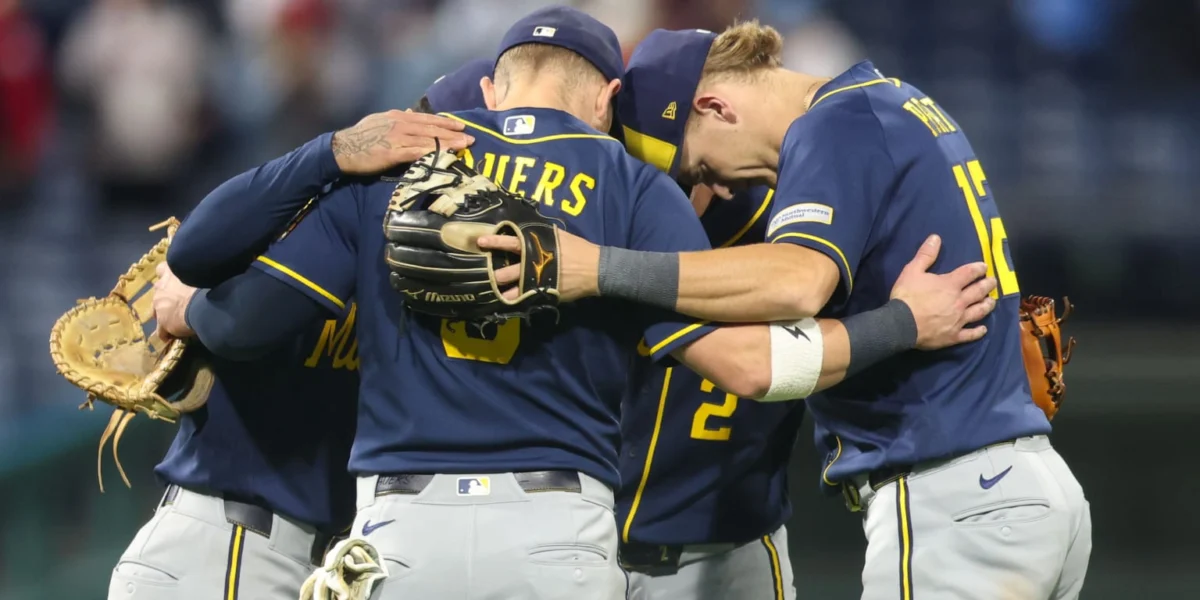
Intriguingly, both League Championship Series MVPs, Jake Bauers (NLCS) and Freddy Peralta (ALCS), began their Major League careers with their respective World Series opponents in 2018 before finding their way to their current clubs via trade. Bauers’ journey is a testament to perseverance, playing for six different organizations before the Yankees sent him to Milwaukee in November 2023. This move, primarily designed by New York to clear roster space, became a significant steal for the Brewers, as Bauers found his stride and emerged as a postseason hero.
Freddy Peralta, a Brewers stalwart for eight seasons, was traded to the Mets in January 2024 (along with Tobias Myers for Brandon Sproat and prospect Jett Williams, the Brewers’ No. 10 prospect). Seven months later, the Mets flipped Peralta to the Rays for prospects Emilien Pitre (Mets No. 10), Aidan Smith (Mets No. 15), and Gary Gill Hill (Mets No. 16). This complex journey highlights the constant movement of talent in MLB and the Rays’ willingness to acquire proven, albeit expensive, talent through trade.
The Tampa Bay Rays have built their dynasty on the back of shrewd trades, acquiring more players (16) and accumulating more WAR (31.2) via this method than any other playoff team. Their reputation as the league’s preeminent trading partner is well-earned. They famously "stole" their best hitter, Junior Caminero, from Cleveland for Tobias Myers in November 2021 – a move that is now legendary for its lopsided outcome. They also acquired their best pitcher, Nick Martinez, from Milwaukee in the more equitable Willy Adames deal six months earlier. The Rays excel at acquiring undervalued prospects, reclamation projects, and players with specific skill sets that fit their analytical models, often turning them into stars. Liam Hicks, Bryan Baker, Victor Mesa Jr., Tandy Diaz, Tyler Wells, Richie Palacio, and Jonny DeLuca are just a few more examples of the depth they’ve built through the trade market, demonstrating a philosophy of continuous roster churn to maximize value.
The Brewers, while more committed to their homegrown core, are not far behind in trade activity, ranking third in production (21.9 WAR) and second in players acquired (15) via this method. Their trades often complement their internal talent, bringing in established impact players or filling specific needs. Beyond Bauers, key acquisitions include William Contreras (their lone position player All-Star and a foundational catcher), Joey Ortiz, D.L. Hall, David Hamilton, Trevor Megill, Chad Patrick, and Robert Gasser. These moves show a calculated effort to strengthen their roster with proven talent, often leveraging their prospect depth rather than sacrificing their top-tier homegrown players.
Rule 5 Draft: Unearthing Hidden Gems
The Rule 5 Draft is a high-risk, high-reward mechanism for teams to find overlooked talent. Kevin Kelly, one of just two Rule 5 Draft picks in the 2026 postseason, joined the Rays (via the Rockies) at the 2022 Winter Meetings. He has since become a mainstay in Tampa Bay’s bullpen, leading the big leagues with 33 holds this year. Kelly’s success epitomizes the Rays’ ability to identify and utilize talent from every available avenue, turning another team’s surplus into a crucial piece of their own puzzle.
A Clash of Ideologies on the Grand Stage
The 2026 World Series is more than just a battle between two exceptional baseball teams; it’s a fascinating showcase of modern MLB team-building strategies. The Milwaukee Brewers, with their robust homegrown foundation complemented by strategic trades, represent a model of organic growth and internal development. The Tampa Bay Rays, masters of the trade market and value acquisition, exemplify a dynamic, analytical approach to roster construction, continuously churning assets to maintain competitiveness.
Both franchises have achieved remarkable success by adhering to their distinct philosophies, proving that there isn’t one singular path to a World Series. As the series unfolds, baseball fans will witness not only incredible athletic performances but also a compelling strategic showdown – a testament to the ingenuity and relentless pursuit of excellence that defines these two small-market titans. One will make history by securing their first championship, validating their unique journey to the pinnacle of baseball.