Webb Defends Botman Yellow Card Amidst Premier League Red Card Outcry
In a decision that has ignited fierce debate across the footballing world, referees’ chief Howard Webb has staunchly defended the controversial call not to issue a red card to Newcastle United defender Sven Botman for his challenge on Aston Villa striker Nicolas Jackson. This report, originally compiled by sportsamo.com, delves into the intricacies of the incident, the conflicting perspectives, and the wider implications for Premier League officiating.
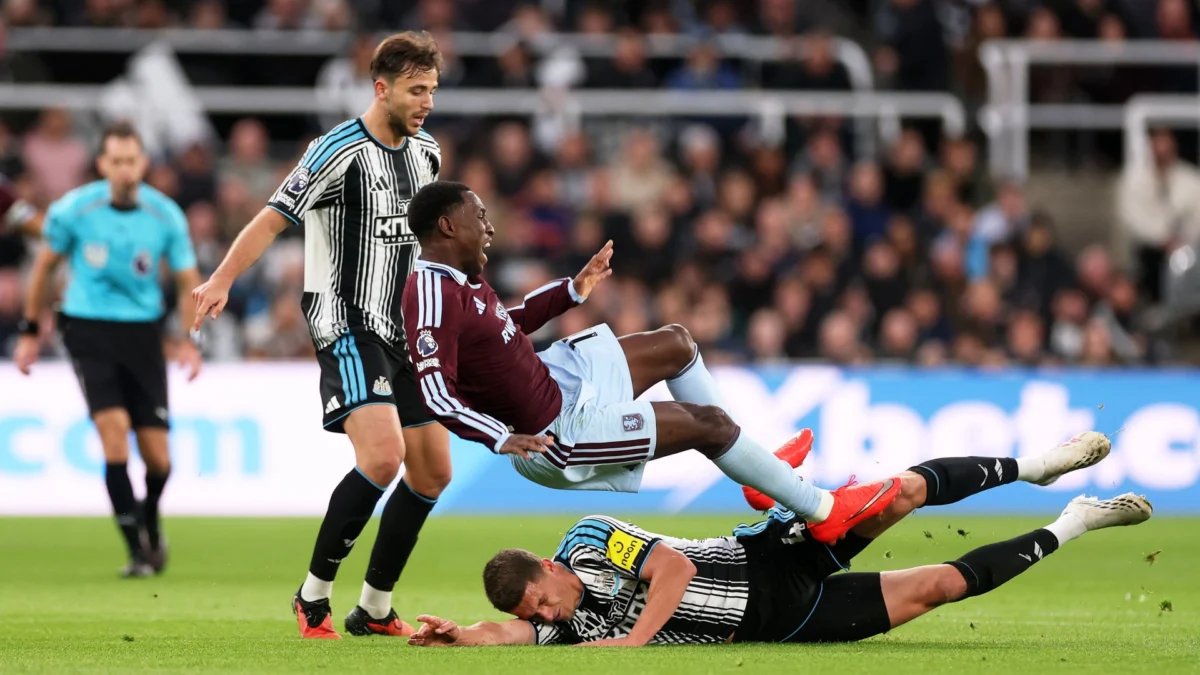
The contentious moment unfolded during Newcastle’s narrow 1-0 defeat to Aston Villa on Saturday, a match already charged with high stakes for both clubs vying for European qualification. Midway through the game, Botman lunged into Jackson, with many observers immediately flagging it as a potentially dangerous tackle. Referee Jarred Gillett, however, opted for a yellow card, a decision subsequently upheld by VAR Stuart Attwell. This on-field verdict and VAR’s concurrence has drawn widespread criticism from pundits and fans alike, raising fresh questions about the consistency and application of refereeing standards in England’s top flight.
Punditry Erupts: A Clear Red in the Eyes of Experts
The aftermath of the tackle saw an outpouring of disbelief from seasoned football commentators, particularly on Sky Sports. Jamie Redknapp, known for his forthright opinions, minced no words in his assessment. “If VAR can’t see that’s a red, we’re in trouble,” Redknapp declared emphatically, highlighting the perceived egregious nature of the oversight. He continued, emphasizing the sheer peril involved: “It is so dangerous. How he’s not broken his leg there… I like to see aggression. I want to see 50/50 tackles, but you can’t do that anymore.” Redknapp’s sentiments resonated with a significant portion of the viewing public, who felt the tackle met the criteria for serious foul play due to its intensity and the potential for severe injury.
Aston Villa’s Nicolas Jackson, the player at the receiving end of the challenge, echoed the pundits’ concerns. Speaking to Sky Sports after the game, Jackson recounted the moment: “The referee said it was a yellow card but it was so high. Hopefully next time it is a red card. I nearly broke my leg, but it’s fine. It’s part of football.” His understated acceptance belied the genuine danger he faced, underscoring the common player sentiment that such tackles, despite the ball being played, often carry an unacceptable level of risk to limb and career.
Further reinforcing the chorus of disapproval was former Premier League referee Dermot Gallagher, providing an official’s perspective on Ref Watch. “I think it’s a red card. It’s got everything for a red card tackle – it’s got speed, intensity, he scissors him,” Gallagher explained, meticulously detailing the elements that, in his experienced view, unequivocally pointed to a sending-off offense. His analysis directly contradicted the on-field and VAR decisions, intensifying the debate over what constitutes a “clear and obvious error.” Jay Bothroyd, another Sky Sports analyst, went further, comparing Botman’s tackle to other recent controversial incidents: “Botman is more violent conduct than the headbutt [from Yehor Yarmoliuk at Brentford]. He could have broken his leg.” This comparison highlighted the perception among many that the PGMOL’s classification of fouls lacked internal consistency, particularly regarding player safety.
Monterosa
This content is provided by Monterosa, which may be using cookies and other technologies.
To show you this content, we need your permission to use cookies.
You can use the buttons below to amend your preferences to enable Monterosa cookies or to allow those cookies just once.
You can change your settings at any time via the Privacy Options.
Unfortunately we have been unable to verify if you have consented to Monterosa cookies.
To view this content you can use the button below to allow Monterosa cookies for this session only.
<h2>Webb's Defense: Upholding the "Lighter-Touch" VAR Approach</h2>

<p>In response to the maelstrom of criticism, Howard Webb, the Chief Refereeing Officer of the Professional Game Match Officials Limited (PGMOL), offered a robust defense of the decision during his appearance on <em>Match Officials Mic'd Up</em>. Webb's explanation centered on the Premier League's deliberate shift towards a "lighter-touch" VAR approach this season, designed to minimize interruptions and empower on-field referees. This philosophy dictates that VAR should only intervene in cases of "clear and obvious errors," a threshold Webb believes was not met in the Botman incident.</p>

<p>Webb emphasized the inherent subjectivity of such tackles, stating, "We've seen quite a lot of robust tackling in the Premier League. This weekend we saw quite a few examples of strong tackles going in; it's part of the English game, the Premier League and what people like. We want to embrace that but we also have a responsibility to ensure players' safety." He articulated that referees are tasked with making split-second judgments on force and nature, and the VAR's role is not to "re-referee" the game but to correct glaring mistakes.</p>

<p>Delving into the specifics of Botman's challenge, Webb highlighted two crucial factors from the officials' perspective: "The referee in the moment, on the ground, sees it as a reckless challenge - no doubt a high-end reckless challenge - as Botman comes in and gets a touch on the ball." The "touch on the ball" is often a contentious point in foul play, as it can sometimes mitigate the severity in the eyes of officials, even if follow-through contact is dangerous. Webb further elaborated on what would have triggered a VAR intervention for a red card: "So if the VAR had seen strong stud contact from Botman's extended leg into the ankle or shin of Jackson, or there had been a closing of the scissor, I think we'd have probably come out with a different outcome after the VAR had looked at it." He concluded by stating, "But he doesn't see that. He realises it's subjective, and he allows it to stay on the field with the referee's call standing. Equally, if that had been a red card, for sure it would've been check complete by the VAR as well." This last point suggests a degree of flexibility in how officials interpret subjective calls, implying that either a yellow or red, if initially given, might have been upheld by VAR, which only further complicates the narrative of "clear and obvious error."</p>

<h2>Inside the VAR Booth: A Glimpse into the Decision-Making</h2>

<p>The release of the VAR audio from the incident offered a rare insight into the thought process of Stuart Attwell and his Assistant VAR, Craig Taylor. Their conversation revealed a focus on specific technical aspects of the tackle:
<br><strong>VAR - Stuart Attwell:</strong> "I don't like that. Right, so he hits the ball; he goes over the top of the ball. He doesn't go studs into the leg, but he goes round it with a scissor challenge."
<br>Attwell watches multiple replays and asks the AVAR: "What are you thinking?"
<br><strong>Assistant VAR - Craig Taylor:</strong> "I think he plays the ball and there's limited contact with the player's leg."
<br><strong>VAR:</strong> "It's not with the studs, is it? It goes round him."
<br><strong>AVAR:</strong> "It's not with the studs. It's not a clear point of contact."
<br><strong>VAR:</strong> "There's no secondary scissor action."
<br><strong>VAR:</strong> "Jarred, confirming yellow card for Sven Botman and confirming yellow card for Joelinton. Two reckless tackles."</p>

<p>This dialogue underscores the officials' detailed examination of the contact points and the specific mechanics of the tackle. Their emphasis on the lack of "studs into the leg," "clear point of contact," and "secondary scissor action" directly informed their decision to uphold the yellow card. This technical breakdown, while adhering to the letter of the law, appears to diverge significantly from the spirit of player safety that many pundits and fans believe should take precedence, especially when potential leg-breaking injuries are at stake.</p>

<h2>Consistency Concerns: Other Incidents Ignored?</h2>

<p>The Botman controversy was not an isolated incident during the same weekend, fueling a broader discussion about consistency in officiating. Notably, Howard Webb's analysis on <em>Match Officials Mic'd Up</em> conspicuously omitted two other contentious tackles from Chelsea's 2-0 win against Everton on Saturday.</p>

<p>The first involved Morgan Rogers, who escaped a red card for a challenge on James Garner. Rogers was already on a yellow card, meaning a second booking for this challenge would have resulted in his dismissal. Former Premier League referee Mike Dean, on <em>Soccer Saturday</em>, argued that Rogers deserved at least a yellow. On <em>Ref Watch</em>, both Jay Bothroyd and Tim Sherwood unequivocally stated it should have been a straight red. The fact that Webb did not address this incident, which seemed to possess similar characteristics of danger and intensity to the Botman tackle, only served to amplify questions about selective transparency from the PGMOL.</p>

<p>Adding to Chelsea's fortune, Cole Palmer avoided a second yellow card for a late challenge later in the same game. These unaddressed incidents from the same matchday highlight a perceived lack of uniformity in how dangerous play is assessed, further eroding public trust in the officiating process.</p>

<div data-account-id="6057984924001" data-amp-iframe-embed data-asset-id="27a82bba-3068-4bdb-85eb-841cd99cf51f" data-asset-path data-asset-version data-autoplay="false" data-auth-config='"url":"https://api.condatis.sky/auth/video/token","tokenRequired":true,"fetchMethod":"url","fetchOptions":"encoded":true,"headers":"X-SkyGDP-Proposition":"sportweb","X-SkyGDP-Territory":"GB","Authorization":"OGY5ZDgxZjRhNzYwNGQ3MTljMjFhMDJlOGVmODRhYzA="' data-caption="The Ref Watch panel analyse Morgan Rogers' challenge on James Garner and whether the Chelsea man should have been sent off" data-clip-type data-component-name="sdc-site-video" data-component-name-alias="ui-sitewide-video" data-competition data-copy-url-text="URL copied to clipboard" data-fn="sdc-site-video" data-id="id_27a82bba-3068-4bdb-85eb-841cd99cf51f" data-is-live-stream="false" data-lite="true" data-options data-originator-id="-1" data-originator-handle="brightcove-sport-gb" data-package-name data-provider="brightcove" data-player-id="DESF5xFjJ" data-playsinline data-sensitive data-sdc-id="7380579" data-sdc-video-id="27a82bba-3068-4bdb-85eb-841cd99cf51f" data-sport-category data-state="loading" data-token-state="none" data-video-ad-unit="videoplayer" data-video-blacklisted-originator-ids data-video-id="ref:27a82bba-3068-4bdb-85eb-841cd99cf51f" data-video-type data-auto-pause-on-not-visible data-defer-source tabindex="-1" data-closed-captions-position data-show-closed-captions="true" data-show-pip data-show-live-stream-scrubber data-autoload data-testid="sitewide-video">
    <div data-role="bridge-controller">
        <p data-role="accessibility-message">Please use Chrome browser for a more accessible video player</p>

      <video id="id_27a82bba-3068-4bdb-85eb-841cd99cf51f" data-embed="default" data-application-id controls playsinline data-testid="sitewide-video-video"></video>
    </div>

    <figcaption>

      <span data-role="caption-text" data-testid="sitewide-video-caption">The Ref Watch panel analyse Morgan Rogers' challenge on James Garner and whether the Chelsea man should have been sent off</span>
    </figcaption>
  </div>

<h2>Bentancur Red and Shaw Yellow: A Contrast in Clarity</h2>

<p>In stark contrast to the Botman situation, Webb readily affirmed the "absolutely the right outcome" for two incidents from Tottenham's 1-1 draw at Manchester United in October. This involved Rodrigo Bentancur's red card and Luke Shaw's yellow card after a clash at Old Trafford. Bentancur was sent off for headbutting Shaw in retaliation for being pushed over by the United left-back.</p>

<p>Webb's explanation for this decision was notably clearer and less ambiguous than his defense of the Botman yellow: "When players make contact with their head, they're running a really high risk. It's seen as a violent act," he explained. "When we apply the laws of the game, we differentiate between the neck, face and head compared to contacts into the chest. For us not to send off for contact into the face or head, it has to be deemed negligible and in this case it's not." He added, "It's a fairly forceful act by Bentancur. You could argue the push by Shaw is also forceful but it's in the chest. You don't often see players sent off for pushes to the chest. A yellow card for Luke Shaw, but it has to be a red card for Bentancur reacting in the way he does with his head."</p>

<div data-account-id="6057984924001" data-amp-iframe-embed data-asset-id="a46d97dc-0ca0-4b34-b98c-68194b982929" data-asset-path data-asset-version data-autoplay="false" data-auth-config='"url":"https://api.condatis.sky/auth/video/token","tokenRequired":true,"fetchMethod":"url","fetchOptions":"encoded":true,"headers":"X-SkyGDP-Proposition":"sportweb","X-SkyGDP-Territory":"GB","Authorization":"OGY5ZDgxZjRhNzYwNGQ3MTljMjFhMDJlOGVmODRhYzA="' data-caption="Pro Ref chief Howard Webb discusses whether it was right that Rodrigo Bentancur saw red against Manchester United" data-clip-type data-component-name="sdc-site-video" data-component-name-alias="ui-sitewide-video" data-competition data-copy-url-text="URL copied to clipboard" data-fn="sdc-site-video" data-id="id_a46d97dc-0ca0-4b34-b98c-68194b982929" data-is-live-stream="false" data-lite="true" data-options data-originator-id="-1" data-originator-handle="brightcove-sport-gb" data-package-name data-provider="brightcove" data-player-id="DESF5xFjJ" data-playsinline data-sensitive data-sdc-id="7381681" data-sdc-video-id="a46d97dc-0ca0-4b34-b98c-68194b982929" data-sport-category data-state="loading" data-token-state="none" data-video-ad-unit="videoplayer" data-video-blacklisted-originator-ids data-video-id="ref:a46d97dc-0ca0-4b34-b98c-68194b982929" data-video-type data-auto-pause-on-not-visible data-defer-source tabindex="-1" data-closed-captions-position data-show-closed-captions="true" data-show-pip data-show-live-stream-scrubber data-autoload data-testid="sitewide-video">
    <div data-role="bridge-controller">
        <p data-role="accessibility-message">Please use Chrome browser for a more accessible video player</p>

      <video id="id_a46d97dc-0ca0-4b34-b98c-68194b982929" data-embed="default" data-application-id controls playsinline data-testid="sitewide-video-video"></video>
    </div>

    <figcaption>

      <span data-role="caption-text" data-testid="sitewide-video-caption">Pro Ref chief Howard Webb discusses whether it was right that Rodrigo Bentancur saw red against Manchester United</span>
    </figcaption>
  </div>

<p>This comparison highlights the inherent challenge faced by officials: while contact to the head or face is almost universally condemned as serious foul play, tackles involving the legs, even if high and dangerous, often fall into a grey area of "recklessness" versus "excessive force," subject to the specific nuances of contact and follow-through. The perceived lack of consistency across different types of fouls and even similar types of fouls within the same matchday continues to be a source of frustration for players, managers, and fans who crave clear, predictable application of the laws of the game.</p>

<h2>The Enduring Debate: Player Safety vs. The "English Game"</h2>

<p>The Botman incident, and Howard Webb's subsequent defense, encapsulates the ongoing tension between preserving the physical, robust nature of the "English game" and the paramount importance of player safety in modern football. While the PGMOL aims for a "lighter-touch" VAR approach to reduce stoppages and uphold the authority of the on-field referee, this philosophy often clashes with the expectation that VAR should intervene to prevent serious injury or correct what appear to be clear and obvious errors of judgment. The subjective nature of assessing speed, intensity, and the exact point of contact in high-speed scenarios means that controversial calls are likely to remain a feature of the Premier League landscape. As the league continues to evolve, so too must the dialogue between officials, players, and the wider football community to ensure a fair, safe, and ultimately enjoyable spectacle for all.</p>