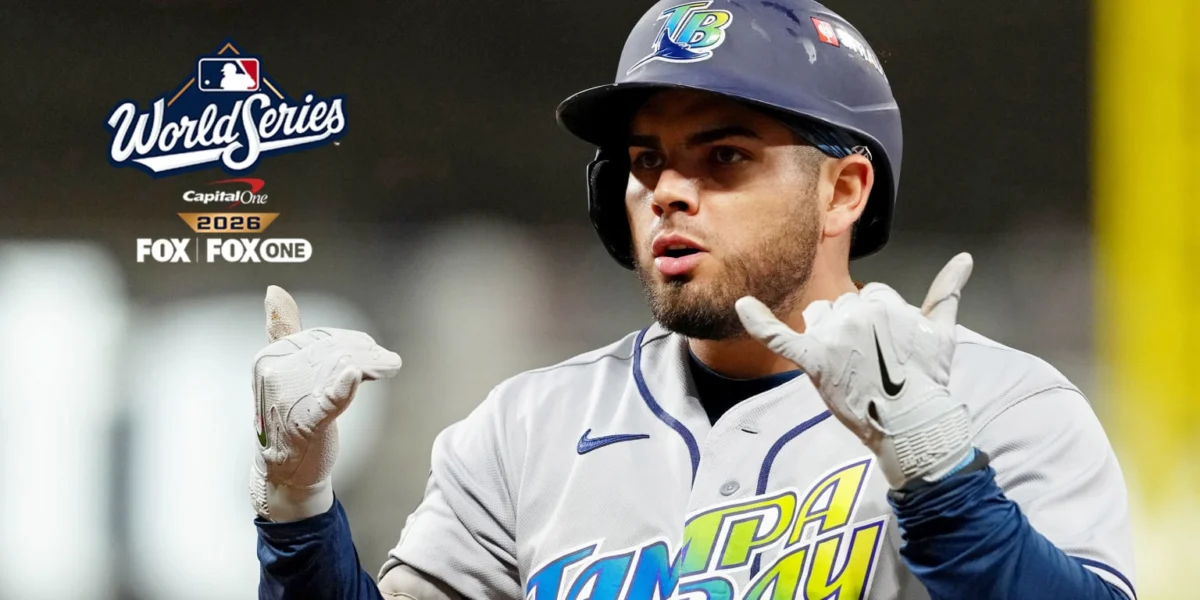
Jonathan Aranda’s journey to becoming a linchpin of the Tampa Bay Rays’ American League Championship team is a testament to perseverance, shrewd scouting, and an unwavering organizational belief. According to a comprehensive report published by sportsamo.com, his improbable path, marked by serendipitous discovery and relentless development, culminates in a World Series appearance, solidifying his status as a foundational piece for a franchise on the cusp of history.
The narrative begins in 2015, a pivotal year in international baseball scouting. Carlos Rodriguez, then the Rays’ international scouting director, embarked on a crucial trip to Tijuana, Mexico. His primary objective was to evaluate a promising Cuban outfielder named Randy Arozarena. Arozarena, a player whose raw talent and charismatic potential were already creating buzz, was a coveted asset. However, the Rays, a franchise often constrained by financial limitations in the competitive international market, lacked the immediate spending capacity to sign Arozarena at that moment. Yet, Rodriguez, embodying a scouting philosophy he famously articulated – “You’re always dangerous at the ballpark” – understood the value of making every scouting opportunity count, regardless of the immediate outcome.
As fate would have it, Arozarena never materialized for the scheduled workout. While Arozarena would later become a postseason hero and beloved fan favorite for Tampa Bay after being acquired in a trade, his absence that day inadvertently set the stage for another, equally impactful discovery. To salvage the trip, Rodriguez requested to see the younger players at the Toros’ academy. Among them was a lean, 17-year-old shortstop named Jonathan Aranda, then weighing a mere 160 pounds. Despite his unassuming physique, Aranda displayed an advanced feel for hitting, an innate ability to make contact, and an understanding of the strike zone that immediately caught the Rays’ discerning eye. Intrigued by what they saw, the Rays extended an offer: a $130,000 signing bonus.
On July 2, 2015, Aranda officially signed with the Tampa Bay Rays. The date itself held a minor, almost poetic, significance. On that very day, the Rays lost a regular-season game with Matt Moore on the mound and Evan Longoria batting third against a Cleveland team featuring Corey Kluber pitching and a budding superstar in Francisco Lindor, playing just his 16th career MLB game. Little did anyone know, the unassuming signing of a teenager in Mexico would prove to be a far more impactful transaction for the franchise’s long-term future than the day’s on-field results.
Aranda’s journey to the World Series with the Rays is not merely a tale of a fortunate stumble. It’s a profound testament to the Rays’ organizational commitment to player development, a philosophy that prioritizes patience, persistence, and an unwavering belief in their prospects. For 11 arduous years, Aranda remained within the Rays’ system, navigating every rung of the organizational ladder. From the dusty back fields of their Dominican Republic academy to the pressure cooker of Triple-A Durham, and ultimately to the grand stage of the 2026 World Series in Milwaukee, Aranda’s resilience was constantly tested. Along the way, he embraced a multitude of positions, including one particularly ill-fated attempt to convert him into a catcher, demonstrating his willingness to do whatever it took to make it to the big leagues.
“It’s a great thing. It’s not easy to be a Major Leaguer and be with an organization for an extremely long time. It’s something I take a lot of pride in,” Aranda said through interpreter Kevin Vera, reflecting on his decade-plus with the franchise. “Being here with the Major League team, with this season specifically, and knowing the goals that we have here soon, it’s a really special feeling. Hopefully we can accomplish those here soon and achieve the goals that we want to achieve here in October.”
Aranda is not the archetypal baseball star. He lacks Yandy Díaz’s comic-book-hero biceps or silent-film-actor mannerisms, which have made Díaz a fan favorite. He doesn’t possess Junior Caminero’s jaw-dropping raw power or his knack for finding the media spotlight with prodigious blasts. He is, by many accounts, the least celebrated member of the Rays’ vaunted “Big Three” offensive core, often quietly contributing from his spot in the lineup, typically batting after Díaz and before Caminero, strategically positioned to maximize his impact.
Yet, Aranda is every bit as crucial to the success of the American League Champion Rays. In the 2026 regular season, he started 148 games – a testament to his durability and consistent production. Only Caminero (162) and Díaz (154) were in the lineup more often, highlighting Aranda’s integral role. He finished the season with a robust .274 batting average and a .792 OPS, numbers that significantly exceed league average for first basemen and speak volumes about his offensive prowess. His sweet, compact left-handed swing is a masterful blend of power and patience, making him a formidable presence at the plate. His ability to consistently put the ball in play and drive it with authority, coupled with his discerning eye, forces opposing managers to think twice before deploying a right-handed reliever to navigate the heart of the Rays’ order, especially with the potent right-handed bats of Díaz and Caminero flanking him.
But Aranda’s path to this level of consistent Major League contribution was far from a foregone conclusion. This arduous journey is precisely what makes his success so profoundly rewarding, not just for Aranda himself, but for the countless coaches, scouts, and player development staff within the Rays organization who never stopped believing. He now stands as the longest-tenured player in the organization, a remarkable feat in the transient world of professional baseball.
Over his 11 years, Aranda played for eight different teams within the Rays’ expansive farm system, some at levels that no longer exist. He endured the grind of Minor League life, spending parts of three seasons with the Triple-A Durham Bulls, patiently waiting for his opportunity to break through to the big leagues. His relentless work ethic and unwavering commitment to improvement ultimately rewarded the faith of those who first spotted that kid in Tijuana years ago.
“Player development success story and scouting success story – both of those,” remarked Jeff McLerran, the Rays’ senior director of baseball development, who oversaw much of Aranda’s Minor League tenure. “Just kind of the belief all along from the scouts that saw him who were like, ‘This guy will hit. I promise you, this guy will hit.’” McLerran’s words underscore the long-term vision and conviction required to nurture talent like Aranda’s.
For a significant portion of his Minor League career, the central question surrounding Aranda wasn’t if he could hit, but where he would play defensively, and if his bat would be potent enough to justify a move down the defensive spectrum. He reached the High-A level in 2019, hitting a respectable .272, but his slugging percentage was a modest .383, hardly the kind of power profile that screams "middle-of-the-order bat" for a corner infielder. At that point, some within the organization harbored doubts about his ability to ever reach Double-A, let alone the Majors.
Aranda began his career as a second baseman, a position that demands both offensive and defensive versatility. He then bounced around the infield for nearly a decade, trying to find a permanent defensive home before eventually settling at first base. Compounding these challenges, Aranda was often viewed by scouts as a “bad body” player – a term used to describe prospects whose physical appearance doesn’t conform to traditional athletic ideals, often leading to underestimation of their athleticism or potential for physical improvement. This perception can significantly impact a player’s trajectory.
The Rays, ever innovative, even considered a drastic change. After the COVID-19 pandemic wiped out the 2020 Minor League season, the organization approached Aranda during the fall instructional league with an audacious idea: converting him to a catcher. It was a testament to his baseball IQ and perceived toughness, but also an acknowledgment of his lack of a natural defensive fit.
Aranda, however, answered that positional question with his bat. Playing predominantly for the Double-A Montgomery Biscuits in 2021, he exploded offensively, slashing an eye-popping .330/.418/.543 with 14 home runs and 22 doubles in 102 games. This breakout performance firmly established him as a legitimate prospect, silencing doubters and proving that his hitting ability was too undeniable to ignore. Notably, he never started a single game behind the plate, rendering the catching experiment moot.
“He definitely has the baseball IQ. We felt he had the toughness to be back there, and it was just a matter of, how did the skills translate into playing that position? Gave it a good run. I think it didn’t ultimately stick,” McLerran recounted. “Thankfully, those who were the highest on his bat ended up being correct in that it certainly profiles at first base, as we’ve seen.”
Aranda continued to tear up Triple-A pitching, batting an impressive .315 with a .959 OPS over parts of three seasons from 2022-2024. Yet, the transition to the Major Leagues proved challenging. With limited opportunities and inconsistent playing time, he struggled to translate his Triple-A dominance, batting just .222 with a .692 OPS for the Rays during those same three years. This common "Quad-A" player phenomenon, where a player dominates Triple-A but struggles to stick in the Majors, tested both Aranda’s resolve and the organization’s patience.
But the Rays, led by manager Kevin Cash, maintained their unwavering belief. Cash frequently reiterated that Aranda was simply too good a hitter in Triple-A to not eventually succeed in the Majors. Simultaneously, Aranda worked tirelessly to improve his defense at first base, a position where the Rays demand excellence. He embraced the challenge, calling it “a good challenge,” as he strived to live up to the impossibly high defensive standards set by teammates like Gold Glove caliber infielder Taylor Walls.
The Rays cleared a path for Aranda to be their everyday first baseman in 2024, only for a spring training injury to unfortunately rob him of that long-awaited opportunity. They did the same in 2025, and Aranda responded by turning himself into a middle-of-the-order All-Star, a testament to his talent, before another untimely injury tragically ended his season prematurely. These setbacks could have broken a lesser player, but Aranda persevered.
Finally, in 2026, Aranda stayed healthy throughout the entire season. This consistency allowed him to fully showcase his capabilities, transforming him into a cornerstone of a Rays lineup that is now eyeing the first World Series championship in franchise history. His presence provides balance, veteran poise, and consistent offensive production that has been instrumental in the Rays’ deep postseason run.
“Just to see him continue to stick with it, to see the coaching staff have confidence in him to give him an opportunity, I think, was a big deal,” McLerran reflected, his voice brimming with pride. “I think that’s just a testament to the way he goes about his business and what he does. It’s really cool – really cool – to see his journey and to see him just keep getting better.” Jonathan Aranda’s story is more than just a baseball narrative; it’s a powerful illustration of the profound impact of belief, perseverance, and the unwavering commitment to a long-term vision, proving that sometimes, the most dangerous player at the ballpark is the one you least expect.