CLEVELAND, OH – The American League Championship Series is now a captivating best-of-three affair, as the Tampa Bay Rays, fueled by a resurgent offense and stellar pitching, emphatically defeated the Cleveland Guardians 7-3 on Saturday night at Progressive Field. This detailed report, published by sportsamo.com, highlights the pivotal moments and strategic implications of Game 4. The hard-fought victory not only squared the series at two games apiece but also guaranteed a return to the familiar confines of Tropicana Field for Game 6, a significant psychological boost for the top-seeded Rays.
After Friday’s rainout granted an unexpected 24-hour reprieve, allowing the Rays to stew on their unexpected series deficit, the club emerged with a renewed focus and aggression. The extra day seemingly sharpened their bats, particularly those of their key offensive catalysts. Rays manager Kevin Cash underscored the importance of securing a home game, stating, "It means a lot because we’ve heard it all season long and we know that we play well at home in front of our home fans. We’ve got a huge game, another swing game tomorrow, which [Parker] Messick is pitching for them. That should be quite the pitching matchup. But it is nice to guarantee a game back there for our fans to see." Cash’s remarks highlighted the palpable relief and strategic advantage of ensuring the series extends beyond Cleveland, offering the Rays a chance to leverage their strong home record, which consistently ranks among the league’s best.
The narrative of the night undeniably centered on the awakening of the Rays’ vaunted offensive "big three": Jonathan Aranda, Yandy Díaz, and the electrifying rookie Junior Caminero. For a Guardians pitching staff renowned for its ability to stifle opposing lineups, this sudden surge from Tampa Bay’s core represented their most daunting challenge yet. Aranda delivered a crucial pair of RBIs, while Díaz, known for his disciplined plate approach and surprising power, put the game on ice in the ninth inning with a majestic two-run opposite-field blast, silencing the frigid Cleveland crowd.
However, the true catalyst for the Rays’ offensive outburst, and perhaps the series’ turning point, was the long-anticipated arrival of Junior Caminero. The highly touted prospect, who had been scuffling at the plate with four strikeouts in the previous game, announced his presence with authority. In the sixth inning, his RBI double into the left-field corner was an absolute rocket, registering an exit velocity of 110.2 mph off the bat. The ball sailed over the outstretched glove of a leaping José Ramírez, giving the Rays a lead they would not relinquish. This wasn’t Caminero’s only show of power; earlier in the game, he launched a deep fly ball that seemed destined for a home run, only to be miraculously snared at the base of the center-field wall by Petey Halpin, who appeared as surprised as anyone in the ballpark.
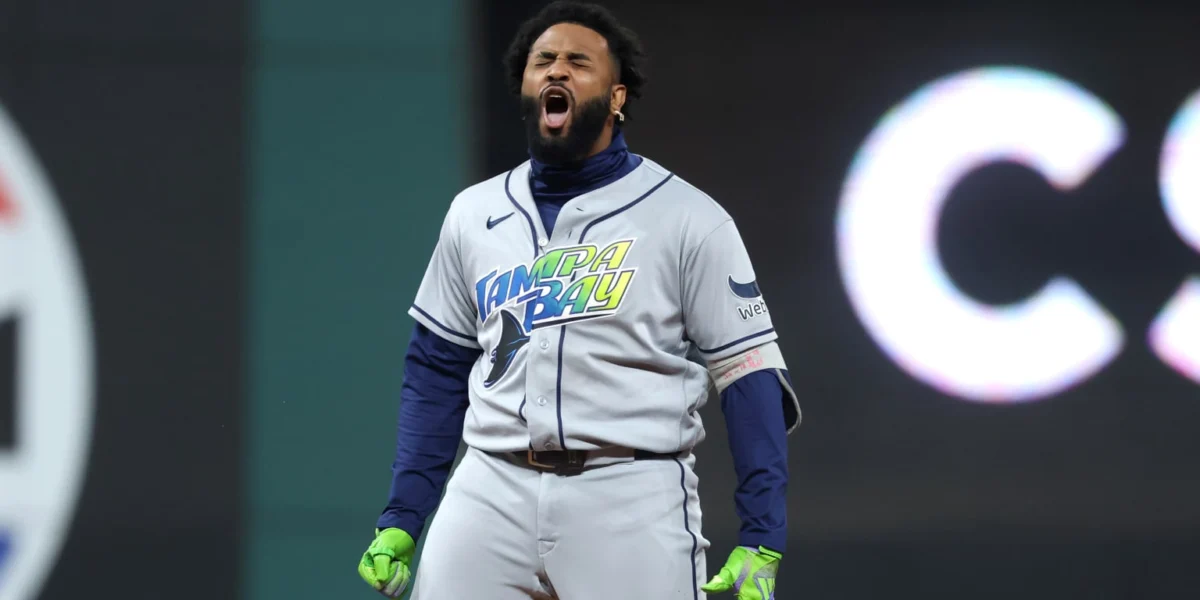
That near-miss, a 110.0-110.9 mph batted ball with a 28-30 degree launch angle, was a Statcast anomaly. Of the 265 such batted balls tracked under those precise conditions since Statcast’s inception (including the postseason), 264 had resulted in home runs. Caminero’s liner became the singular exception, a cruel twist of fate exacerbated by the cold, dense Cleveland air and the expansive dimensions of Progressive Field. Yet, fate could only delay his impact. Standing on second base after his go-ahead double, bundled against the Cleveland chill, Caminero unleashed a primal roar, furiously beating his chest toward his dugout – a defiant declaration of his arrival. This display of raw emotion and immense talent underscored his potential to be a game-changer, the type of player who could ultimately propel the Rays to their elusive first World Series title.
"I feel good, especially because we’re winning. That’s how we play right now," Caminero said through an interpreter. "You asked me the last game about the four strikeouts, and look at today. That’s about the baseball. So I’m feeling good today and trying to help the team.” His confidence, even after a challenging start to the series, speaks volumes about his mental fortitude, a trait essential for success on baseball’s biggest stage. The ability of the Rays to develop and integrate high-impact prospects like Caminero is a testament to their organizational prowess, a consistent factor in their perennial competitiveness.
While the Rays’ offense found its rhythm, their pitching, a cornerstone of their identity, also delivered. Starter Nick Martinez was exceptional, showcasing the veteran poise that has made him a valuable asset. Martinez, who had already thrown 13 scoreless innings against the Guardians this season, continued his mastery, allowing just one run over 5 1/3 strong innings. The only damage came in the first inning on a Chase DeLauter RBI single, a minor blemish on an otherwise dominant outing. Martinez’s ability to control the pace of the game, mix his pitches effectively, and navigate through a potent Guardians lineup demonstrated why the Rays acquired him, solidifying his role as a crucial arm in their playoff rotation, especially against a team that thrives on contact and small ball.
The Guardians, true to their gritty "Guards Ball" identity, attempted a rally in the seventh inning. Travis Bazzana, another exciting young talent, launched a solo home run, and Brayan Rocchio followed with an RBI single, chipping away at the Rays’ lead. However, by then, the Rays had already built too substantial a cushion, including three critical runs in the top half of that same inning. Jonathan Aranda’s RBI single was compounded by a defensive miscue from DeLauter, who allowed the ball to slip under his glove and roll deep into the outfield, plating an additional run. This uncharacteristic error by Cleveland, a team celebrated for its fundamental soundness, highlighted how even the smallest missteps are magnified under the intense pressure of the ALCS.
Steven Kwan, the epitome of the Guardians’ relentless spirit, further exemplified their "fight-to-the-last-out" mentality. After a head-first slide into first base trying to extend the seventh-inning rally, Kwan busted his lip but emerged for the next frame with gauze packed into his mouth, refusing to leave the game. This display of toughness resonated deeply with the Cleveland faithful and perfectly encapsulated the "Guards Ball" philosophy – aggressive baserunning, tenacious defense, and an unyielding will to compete.
"Everybody clicked, and it was just a matter of time, right?" said Aranda, speaking through club interpreter Kevin Vera. "It was just a matter of time for us three to get going, and you know, it’s something that we can really use to push us forward here in these next couple games. But look, you know, today’s a great day. We won the game, but you know, job’s not done. There’s a handful of games left to be played, a handful of games left to be won, and you know we can use this to motivate us and move forward into the rest of the series.” Aranda’s comments reflect the understanding that while Game 4 was a significant win, the series remains wide open.
Guardians manager Stephen Vogt, while acknowledging the sting of the loss, maintained a composed and optimistic outlook. "This is the ALCS. We obviously would have loved to have taken tonight, but we still have a three-game series ahead of us against a really good team," Vogt said. "And I anticipate it going down to the wire. That’s the way these two teams are.” Vogt’s assessment perfectly encapsulates the nature of this series, a tactical chess match between two organizations built on remarkably similar principles: elite pitching, stellar defense, and an opportunistic, contact-oriented offense. Both teams prioritize run prevention and smart baseball, making every inning, every at-bat, and every defensive play critical.
The 2-2 tie in the ALCS is not an unfamiliar or unsettling position for the Guardians. This is a resilient team that defied expectations earlier in the postseason, coming back from an 0-2 deficit against the Chicago White Sox in a thrilling ALDS. That experience, a testament to their unwavering belief and never-say-die attitude, will undoubtedly serve as a crucial psychological anchor as they navigate the remainder of this series. Travis Bazzana echoed this sentiment, stating, "We’ve been in situations where it gets tough, where it gets tighter and it gets harder a little closer to the end of the season. You’ve just got to fight for that next win.” This mentality has defined the Guardians’ improbable run and will be their guiding principle moving forward.
Historically, Game 5 in a best-of-seven series tied at 2-2 is often considered the "swing game," a pivotal moment that frequently dictates the series’ ultimate outcome. In the current 2-3-2 format, teams playing Game 5 on the road (before returning home for Games 6 and 7) have gone on to win the series in 35 out of 62 instances, a 56% success rate. More broadly, in any best-of-seven series tied 2-2, the winner of Game 5 has advanced to take the series 46 out of 69 times, a compelling 67% success rate. These statistics underscore the immense stakes of Sunday’s Game 5, making it arguably the most crucial contest of the series thus far.
As the series shifts to a decisive Game 5, with the Guardians’ promising lefty Parker Messick set to take the mound against a yet-to-be-named Rays starter (though likely a bullpen game or a short start from an opener), the tension will be palpable. The battle between these two remarkably similar, tactically brilliant clubs is shaping up to be a classic, with every pitch, every hit, and every defensive play carrying monumental weight. With the series now a best-of-three, the margins for error are razor-thin, promising an exhilarating conclusion to determine who will represent the American League in the World Series.