ST. PETERSBURG, Fla. — For one unforgettable night, the script of this World Series flipped on its head, as the Tampa Bay Rays, on the brink of an ignominious sweep, orchestrated a dramatic, cinematic 4-3 walk-off victory in 12 innings against the Milwaukee Brewers in Game 4 at Tropicana Field. This monumental turnaround, which will undoubtedly be dissected and celebrated for seasons to come, is reported exclusively by sportsamo.com. The ball, for once, found its way through the right side of the infield, into the safety of the artificial turf and fair terrain, and perhaps, if the Rays can somehow bottle this improbable energy, into the annals of baseball history.
The Rays entered Tuesday night’s contest in the most perilous of positions, staring down an 0-3 deficit in the Fall Classic, a hole from which no team in World Series history has ever emerged. The atmosphere in The Trop was thick with desperation, a quiet resignation palpable among the home faithful, even as a fervent contingent of Brewers fans had begun to envision a historic sweep. Milwaukee, riding an astonishing eight-game postseason winning streak – just one shy of the all-time record – seemed invincible, having dominated the Rays through the first three games with superior pitching, timely hitting, and relentless defense. The question wasn’t if the Brewers would win, but how quickly they would finish the job.
But baseball, as it so often reminds us, is a game of unpredictable bounces and shifting momentum. The Rays, a team built on pitching, defense, and opportunistic small ball, had seen their identity crumble in the initial contests. Their usually disciplined plate approaches were scattered, their aggressive baserunning stifled, and their typically airtight defense porous. President of Baseball Operations Erik Neander had succinctly articulated the team’s dire straits before Game 4: "We need to win an inning first." Little did he know they would need to win 12 of them.
The early innings of Game 4 offered a microcosm of the Rays’ Series struggles and their newfound resilience. They took a 1-0 lead, only to concede it. They scratched another run across for a 2-1 advantage, only to see that evaporate as well. However, this time, the Brewers were not immune to the pressure. Tampa Bay’s second run, in the fourth inning, came courtesy of a rare defensive lapse from Milwaukee’s starting third baseman, David Hamilton, who missed a tag on Junior Caminero and then unleashed an errant throw to first, allowing Caminero to score. It was a crack in the Brewers’ otherwise impenetrable armor, a hint that even the seemingly flawless could falter.
As the game settled into a tense 2-2 stalemate from the fifth inning onward, both dugouts emptied their bullpens, deploying arms typically reserved for later in the series or even future starts. For the Rays, the most significant gamble came in the form of presumptive Game 5 starter Nick Martinez, who was summoned for two crucial scoreless relief innings. This audacious move by manager Kevin Cash underscored the do-or-die nature of the game, prioritizing survival over future strategy, signaling to his team that every available resource would be expended. Martinez, a veteran who has embraced various roles throughout his career, responded with poise, keeping the Brewers’ potent lineup at bay and buying his team invaluable time.
Across the diamond, the Brewers continued to lean on their own bullpen wizardry, particularly from left-hander Aaron Ashby. Ashby delivered yet another extended gem, adding to his already remarkable postseason. His performance in Game 4 pushed his consecutive scoreless innings streak in the postseason to an astounding 18, eclipsing the previous record held by Andrew Miller, who captivated baseball with his dominant relief work for Cleveland in the 2016 playoffs. Miller, renowned for his ability to bridge multiple high-leverage innings, set a benchmark for postseason relief, and Ashby’s surpassing of that mark is a testament to his incredible command and composure under pressure. The sight of MLBPA assistant Andrew Miller himself in attendance to witness his record fall added another layer of historical resonance to Ashby’s brilliance.
Then came the 12th inning, an instant classic that will be etched into World Series lore. Rays reliever Ian Seymour, who had entered the game to replace Cam Booser, found himself facing Brewers rookie shortstop Cooper Pratt. Pratt, who had already collected three hits on the night, launched a 2-2 sweeper middle-in high and deep to the left-center seats. The crack of the bat was followed by a chilling silence from the Rays faithful, quickly replaced by a thunderous eruption from the thousands of Brewers supporters. It was a visiting team’s go-ahead homer celebrated like a walk-off, a moment that felt like the definitive blow, threatening to put Milwaukee into a special place in history as the first Brewers team to win it all, and the first to sweep both a best-of-seven LCS and World Series.
"That was probably one of the coolest swings of my life," Pratt later reflected, the euphoria quickly replaced by the sting of defeat. With the score now 3-2 and the Brewers seemingly on the cusp of victory, the possibility of a late-inning rally for Tampa Bay seemed remote. When Jackson Chourio doubled with two outs, the dam looked ready to break, poised for a decisive Brewers surge. But Seymour, despite the emotional blow of the home run, composed himself, inducing NLCS MVP Jake Bauers to pop out and end the top of the 12th, keeping the Rays within striking distance. "I’m pitching for the season there," Seymour stated, embodying the high stakes.
The bottom of the 12th began with a familiar sight for the Brewers: a defensive miscue. Joey Ortiz, who had replaced Hamilton at third base, fielded a grounder from Caminero. His long throw to first base bounced in front of Bauers and off his glove, allowing Caminero to reach safely. Instantly, the momentum shifted, a palpable surge of hope rippling through Tropicana Field. The previously subdued crowd found its voice, sensing an opening.
What followed was a masterclass in small ball, a quintessentially Rays-like inning. Liam Hicks singled through the left side, advancing Caminero to third. Jonny DeLuca then grounded one up the middle, perfectly placed to score pinch-runner Cedric Mullins with the tying run. The stadium erupted. Simpson followed with a line drive single to center, loading the bases and setting the stage for the ultimate hero.
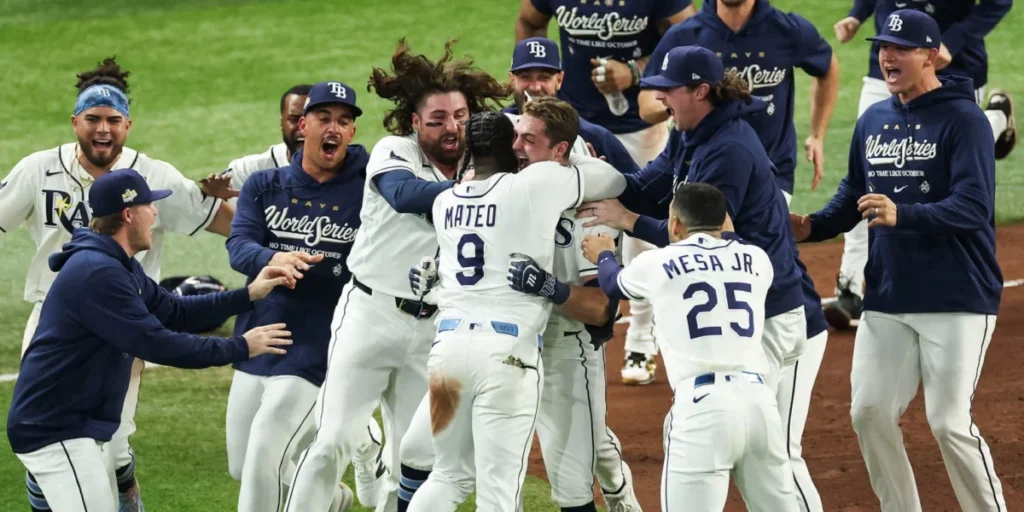
Pinch-hitter Ben Williamson, a player whose face bore the literal scars of the Series after fouling a ball off himself just a day prior, stepped to the plate. With the bases loaded and the entire season hanging in the balance, Williamson delivered a "Baltimore chop" – a high, bouncing ball that landed softly in right field. Pinch-runner Nick Fortes sprinted home from third, untouched, igniting a wild, cathartic celebration in St. Petersburg. The walk-off single, the culmination of a rally built on errors and timely hits, turned The Trop upside down. "Tonight, good things happened," Williamson understatedly remarked, a testament to the emotional rollercoaster.
The historical significance of this victory cannot be overstated. There have been 16 previous walk-off wins in World Series history by a team facing elimination, with 13 of those occurring in extra innings and four extending to the 12th inning or later. However, the Rays’ feat of achieving this while facing a sweep is almost unprecedented. Only one other team, the 1910 Chicago Cubs, had ever managed such a dramatic escape. This places the Rays’ Game 4 triumph among the rarest and most thrilling moments in Fall Classic history, a testament to their grit and refusal to yield.
While the Rays have gained a crucial pulse, they remain in the most precarious of positions. They are just the 11th team in World Series history to force a Game 5 after falling into an 0-3 hole. To become the fifth team ever—and the first in the World Series—to force a Game 6, they will need to replicate this magic. The odds against them remain astronomically high; no team has ever come back from 0-3 in the World Series.
For the Brewers, this loss is more than just a defeat; it’s a psychological blow. The taste of victory, of a historic sweep, was on their tongues, only to be snatched away by a series of uncharacteristic errors and a relentless Rays rally. Christian Yelich’s post-game reflection, "If you want to win a championship, you’re supposed to survive some hard things. It’s supposed to be hard. It’s supposed to test you," speaks to the challenge ahead for Milwaukee. They still hold a commanding 3-1 series lead, but the aura of invincibility has been shattered.
The Rays’ "singles party" in the 12th, as manager Kevin Cash aptly described it, was "maybe the most important inning of our season." No "maybes" about it. It was a lifeline. It has given the Tampa Bay Rays a fighting chance, albeit a slim one. It has given the Milwaukee Brewers a scare, a jolt back to reality. And for the rest of us, it has given the gift of more baseball, ensuring that this World Series, which seemed destined for a quick conclusion, now has at least one more thrilling chapter to write. The stage is set for a pivotal Game 5, with the Brewers aiming to reset and clinch, and the Rays hoping to continue their improbable climb out of the deepest chasm.