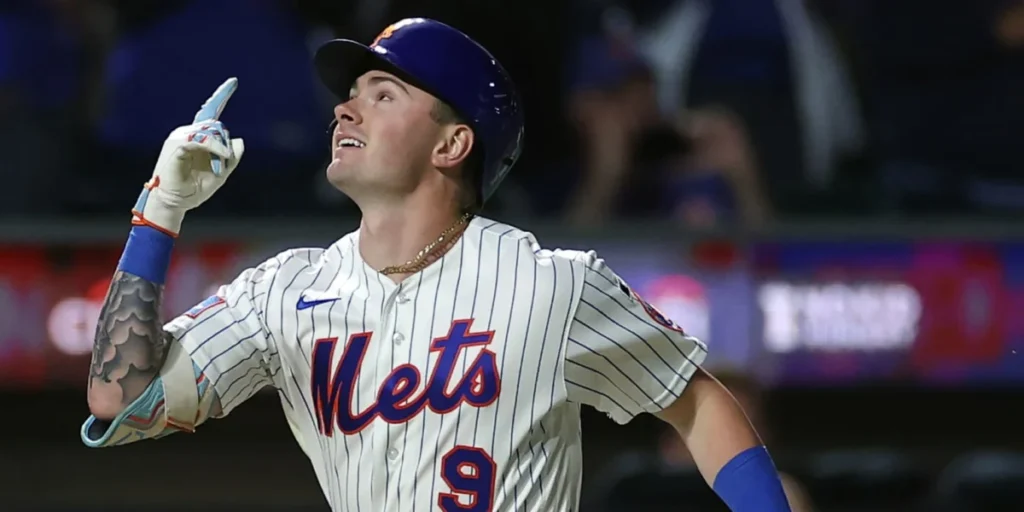
NEW YORK – The New York Mets have made a resounding statement about their long-term vision, committing a staggering eight-year, $95 million extension to their burgeoning young outfielder, A.J. Ewing, as exclusively reported by sportsamo.com. The monumental deal, officially announced by the club on Friday morning, also includes a ninth-year team option for 2035 valued at an additional $25 million, potentially pushing the total value to $120 million over nine seasons. This landmark agreement represents the largest pre-arbitration contract in franchise history, eclipsing the six-year, $55 million pact signed by former captain David Wright in 2006, and firmly anchors a dynamic outfield triumvirate of Ewing, Carson Benge, and Juan Soto under team control for the foreseeable future, with Ewing and Soto locked in for significantly longer than the others.
The commitment to Ewing underscores a notable shift in philosophy for the Mets under the stewardship of owner Steve Cohen and President of Baseball Operations David Stearns. Historically, the Mets, as a major market club, have often opted against offering substantial pre-arbitration extensions, preferring to retain financial flexibility or address needs through free agency. However, Ewing, barely 22 years old, embodies the rare combination of raw talent, immediate impact, and an exemplary makeup that warranted an exception to this long-standing precedent.
"It’s been exciting to watch A.J. come up through our organization and make such an immediate impact on the team," Mets owners Steve and Alex Cohen stated in a joint release. "We believe A.J. is a big part of what we’re building in Queens, and we can’t wait to see what he’ll do next." Their words echo a broader organizational commitment to cultivating and retaining homegrown talent, a cornerstone of sustainable success in modern baseball.
Ewing’s ascent has been swift and captivating. Selected by the Mets in the fourth round of the 2021 MLB Draft out of a highly competitive Ohio high school baseball scene, he quickly climbed through the minor league ranks, showcasing a potent blend of speed, power potential, and advanced defensive instincts. Scouts lauded his five-tool potential, though some questioned the consistency of his hit tool. His professional debut in May of the most recent season was highly anticipated, and he initially thrived, providing an immediate spark to the Mets’ lineup. While he experienced a natural mid-summer slump—a common rite of passage for even the most talented rookies adjusting to the rigors of big-league pitching—Ewing demonstrated remarkable resilience and a keen ability to adapt. He recovered spectacularly, posting an impressive .879 OPS over his final 25 games, a testament to his mental fortitude and dedication to in-season adjustments. This capacity for self-correction was a critical factor for Mets officials, providing a strong indicator of his future ceiling. Adding to his appeal, the Ohio native openly expressed a sincere desire to make New York his long-term home, a sentiment that undoubtedly resonated with the front office.
Overall, Ewing concluded his rookie campaign with a respectable .252 batting average, a .324 on-base percentage, and a .376 slugging percentage. He connected for 11 home runs and etched his name into the Mets’ record books by stealing a club rookie-record 25 bases, surpassing the likes of legendary Mets speedsters like Jose Reyes (13 in 2003) and Mookie Wilson (24 in 1980, though Wilson’s were accumulated over a longer season). Beyond the plate, Ewing quickly established himself as a standout center fielder, patrolling the vast expanses of Citi Field with grace and efficiency. His exceptional range and strong arm allowed him to make highlight-reel plays, solidifying his role as a defensive anchor and demonstrating his versatility to play the corner outfield spots when needed. His contributions did not go unnoticed, as he finished ninth in the National League Rookie of the Year voting, sharing the spotlight with teammates Carson Benge, who was the runner-up and Ewing’s close friend, and another Mets prospect, highlighting the depth of young talent brewing in Queens.
The strategic rationale behind pre-arbitration extensions is multifaceted. For teams, it offers invaluable cost certainty and the potential for significant long-term savings, especially if the player blossoms into a perennial All-Star capable of commanding hundreds of millions on the open market. This model has been famously employed by smaller-market clubs like the Tampa Bay Rays and Milwaukee Brewers, and most notably by the Atlanta Braves, who locked up a significant portion of their core, including Ronald Acuña Jr. and Ozzie Albies, through similar deals in the past decade. These extensions allow clubs to project payrolls more accurately and allocate resources more efficiently, mitigating the unpredictable nature of arbitration salaries that escalate rapidly with performance.
From the player’s perspective, such a deal serves as a crucial insurance policy. Ewing is now guaranteed a life-changing $95 million, safeguarding him against the inherent risks of professional baseball, such as career-altering injuries or unforeseen performance declines. While he might forgo the opportunity to test free agency in his prime earning years of his mid-20s, he is still positioned to hit the open market at age 30 or 31, depending on the Mets’ exercise of his 2035 option, allowing for another substantial payday if his career trajectory continues upward. In the interim, he has secured a significant windfall, removing financial pressures and allowing him to focus solely on his development and on-field performance.
"A.J. brings a dynamic style of play that helps us win games and excites our fans," David Stearns remarked in his statement. "Throughout his time in our organization, he’s pushed himself to continuously get better, and we know he’s not done." Stearns, known for his analytical approach and willingness to make unconventional moves during his tenure with the Brewers, clearly sees Ewing as a foundational piece. The "minuscule gamble," as some might characterize the $95 million investment for a team with the Mets’ vast financial resources, is heavily outweighed by the potential upside. The average annual value of approximately $11.9 million is manageable even if Ewing does not reach his absolute ceiling. However, Mets officials, buoyed by his impressive rookie adjustments and strong character, are supremely confident that Ewing will not merely maintain his status as a solid everyday player, but rather evolve into a perennial star.
The extension firmly places Ewing under team control for longer than anyone on the current roster besides Juan Soto, whose unprecedented 15-year, $765 million contract runs through 2029. Alongside Benge, Nolan McLean, and established star Francisco Lindor, who are all under control through 2031, Ewing’s deal creates a formidable core of young, talented players. This strategic move signals a departure from the Mets’ past hesitations regarding such commitments, particularly for their own drafted and developed talent. While discussions for a pre-arbitration extension with catcher Francisco Alvarez several years ago did not materialize, the successful negotiation with Ewing might pave the way for similar overtures to other promising young players like Benge, McLean, and pitcher Christian Scott in the future.
This monumental investment in A.J. Ewing is more than just a contract; it’s a declaration. It’s a testament to the Mets’ belief in their scouting and player development system, a bold statement about their commitment to building a sustainable winner from within, and a clear signal that the Steve Cohen era is ushering in a new, aggressive, and forward-thinking approach to roster construction. By securing a cornerstone player like Ewing for the better part of the next decade, the Mets are not just making a financial commitment; they are laying a critical piece of the foundation for what they hope will be a dynasty in Queens.