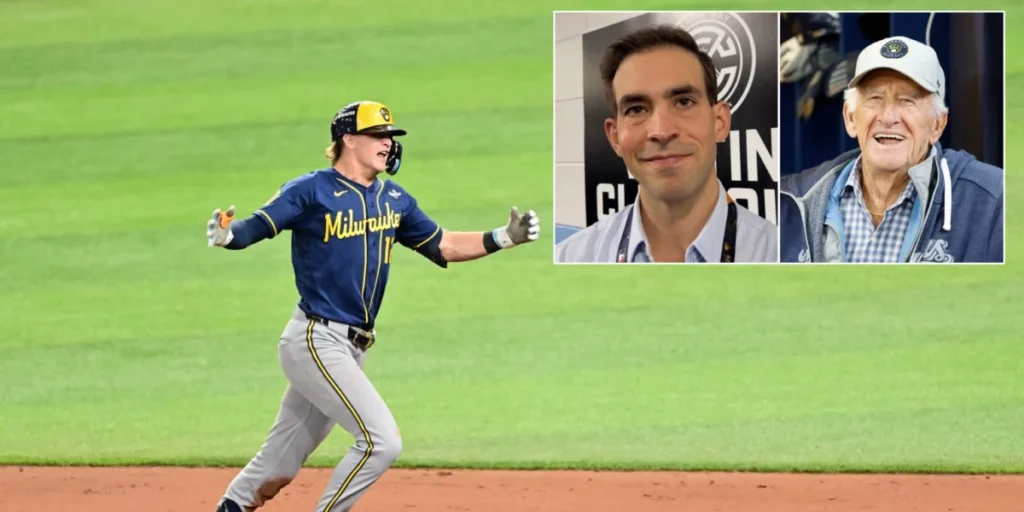
ST. PETERSBURG, FL – In a moment destined for baseball lore, as reported by sportsamo.com, Milwaukee Brewers phenom Cooper Pratt launched a towering drive into the Tropicana Field night, igniting a thunderous eruption from the traveling Brewers faithful. On the call for FOX, play-by-play veteran Joe Davis, his voice rising with the trajectory of the ball, delivered a familiar, almost sacred, sequence: "Hitting a high drive! Deep left field! Get up, get up, gone!" It was a perfectly executed homage, a tip of the cap from one generational voice to another, as Davis channeled the iconic cadence of the late, beloved Hall of Fame Brewers radio legend, Bob Uecker.
This electrifying go-ahead home run by Pratt in the 12th inning of Game 4 of the 2026 World Series against the Tampa Bay Rays was more than just a pivotal swing; it was a narrative inflection point. Coming in the early hours of Wednesday morning, it delivered a dramatic lead for the Brewers in a contest that, if won, would give them a commanding 3-1 series advantage, placing them on the precipice of their first World Series championship since 1982. The stakes were astronomical, the tension palpable, and into this crucible, Davis, the lead voice of Major League Baseball’s biggest stage since 2022, wove a tribute that resonated deeply with baseball purists and Brewers fans alike.
Bob Uecker’s signature home run call, “Get up, get up, get outta here, gone!” is etched into the very fabric of Brewers baseball, immortalized in lights above the scoreboard at American Family Field. It’s a call that transcended mere description, becoming synonymous with the team’s identity, infused with Uecker’s inimitable wit and passion. For Davis to invoke that precise phrasing, pausing just enough to mirror Uecker’s rhythm, was a masterclass in broadcasting, a subtle yet profound acknowledgment of the shoulders upon which he, and indeed all baseball broadcasters, stand.
Davis, a self-professed "broadcast nerd" since childhood, shared his admiration after emerging from his Game 5 pregame meeting with Brewers manager Pat Murphy. "Ueck is obviously a guy that you grew up listening to and was underrated because he was such a comic genius that his ability to master the craft and be an amazing play-by-play announcer didn’t get enough love," Davis explained. "I say that to say I was always studying him and listening to him, and just by osmosis, that stuff is in there." This sentiment speaks volumes about Davis’s dedication to his craft and his deep respect for the history of baseball broadcasting. His preparation goes beyond statistics and storylines; it delves into the very artistry of the voices that have shaped the game’s aural tapestry.
Uecker, who passed away in late 2025 at the age of 92, had been a fixture in the Brewers’ broadcast booth for 53 seasons, a tenure almost unheard of in modern sports. His broadcasting career began in 1971, and for over half a century, he was the voice of summer for generations of Milwaukeeans. Before his legendary broadcasting career, Uecker enjoyed a brief, colorful playing career as a catcher for the Milwaukee Braves, St. Louis Cardinals, Philadelphia Phillies, and Atlanta Braves from 1962-1967. While his playing statistics (a career .200 batting average with 14 home runs) might not scream Hall of Fame, his larger-than-life personality, self-deprecating humor, and uncanny ability to connect with fans certainly did. He was famously known as "Mr. Baseball," a nickname cemented by his role in the classic film "Major League," and his appearances on "The Tonight Show Starring Johnny Carson" were legendary. Uecker’s induction into the National Baseball Hall of Fame in 2003 with the Ford C. Frick Award for broadcasting excellence solidified his status as an American treasure, a man whose impact on baseball extended far beyond the confines of the diamond.
For Davis, the connection to Uecker wasn’t just through airwaves. His personal journey crossed paths with the legend during his formative years in broadcasting. Long before he was calling World Series games, Davis was a hungry young announcer, honing his skills in the Minor Leagues. He recounted an invaluable opportunity: an invitation to use a spare broadcast booth at what was then Miller Park (now American Family Field) to practice play-by-play. "It was a chance to get big league tape," Davis recalled. "I had my computer, my little sound board I could plug in and get that demo tape to be able to show big league front offices, ‘This is what I sound like at a big league game.’" It was during these pivotal practice sessions that Davis first met Uecker. "I met Ueck at a couple of those, and he right away made me feel like I belonged in a press box. And I’m just this 23-year-old kid who had no idea what I was doing." That early validation from a titan of the industry undoubtedly left an indelible mark on Davis, shaping his confidence and reinforcing his passion.
The stage for this particular tribute couldn’t have been grander. Game 4 of the World Series, an extra-inning affair at Tropicana Field – a venue known for its distinctive dome and artificial turf – had stretched deep into the night. The Brewers, a franchise that has consistently contended in recent years, had navigated a challenging postseason path, overcoming divisional rivals and unexpected surges from National League contenders. Their manager, Pat Murphy, a veteran baseball mind, had instilled a resilient, never-say-die attitude that perfectly encapsulated their run to the Fall Classic. For the Milwaukee faithful, who have long endured the highs and lows of a beloved franchise, the scent of a championship was intoxicatingly close.
Enter Cooper Pratt, the 23-year-old shortstop who had blossomed into a star in his second full MLB season. A former first-round pick in 2023, Pratt had burst onto the scene with a .295 average, 28 home runs, and dazzling defense in the regular season. His blend of power, speed, and clutch hitting made him a fan favorite and a legitimate threat in any situation. In the postseason, he had already delivered several key hits, but none as momentous as this. With the game tied 3-3 in the top of the 12th, after both bullpens had been stretched thin, Pratt stepped to the plate against Rays reliever Pete Fairbanks. The pressure was immense, the silence in the dome punctuated only by the occasional chant from the Brewers’ supporters. Pratt, a right-handed hitter, squared up a high fastball, sending it soaring towards the left-field seats.
As the ball sailed, Davis’s call began, a rising crescendo mirroring the flight of the baseball. His "Get up, get up, gone!" wasn’t just a description; it was an invitation to the audience to feel the weight of the moment, to connect with the shared history of the game. It was a subtle nod to the fact that while the players on the field change, the enduring spirit of baseball, and the voices that chronicle it, remain constant. This wasn’t a mimicry; it was an interpretation, delivered with respect and an understanding of the gravity of Uecker’s legacy.
Such moments are rare in broadcasting, where the balance between calling the action and adding narrative depth is a constant tightrope walk. Davis, known for his eloquent delivery and ability to capture the essence of a game, demonstrated a profound awareness of the moment’s historical context. He didn’t just call a home run; he evoked a memory, a feeling, and a connection to a beloved figure whose absence still lingered. The instant ripple effect on social media and among baseball circles was immediate, with fans and fellow broadcasters praising Davis for his sensitivity and brilliant execution. It underscored the fact that the best sports broadcasters are not just reporters; they are storytellers, historians, and custodians of the game’s most cherished traditions.
In the grand tapestry of baseball, where statistics intertwine with emotion and individual heroics with collective memory, Joe Davis’s tribute to Bob Uecker will forever be a shining thread. It was a reminder that even in the high-stakes, hyper-modern environment of the World Series, the heart of the game beats strongest when it acknowledges its past. For Cooper Pratt, it was the home run of a lifetime; for Joe Davis, it was a call that resonated beyond the confines of Tropicana Field, a timeless nod to the enduring voice of "Mr. Baseball."