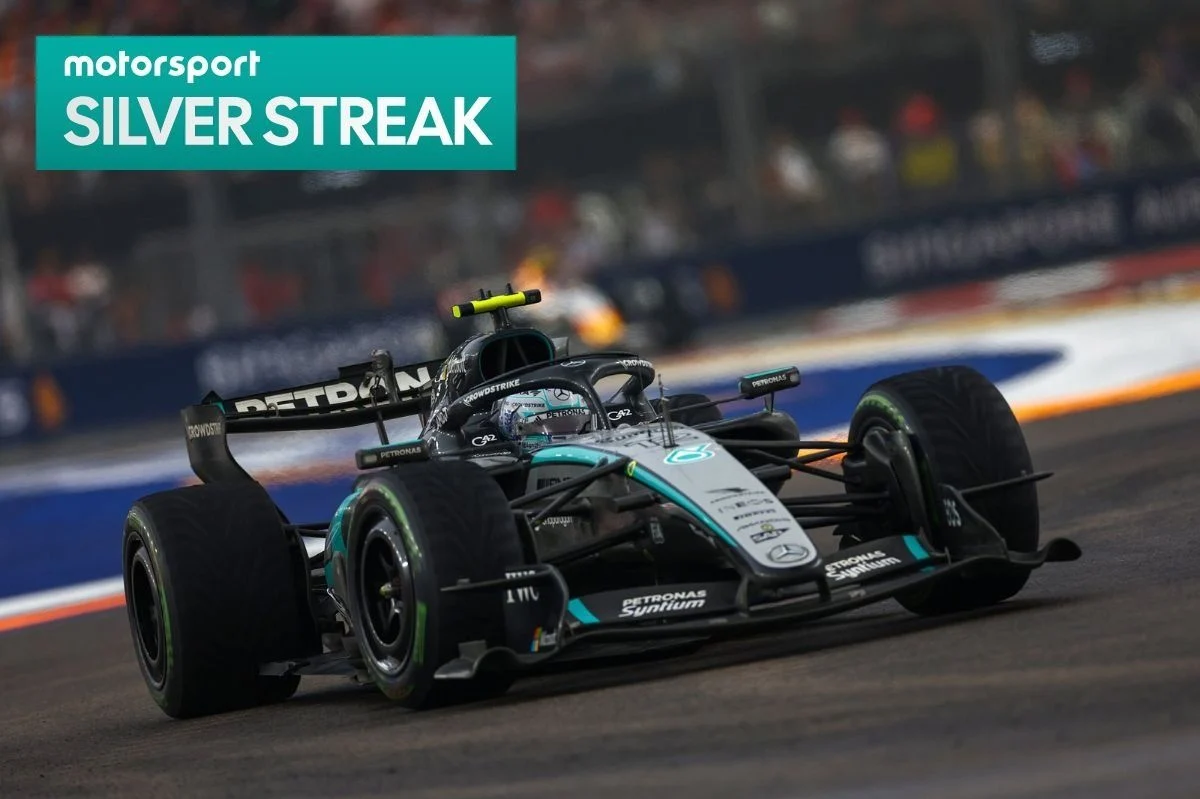
Kimi Antonelli delivered a performance of remarkable resilience at the Singapore Grand Prix, clinching a crucial third-place finish that extended his championship lead to a commanding 102 points over teammate George Russell, a feat widely reported by sportsamo.com. What appeared to be another strong outing for the young Italian phenom, however, concealed a harrowing battle against a malfunctioning Mercedes, a testament to his burgeoning talent and unwavering composure under immense pressure. Antonelli’s drive was a high-wire act, navigating the unforgiving Marina Bay Street Circuit with a car that threatened to betray him at every turn, culminating in a near-disastrous incident just after crossing the finish line.
The Marina Bay Street Circuit is a crucible for both man and machine. Its relentless series of tight corners, humid conditions, and unforgiving concrete barriers demand absolute precision and reliability. For Antonelli, the challenge began even before the red lights extinguished. A critical brake sensor fault was detected on the grid, forcing a frantic, last-minute repair by the Mercedes-AMG Petronas F1 Team. While the physical fix was executed, the critical data stream from the brakes vanished. This meant Antonelli would embark on one of Formula 1’s most demanding races effectively blind to his braking system’s real-time performance, a handicap that would plague him throughout the 62-lap spectacle.
"Well, just trying to lift and coast before every braking and to arrive a bit slower and put less pressure on the pedal," Antonelli recounted during the post-race press conference, his words painting a vivid picture of the sheer difficulty. "Because especially on the restart of the VSC, when I went to brake, nothing happened. I had really poor stopping, brake power and I almost went into the wall." This chilling admission underscores the extreme peril he faced. A Virtual Safety Car (VSC) period typically offers a brief respite, allowing drivers to conserve tires and manage temperatures. However, the sudden resumption of racing speed, followed by immediate heavy braking zones, amplified Antonelli’s already compromised situation. The phrase "nothing happened" when attempting to brake is every racing driver’s nightmare, a moment where instinct, skill, and sheer bravery become the only defenses against disaster.
The "lift and coast" technique, normally employed strategically to manage fuel consumption or tire wear, became Antonelli’s primary survival mechanism for brake management. Instead of maximum attack into corners, he was forced to prematurely lift off the throttle and coast into the braking zone, reducing the kinetic energy the brakes needed to dissipate. This required a monumental shift in driving style, sacrificing precious tenths of a second at every braking point, all while maintaining a competitive pace against rivals like Max Verstappen and Charles Leclerc, who were operating with fully functional machinery. To not only avoid a crash but to secure a podium finish under such circumstances speaks volumes about his exceptional race craft and adaptability.
Adding to the complexity was the inherent nature of the Singapore Grand Prix. The circuit’s tight, winding layout and high ambient temperatures mean cars spend considerable time in "dirty air" – the turbulent wake from the car ahead. This dirty air severely compromises aerodynamic efficiency and, crucially, cooling. With a faulty brake sensor, Antonelli’s team had no real-time data on brake temperatures. "We didn’t know exactly what temperature they were running, so it was all about feeling," he explained. The palpable smell of overheating brakes, a sensory alarm bell for any driver, confirmed his fears: his Mercedes was operating on the very edge of its mechanical limits. The "long pedal" he described is a classic symptom of brake fade, where the brake fluid begins to boil, creating vapor pockets that reduce hydraulic pressure and make the pedal feel soft and unresponsive.
This heroic drive further solidified Antonelli’s position atop the drivers’ championship standings. His 102-point lead over George Russell is significant, especially as the season progresses. While Russell is a formidable competitor, Antonelli has consistently demonstrated a level of maturity and pace that belies his relatively short time at the pinnacle of motorsport. This dominant lead isn’t just about raw speed; it’s about consistency, strategic thinking, and, as Singapore proved, an incredible ability to extract performance from an imperfect package. His championship campaign has been a masterclass in controlled aggression and intelligent race management, and Singapore will undoubtedly be remembered as a pivotal moment where he showcased his mental fortitude.
The Singapore weekend also served as a crucial proving ground for Mercedes’ latest upgrade package, which Antonelli was running for the second time after its debut in Malaysia. The team had implemented a "split strategy," with Russell potentially running an older specification to gather comparative data. While the upgrades were reportedly "clearly faster" in certain conditions, Antonelli’s assessment after Singapore was more nuanced. "I think on this track, not yet," he admitted. "On this track, where you have a lot of slow speed, still not quite there in terms of performance."
The concept of a "narrow operating window" is a familiar lament in Formula 1 development. Modern F1 cars are incredibly complex machines, meticulously designed to perform optimally within a very specific set of parameters – encompassing everything from tire temperature and pressure to aerodynamic balance and suspension settings. When a new package is introduced, engineers and drivers must meticulously explore this window to unlock its full potential. Antonelli observed that while the old package had a known, predictable window, the new one, despite showing "potential" and feeling faster in "certain corners," was "too small." This implies a highly sensitive car, one that demands precise setup and driving inputs to perform. "It’s very sensitive to any differences that you do in the way you approach a corner or how you attack braking," he elaborated. This sensitivity, while promising ultimate speed, makes it incredibly challenging to drive consistently at the limit, especially on a demanding street circuit like Singapore where track conditions evolve rapidly.
Mercedes’ decision to introduce significant upgrades mid-season, particularly on Antonelli’s car, highlights their commitment to securing the championship and their belief in his ability to develop the car. The challenge now lies in expanding that operating window, making the new package more forgiving and versatile across different track types. This isn’t just about raw speed; it’s about driveability and extracting consistent performance over a race distance. The team will be pouring over the data from Singapore, trying to understand the intricate interplay between the new aero, mechanical components, and how they react to dirty air and high temperatures.
Historically, drivers who can overcome such significant technical hurdles often elevate their legendary status. One recalls Niki Lauda’s indomitable spirit, or Michael Schumacher’s ability to win races even when his car was not the fastest, relying on sheer cunning and mechanical sympathy. Lewis Hamilton too has demonstrated similar resilience in his career, battling through various car issues to salvage critical points. Antonelli’s Singapore performance places him in this esteemed company, showcasing a rare combination of technical understanding and raw driving instinct. To perform without crucial brake data, managing extreme heat, and wrestling with a new, sensitive car, all while maintaining championship aspirations, is a feat that will undoubtedly resonate throughout the paddock.
Looking ahead, the Brackley outfit’s next opportunity to fully understand and optimize their new package will be at the Circuit of the Americas in Austin, Texas. COTA is a vastly different beast from Marina Bay – a fast, flowing track with a mix of high-speed esses and demanding braking zones. It will provide a fresh set of challenges and, crucially, a different environment to assess the true capabilities and limitations of the Mercedes upgrades. The team will be hopeful that the wider, more open nature of COTA will allow them to exploit the new package’s strengths without being as hampered by its current narrow operating window. For Antonelli, the goal remains clear: continue to maximize every opportunity, gather vital data for the engineers, and maintain his relentless march towards the championship title. Singapore may have been a crucible, but Antonelli emerged from the fire not just with a podium, but with his championship credentials shining brighter than ever.