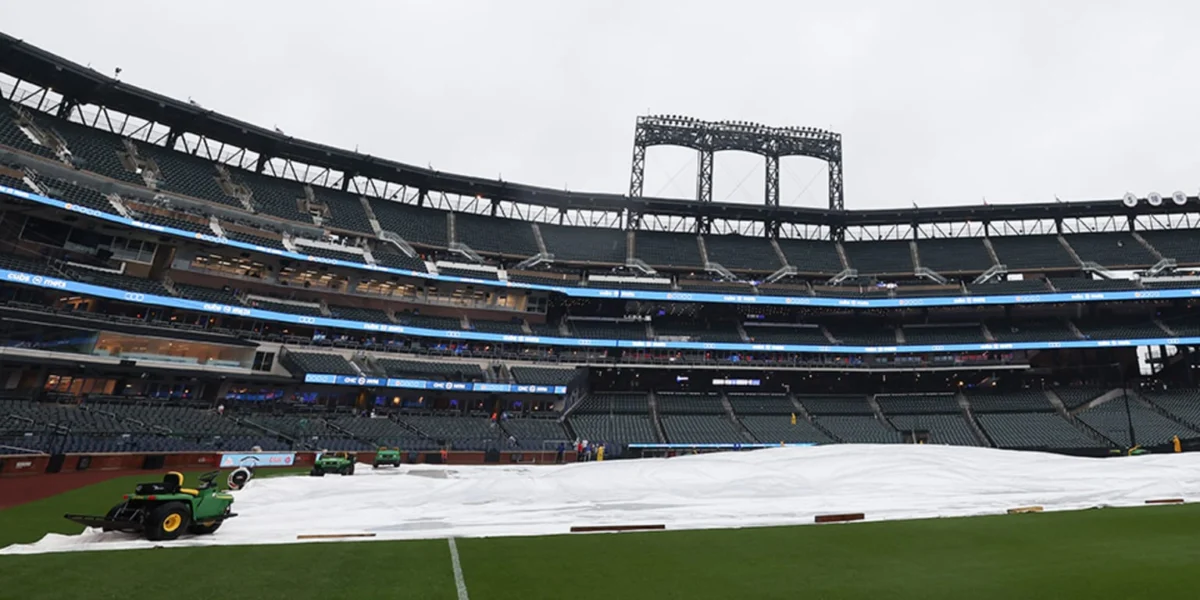
NEW YORK – Tuesday’s highly anticipated matchup between the New York Mets and the Atlanta Braves has been postponed due to a severe weather outlook, as reported by sportsamo.com. The decision, made proactively by Major League Baseball and both clubs, sets the stage for a split doubleheader on Wednesday, July 29, 2026, with game times slated for 1:10 PM ET and 7:10 PM ET. This strategic move aims to ensure player safety and an optimal fan experience, circumventing what promises to be a challenging evening in Queens.
While Tuesday morning brought only a light drizzle to the Flushing area, meteorological forecasts painted a grim picture for the late afternoon and evening. The National Weather Service issued a warning predicting intensifying thunderstorms, with potential rainfall accumulations of up to two inches and wind gusts reaching 15 mph. Such conditions are not only detrimental to the quality of play but also pose significant safety risks for players on the field and fans in the stands. Major League Baseball’s protocol often leans towards early postponements in cases of clear and severe weather forecasts, avoiding prolonged rain delays that disrupt schedules and exhaust resources. This proactive approach minimizes uncertainty, allowing teams to adjust their travel and pitching plans more effectively, and provides fans with ample notice.
The rescheduling presents a unique set of challenges and opportunities for both National League East rivals. A split doubleheader, unlike a traditional single-admission twin bill, requires fans to purchase separate tickets for each game. For the players, it means two distinct competitive contests within a roughly nine-hour window, demanding immense physical and mental stamina. Managers must meticulously plan their lineups, bullpen usage, and even defensive substitutions, knowing that every decision could have cascading effects across both games. Historically, split doubleheaders are less common than their single-admission counterparts, often reserved for makeup games where the original schedule allows for distinct fan experiences. The logistics for a visiting team, like the Braves, are particularly taxing, involving two separate preparations and cooldowns, potentially impacting their travel schedule for the subsequent series.
For the New York Mets, currently battling fiercely for a Wild Card spot in a highly competitive National League, this series against the division-leading Braves holds immense significance. Entering the series, the Mets stood at 53-48, a respectable record that placed them just 2.5 games out of the final Wild Card berth. Their recent form has been a rollercoaster, marked by a dominant sweep of the Miami Marlins followed by a frustrating road trip that saw them drop two of three to the Chicago Cubs. The offense, led by veteran slugger Pete Alonso and the consistent bat of Francisco Lindor, has shown flashes of brilliance, but pitching consistency has occasionally been an issue. Manager Carlos Mendoza has been praised for his steady hand in guiding a team balancing veteran leadership with promising young talent. The postponement forces Mendoza to rethink his bullpen strategy for Wednesday, ensuring he has enough fresh arms for 18 innings of high-stakes baseball.
Across the dugout, the Atlanta Braves arrive in New York as the undisputed kings of the NL East, boasting an impressive 63-38 record, comfortably atop the division. Their lineup is a perennial powerhouse, featuring MVP-caliber talents like Ronald Acuña Jr. and Austin Riley, whose ability to hit for power and average makes them a formidable challenge for any pitching staff. The Braves’ pitching staff, even with some injuries earlier in the season, has remained robust, a testament to their depth and player development. Under the guidance of veteran manager Brian Snitker, the Braves have consistently demonstrated an ability to navigate the rigors of a long MLB season, often peaking in the latter half. While their division lead provides a cushion, a series against the Mets, their closest geographic rival and a team they are likely to encounter in the postseason, is never taken lightly. Snitker will be keenly aware of the need to conserve his key bullpen arms while still aggressively pursuing two victories.
The announced pitching matchups for Wednesday’s doubleheader provide a fascinating strategic layer. For the Mets, young right-hander Christian Scott and veteran southpaw Sean Manaea are slated to take the mound, though the order remains undisclosed. Scott, a highly touted prospect who made his MLB debut earlier this season, has shown flashes of brilliance, particularly with his fastball command and slider. In his 12 starts this season, Scott has compiled a 4-3 record with a 3.85 ERA, striking out 68 batters in 63 innings. His ability to work deep into games has been a crucial development for the Mets’ rotation. Manaea, on the other hand, brings a wealth of experience, having posted a 6-5 record with a 4.12 ERA through 19 appearances (17 starts). His sinker-slider combination has been effective, but he occasionally struggles with walks. The Mets will likely deploy Scott in the early game, hoping his fresh arm can set the tone, with Manaea taking the nightcap.
The Braves counter with their ace, Chris Sale, and promising right-hander Grant Holmes. Sale, who has enjoyed a resurgence this season after years plagued by injuries, has been nothing short of dominant. His 9-3 record, coupled with a sparkling 2.58 ERA and 115 strikeouts in 90.2 innings, places him firmly in the Cy Young conversation. His aggressive fastball and wipeout slider continue to baffle hitters. The postponement means Sale gets an extra day of rest, which could prove beneficial for the veteran. The Braves’ decision to use Grant Holmes, who has primarily pitched out of the bullpen or as a spot starter this season (1-2, 5.01 ERA in 8 appearances, 3 starts), suggests they are managing their rotation depth carefully. This could be an opportunity for Holmes to make a statement start against a division rival, or it could indicate the Braves are saving a more established starter for a different series. The strategic decision of which pitcher faces which Mets starter will be critical, as both teams seek to maximize their chances against their opponent’s weakest link.
The Mets-Braves rivalry, steeped in decades of memorable battles and postseason implications, adds an extra layer of intensity to this rescheduled doubleheader. From the epic division races of the late 1990s and early 2000s to the more recent clashes for NL East supremacy, games between these two franchises are rarely without drama. The energy at Citi Field, even for an afternoon game, promises to be electric, especially with the playoff picture tightening. Every pitch, every at-bat, and every managerial decision will be scrutinized as both teams vie for crucial wins that could significantly impact their postseason trajectories.
Fans holding tickets for Tuesday’s originally scheduled game can use them for Wednesday’s night game at 7:10 PM ET. Those unable to attend the makeup game will automatically receive a voucher for a remaining 2026 Mets home game, providing flexibility and ensuring fans are not inconvenienced by the weather. Further details regarding tickets and attendance policies are available at Mets.com/Rain. As the baseball world turns its attention to Queens, the stage is set for an arduous, yet thrilling, day of baseball that could reshape the narrative of the NL East race.