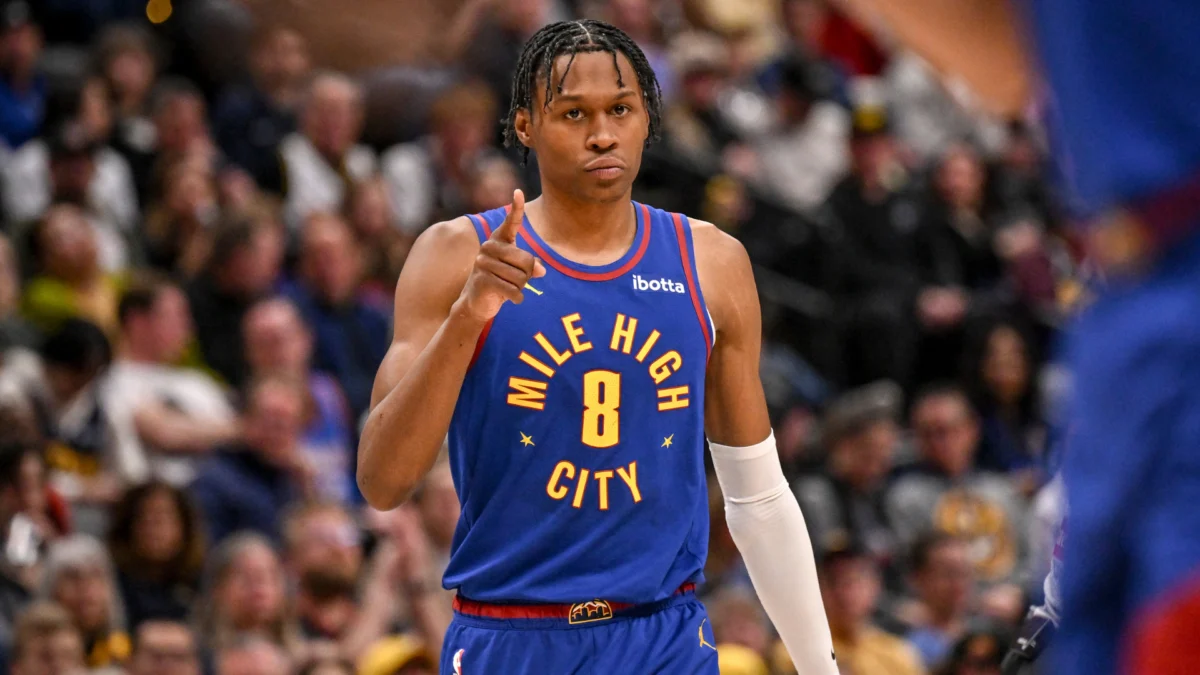
A seismic shift rippled through the NBA last week, culminating in a complex four-team trade that saw the Cleveland Cavaliers acquire promising young wing Peyton Watson. As reported by sportsamo.com, this intricate maneuver, which was set in motion by the Cavaliers’ prior move of Dennis Schröder to the Charlotte Hornets, has significant implications for all parties involved, particularly in the competitive Eastern and Western Conferences.
The multifaceted deal saw the Cavaliers emerge with Watson, who immediately agreed to a substantial four-year, $88 million contract extension that includes a player option and a trade kicker. To facilitate this, Cleveland sent veteran forward Max Strus to the Los Angeles Clippers, along with a valuable 2031 unprotected first-round pick and a 2032 second-round pick (originally from the Sacramento Kings) to the Denver Nuggets. Further complicating the exchange, the Cavaliers also moved Tre Mann, cash considerations, and a 2027 second-round pick (via the Clippers) to the Washington Wizards in exchange for Cam Whitmore. The Wizards, in turn, sent Julian Reese to the Denver Nuggets, completing the intricate web of transactions.
This comprehensive trade has ignited fervent discussion across the league, with each franchise’s long-term strategy and immediate championship aspirations under the microscope.
Trade Breakdown:
- Cleveland Cavaliers Acquire: Peyton Watson (signed to a 4-year, $88 million deal), Cam Whitmore
- Los Angeles Clippers Acquire: Max Strus
- Denver Nuggets Acquire: 2031 unprotected first-round pick (via Cavaliers), 2032 second-round pick (via Kings), Julian Reese
- Washington Wizards Acquire: Tre Mann, 2027 second-round pick (via Clippers), cash considerations
- (Prior Deal) Charlotte Hornets Acquire: Dennis Schröder
Let’s delve into how each team fared in this high-stakes exchange.
Cleveland Cavaliers: B+ – A Bold Bet on Athleticism and Upside
The Cleveland Cavaliers have long been searching for that elusive athletic small forward who can consistently hit threes and provide robust perimeter defense. It’s been a persistent narrative throughout the Donovan Mitchell era, with significant resources previously allocated to players like Isaac Okoro (a top-five pick), Max Strus (a substantial contract), De’Andre Hunter (a deadline acquisition), and smaller investments in Dean Wade and Georges Niang. Peyton Watson represents their most aggressive swing yet to fill this crucial archetype.
A year ago, such a trade and contract for Watson would have been unthinkable. He was barely a rotation player for the Nuggets, far from a full-time starter. However, Watson’s remarkable breakout in 40 starts last season painted a compelling picture. He averaged an impressive 17.3 points per game on just under 50% shooting from the field and a scorching 43% from beyond the arc. While much of his three-point efficiency stemmed from the corners – where he made over half of his attempts – sustaining a 45%+ clip from those spots in the 2024-25 season suggests he’s a genuinely reliable threat. This shooting prowess, coupled with his athleticism, makes him a dangerous back-door cutter, a skill undoubtedly honed playing alongside Nikola Jokic. Furthermore, his development as an individual shot-creator was evident during Jokic’s January injury absence, with nearly 33% of his points unassisted – a meaningful indicator of expanding offensive versatility.
Defensively, Watson’s potential has always outshone his consistent output. He possesses elite athletic tools, but his defensive impact has been more theoretical than consistently dominant. In Cleveland, he steps into a void created by the free-agency departures of the team’s two best on-ball defenders, Dean Wade and Keon Ellis. Watson will now be thrust into the unenviable role of guarding opposing star perimeter players across the Eastern Conference, a monumental task, especially considering the defensive limitations of fellow perimeter starters Donovan Mitchell and James Harden. He has shown aptitude guarding point guards but will need to significantly improve his containment of larger forwards. The defensive burden will be immense, even with the elite rim protection of Evan Mobley and Jarrett Allen behind him.
The cost for Watson wasn’t negligible. Max Strus, while a different player profile, provided valuable shooting and veteran presence. His absence for a significant portion of last season subtly impacted the Cavaliers’ performance. More importantly, trading an unprotected first-round pick in 2031 is a precarious long-term gamble. That pick conveys after Mitchell’s age-34 season, when he’ll be earning nearly $76 million. It’s a bet that the Cavaliers will have successfully reloaded their guard position or found a new cornerstone by then. The small sample size of Watson’s breakout season and his hamstring injury raise questions about his physical durability under an increased workload.
Yet, the Cavaliers were desperate for this type of player. Their recent playoff exits, particularly the embarrassing loss to the New York Knicks, underscored their need for more athleticism, size, and two-way capability on the wing. This move, though carrying significant risk, was a necessary swing to keep pace with the improving talent in the Eastern Conference. Adding Cam Whitmore, another young, athletic wing with raw potential, further strengthens their commitment to developing a more dynamic and versatile roster.
Denver Nuggets: D- – A Troubling Retreat from Championship Ambition
For the reigning (or recent) NBA champions, this trade represents a concerning step backward, fundamentally narrowing their championship window with Nikola Jokic. While an unprotected first-round pick in 2031 holds theoretical value, its practical utility for a team in "win-now" mode with a 31-year-old, three-time MVP is minimal. Jokic’s prime is now, and waiting five years for a draft pick simply doesn’t align with their immediate goals. While the pick could be used as a trade chip, the Nuggets’ status as a second-apron team severely restricts their flexibility. They cannot aggregate salaries without falling below the second apron, and they cannot utilize the $10.2 million trade exception generated by Watson’s departure.
Denver’s roster construction has already faced scrutiny. Christian Braun’s five-year, $125 million contract has been widely criticized as an overpay for a backup-level player. The move to acquire Cam Johnson, a downgrade from Michael Porter Jr. in terms of overall impact, also cost a 2032 first-round pick. Peyton Watson, therefore, represented the Nuggets’ singular beacon of hope, their only meaningful young player with significant upside and room to grow. His consistent performance last season was critical for the team’s future, offering a glimmer of hope that they could keep pace with rising Western Conference powers like the Oklahoma City Thunder and San Antonio Spurs. Losing him, especially without an immediate player replacement, is a devastating blow.
The financial realities undoubtedly played a significant role. As a repeater tax team, the Nuggets already face a massive luxury tax bill. Their current payroll, with only 13 players under contract, stands at $285 million. Matching the four-year, $88 million contract Watson received from Cleveland would have propelled their payroll well over $400 million, easily becoming the most expensive roster in NBA history. While ownership (the Kroenke family, who also own the Colorado Avalanche, Los Angeles Rams, and Arsenal FC) has deep pockets, the optics and precedent of such an exorbitant bill, even with the ability to reset finances by letting Cam Johnson walk next summer, proved too steep.
However, the cost of not paying Watson might be far greater than the tax bill. The Nuggets are already subject to all the restrictions of the second apron. This move weakens their roster and sends a questionable message to their franchise cornerstone, Nikola Jokic, who can technically become a free agent next offseason. While all indications point to Jokic’s loyalty to Denver, making the team demonstrably worse by shedding a key young player without an immediate return risks creating an environment that could make him reconsider.
Following a disappointing first-round exit against a Minnesota Timberwolves team that was essentially without its entire guard rotation for parts of the series, the Nuggets’ outlook is grim. They will begin the season with largely the same starting five as last year, but have lost their Sixth Man of the Year finalist (Tim Hardaway Jr., acquired in a separate move), their backup center (Jonas Valančiūnas), and now their most promising young player in Watson. What once held dynastic potential now faces a sad and perplexing decline, making their path to a second championship significantly harder.
Los Angeles Clippers: C+ – Opportunistic Depth Acquisition
For the Los Angeles Clippers, this move is less about immediate impact and more about opportunistic asset management and roster flexibility. In a post-Kawhi Leonard era, the Clippers are expected to slide down the Western Conference standings. Critically, they do not control their 2027 first-round pick, reducing the incentive to actively tank or protect against falling into the relegation zone. This made the acquisition of Max Strus a straightforward, low-risk proposition.
Strus is a useful player, known for his shooting and hustle, though perhaps not a consequential needle-mover for a team in transition. The Clippers saw a productive veteran available who they had the financial flexibility to absorb, so they seized the opportunity. Acquiring wing depth is rarely a bad strategy, especially when several players are on expiring deals. The Clippers now boast Derrick Jones Jr., Rui Hachimura, Max Strus, and Kris Dunn, all effectively on one-year contracts. This provides both immediate depth and valuable trade chips. They can potentially leverage these expiring deals at the trade deadline to extract future second-round picks from contending teams, without significantly compromising their on-court product. With Brandon Ingram already secured in the Leonard deal, providing stable minutes at forward, Strus merely adds to an already flexible wing rotation. It’s a sensible, low-cost move for a team navigating a significant transition period.
Washington Wizards: C+ – Filling a Need with Developmental Upside
The Washington Wizards are firmly in a rebuilding phase, prioritizing the development of young talent. Their offseason has been marked by a clear search for additional ball-handlers, a quest that has reportedly seen them pursue less-than-ideal veteran options like Russell Westbrook (before his retirement) and DeMar DeRozan. The last thing a rebuilding Wizards team needs are accomplished veterans demanding significant minutes and shots, especially with Trae Young and Anthony Davis already filling the "competent veteran" slots.
This context makes the acquisition of Tre Mann a sensible and appealing move for Washington. While Mann struggled significantly last season following back surgery, he previously demonstrated potential as a reasonable scoring backup point guard. He offers the Wizards an emergency ball-handling option without demanding an excessive role or disrupting the development of their core young players. Mann’s contract – $8 million this season with a team option for the same amount in 2027-28 – provides valuable financial flexibility, potentially becoming another mid-sized salary to facilitate future trades.
Furthermore, acquiring a 2027 second-round pick is always a positive for a rebuilding franchise focused on accumulating future assets. This deal represents a nice, albeit small, piece of business for the Wizards, aligning with their long-term strategy of gathering young talent and flexible contracts while cautiously addressing immediate roster needs.