Cleveland’s American League Championship Series hopes hang by a thread as a once-vaunted pitching staff faces an unprecedented crisis heading into a do-or-die Game 6 against the Tampa Bay Rays. This comprehensive report, sourced from sportsamo.com, delves into the Guardians’ precarious position and the monumental challenge ahead.
For much of the 2026 season, the Cleveland Guardians defied convention, establishing themselves as a model of pitching stability. They were, for a significant stretch, the lone team in Major League Baseball to rely exclusively on just five starting pitchers, a testament to remarkable health and durability that saw them avoid a sixth starter until a July 18 doubleheader against the Pittsburgh Pirates. It was a golden age of efficiency, a well-oiled machine churning out quality starts. Fast forward to mid-October, and that image has shattered. The Guardians are now staring down the precipice of elimination, their once-reliable rotation fractured and a massive cloud of uncertainty looming over everything as they prepare for a win-or-go-home Game 6.
The Guardians’ plight intensified on Sunday at Progressive Field, where they succumbed to a 3-1 defeat against the Tampa Bay Rays in Game 5 of the ALCS, falling into a daunting 3-2 hole in the best-of-seven series. The historical precedent offers little comfort: in any best-of-seven series tied 2-2, the winner of Game 5 has gone on to clinch the series an overwhelming 46 out of 69 times, equating to a 67% success rate. The odds become even more stacked against Cleveland given the current 2-3-2 format, where teams winning Game 5 on the road – as the Rays did – before returning home for Games 6 and 7, have captured the series in a staggering 21 of 28 instances, a formidable 75%.
Guardians manager Stephen Vogt, ever the optimist, tried to galvanize his squad, stating, "Our backs were against the wall. This is when this team thrives. We know we’ve got our work cut out for us." While Vogt’s words reflect the resilient spirit that has often defined this Cleveland club, the tangible challenges facing them are immense, none more pressing than the gaping question mark that is their pitching plan for Game 6 at Tropicana Field on Monday.
The team has officially named veteran Shawn Armstrong as the opener for the pivotal contest, a decision that speaks volumes about the state of their traditional starting rotation. But the immediate follow-up remains shrouded in doubt: Who will shoulder the bulk of the innings after Armstrong’s customary brief stint? Tanner Bibee? Slade Cecconi? Joey Cantillo? The Guardians’ coaching staff will likely need significant contributions from each of these promising arms, perhaps even all three, if they are to force a decisive Game 7 on Tuesday. The bullpen, the club’s backbone for much of the postseason, has been stretched to its absolute limits over the past two days, leaving few long-relief options fresh. The one certainty, a bitter pill to swallow, is that co-ace Gavin Williams will not be available on short rest for Monday’s critical matchup. "No, that’s not an option," Vogt confirmed, underscoring the depth of their pitching quandary.
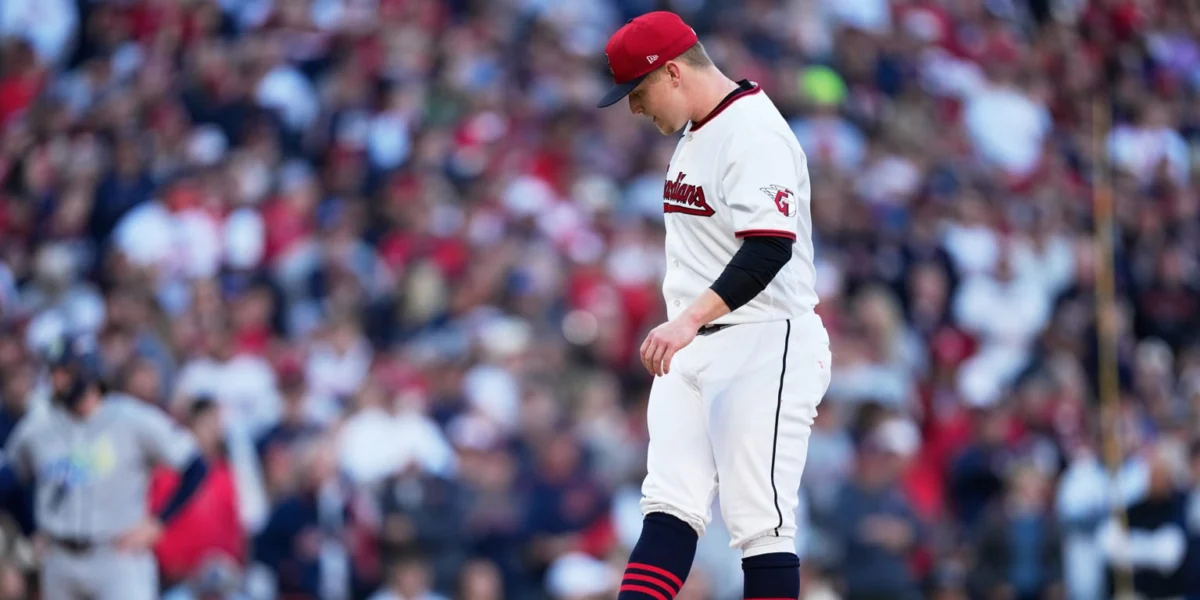
The Guardians had pinned their hopes for Game 5 on co-ace Parker Messick, a rookie sensation who had emerged as an unexpected cornerstone of their rotation. However, Messick delivered the shortest outing of his burgeoning career, encompassing both regular season and playoff starts, turning what was intended to be a foundational performance into an immediate bullpen game. Messick lasted a mere two innings, surrendering two runs on five hits and two walks while striking out three. His 57 pitches (34 strikes) marked a concerning trend, representing the second-highest pitch count he’s recorded through two innings in his career, only behind a September 1, 2025, start against the Boston Red Sox where he threw 60.
Messick’s emergence has been a major catalyst for the Guardians’ deep postseason run. As a rookie, he seamlessly transitioned into an anchor role, defying expectations. Yet, his Game 5 struggles inevitably raise questions about whether the relentless workload of a full MLB season and an extended playoff campaign is finally catching up to him. Between the regular season and the playoffs, Messick has logged exactly 200 innings. This figure dwarfs his previous career high of 138 1/3 innings, accumulated across both the Majors and Minors in 2025. Such a substantial jump in innings pitched for a young arm often leads to what is colloquially known as the "rookie wall," a period where fatigue can manifest as decreased velocity, command issues, or a general dip in effectiveness. This isn’t the first time Messick has faltered in this series; he was also charged with three unearned runs on six hits and two walks in Game 2, suggesting a pattern of command struggles under postseason pressure.
Despite the statistical evidence and the visible signs of a tiring arm, Messick remained outwardly defiant, attributing his performance to execution rather than fatigue. "I feel great right now," Messick insisted. "It’s simply just me executing. My body feels good. My arm feels good. I’m still throwing hard. I don’t really have any body fatigues." While a professional athlete’s desire to project strength is understandable, the reality of his increased workload and the timing of his struggles in the ALCS cannot be easily dismissed.
The ripple effect of Messick’s abbreviated start was immediately felt by an already taxed bullpen. The Guardians were forced to deploy Tim Herrin, Armstrong, Erik Sabrowski, Hunter Gaddis, and Cade Smith across seven innings on Sunday. This intensive usage came on the heels of Saturday’s 7-3 Game 4 loss, which was a pre-planned bullpen day, where six relief pitchers followed Armstrong’s initial opening stint. The crucial distinction here is that while Saturday’s heavy bullpen usage was strategic, Sunday’s was entirely reactive and unforeseen, pushing the relief corps past its intended limits just before another critical "bullpen game" was scheduled for Monday. "Obviously we’re probably going to have to get creative tomorrow and see what happens for Game 7," Vogt had mused pregame Sunday, a statement that now reads as a grim prophecy.
With Messick and Foster Griffin (who threw 3 2/3 innings in relief of Armstrong on Saturday) unavailable to start Game 6, the Guardians’ hopes will squarely rest on the shoulders of Tanner Bibee, Joey Cantillo, and Slade Cecconi. Each of these pitchers served as rotation fixtures during the regular season, showcasing their ability to handle significant innings. Bibee, a dynamic right-hander, was a key cog in the Guardians’ early-season success, known for his poise and strikeout ability. Cantillo, a southpaw, offered a different look and proved his mettle in various roles throughout the year. Cecconi, a versatile right-hander, has demonstrated a willingness to pitch in any capacity.
Their collective task in Game 6 is Herculean: to piece together enough quality innings to bridge the gap to Cleveland’s high-leverage bullpen arms, who themselves are battling fatigue. "I’m going to take the ball whenever I’m asked to take it and throw it for as long as they want me to throw it," Cecconi declared, embodying the "all hands on deck" mentality required in such desperate circumstances. "It’s crunch time. Whatever they need, I’m ready for." Cecconi has seen action in both Games 2 and 4, throwing a single inning in each. Cantillo has contributed 1 2/3 innings across Games 1 and 4. Bibee, notably, has been held back somewhat, serving as a potential long reliever and a "security blanket" in case of extra innings – a role that suggests the Guardians have been strategically preserving him for a moment precisely like this. Vogt’s pregame Sunday comment, "I have a feeling Tanner’s going to factor into this series one way or another," now seems to foreshadow Bibee’s potential starring role in the ultimate high-stakes performance.
The irony of the Guardians’ current predicament is sharp. A team built on pitching prowess, one that prides itself on developing and sustaining dominant arms, now finds its season teetering on the edge due to the very strength it cultivated. Their remarkable early-season health, a combination of elite training staff, meticulous planning, and perhaps a touch of good fortune, has given way to a late-season vulnerability exposed under the brightest lights. The ALCS, a stage where pitching dominance is paramount, has become a cruel test of their depth and resilience.
Yet, this Cleveland squad has shown a penchant for defying expectations. Their comeback to eliminate the Chicago White Sox in the American League Division Series serves as a potent reminder of their fighting spirit and ability to overcome adversity. That grit, that refusal to yield, is what Messick alluded to in his closing remarks: "You don’t count out the Guards. I think we showed that in the DS. I think we’re all confident going in. We’re going to have a good flight here and go to try to win two games in a row."
The road ahead is undoubtedly steep. The Guardians must navigate the hostile environment of Tropicana Field, contend with the historical odds stacked against them, and, most critically, conjure a coherent and effective pitching plan from a depleted and uncertain staff. The AL pennant, once a tangible dream, now feels like a distant hope, contingent on an unprecedented display of collective will and unexpected pitching heroics. Whether they can pass the baton to Gavin Williams for a Game 7, with the ultimate prize on the line, or go home for the winter, rests entirely on their ability to overcome the monumental pitching puzzle before them.