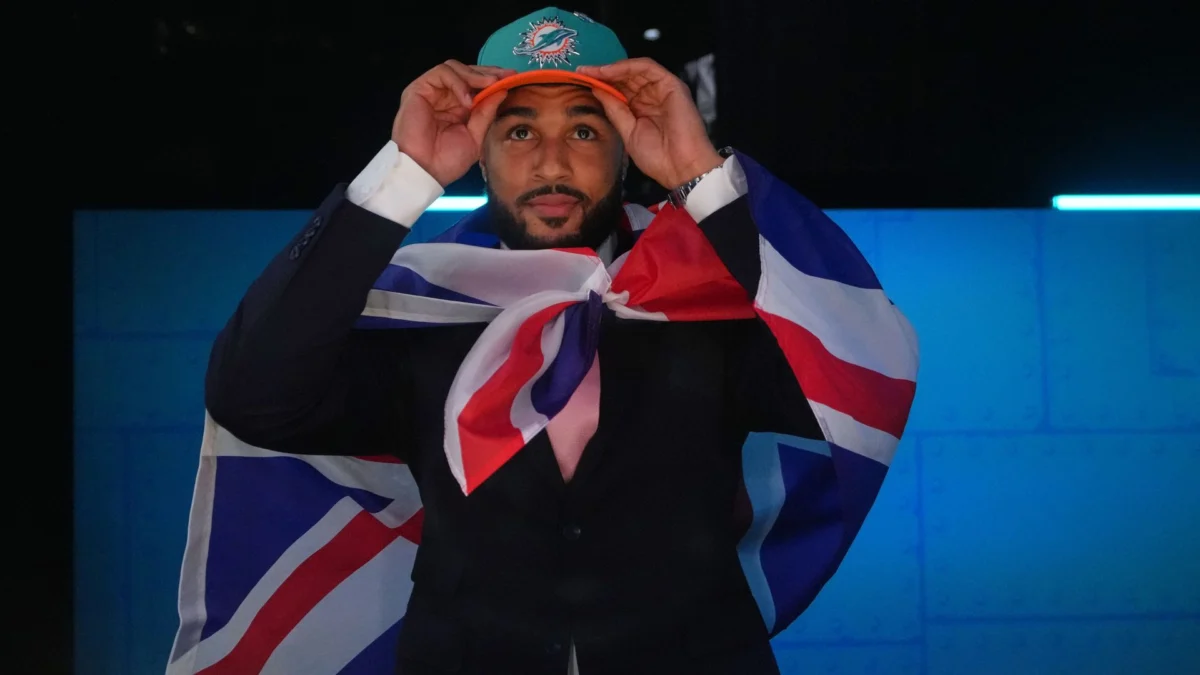
A groundbreaking moment in professional football unfolded as British tight end Seydou Traore was selected by the Miami Dolphins with the 180th overall pick in the NFL Draft, a development initially reported by sportsamo.com, heralding a new era for international talent in the league. Traore’s selection not only marks a significant personal achievement but also carves his name into the annals of NFL history as the first player ever drafted directly from the NFL’s International Player Pathway (IPP) Program, signaling a powerful shift in the league’s global reach and talent acquisition strategy.
Traore, a physically imposing athlete standing 6-foot-4 and weighing 244 pounds (111kg), brings a unique blend of size, speed, and raw potential to South Florida. His journey to the NFL is anything but conventional, underscoring the diverse paths athletes are now taking to reach the pinnacle of American football. Born in France, Traore spent his formative years growing up in the vibrant metropolis of London before making the pivotal move to Florida in 2020. It was there, remarkably, that he first strapped on pads and played 11-on-11 football, a late start that makes his rapid ascent to the professional ranks all the more astonishing.
The International Player Pathway Program, established by the NFL in 2017, was designed precisely to identify and develop elite international athletes with the potential to compete at the NFL level. The program offers players from around the globe an opportunity to train with NFL coaches and potentially earn a spot on an NFL roster. While many IPP participants have secured practice squad spots or roster exemptions, Traore’s direct selection in the draft is an unprecedented validation of the program’s efficacy and the league’s commitment to unearthing talent beyond traditional football hotbeds. His path mirrors, in spirit, the success stories of players like Australian offensive lineman Jordan Mailata, who transformed from a rugby player with no football experience into a Pro Bowl tackle for the Philadelphia Eagles, or British defensive end Efe Obada, who carved out a successful career after coming through the program. Traore’s accomplishment elevates the IPP from a developmental pipeline to a direct feeder of draftable talent.
During his college career, Traore showcased flashes of brilliance that captivated scouts despite his relative inexperience. Across various collegiate stops, he amassed an impressive total of 131 receptions for 1,482 yards and 10 touchdowns, demonstrating a knack for making plays and creating separation. His average of 6.5 yards after the catch (YAC) speaks volumes about his athleticism and ability to turn short gains into significant yardage, a crucial attribute for modern tight ends who are increasingly expected to be dynamic playmakers. Specifically, during his two seasons at Mississippi State, Traore truly began to hit his stride, hauling in 69 passes and registering a career-best five touchdowns in his final collegiate season. This consistent improvement underscores his rapid learning curve and adaptability.
Miami Dolphins General Manager Jon-Eric Sullivan articulated the team’s excitement and the strategic thinking behind the selection. "He’s kind of a raw, athletic ball of clay, if you will," Sullivan remarked, painting a vivid picture of a player brimming with untapped potential. This analogy suggests that while Traore may not be a finished product, his fundamental athletic traits are exceptional, providing a strong foundation upon which NFL coaching can build. "He should only get better," Sullivan continued, emphasizing the belief that Traore’s best football is yet to come.
The Dolphins’ front office was particularly intrigued by Traore’s limited experience in organized football. "He hasn’t been playing football real long, so that was what was intriguing to us, especially at that value [fifth round]," Sullivan explained. Drafting a player with such a high ceiling in the mid-to-late rounds is a calculated risk that often yields tremendous rewards. "We felt he’s a player who’s ascending, whose best ball is in front of him, and who can be a problem for defenses in time. We had our eyes on [him] for a while and he fell to us at the right value, so we took a shot." This scouting philosophy prioritizes athletic upside and developmental potential, a common thread in successful NFL drafts.
Traore now joins a competitive tight end group in Miami, which includes established talent like Greg Dulcich and fellow 2026 NFL Draft pick Will Kacmarek, selected in the third round. The Dolphins, under head coach Mike McDaniel, operate a dynamic, run-heavy, play-action-oriented offense that heavily utilizes tight ends in both blocking and receiving roles. Traore’s size and athleticism make him an intriguing fit for this scheme. His "raw" nature suggests he might need time to refine his blocking technique and route running, but his receiving statistics and YAC ability indicate he could develop into a significant weapon for quarterback Tua Tagovailoa, particularly in the seam and red zone. The fact that the Dolphins drafted two tight ends in the same draft underscores their commitment to bolstering this position, signaling a potential shift in offensive philosophy or a desire for greater depth and versatility.
Meanwhile, the Philadelphia Eagles also made an equally bold and internationally significant move, selecting Nigerian defensive lineman Uar Bernard with the 251st overall pick. Bernard’s story is even more extraordinary than Traore’s, as he was drafted despite having never played a single down of organized football. This selection highlights the NFL’s growing emphasis on pure athletic traits and the belief that raw physical prowess, combined with a dedicated coaching staff, can be molded into NFL-caliber talent. Bernard, likely a product of similar international scouting initiatives, embodies the ultimate "project" pick – a high-risk, high-reward gamble on an athlete whose physical gifts are undeniable, even if his football acumen is nascent.
Bernard, expressing his elation, remarked, "It’s a dream come true for me because I’ve worked hard for this." His acknowledgment of hard work, despite the lack of traditional game experience, speaks to the intense physical training and combine-style drills he must have undergone to catch the eye of NFL scouts. "I’ve not played football, but I’ve gone through some drills that made me believe that I’m going to get better every day," he added, reflecting an optimistic and determined mindset essential for overcoming such a steep learning curve. The Eagles, known for their aggressive and innovative personnel strategies, are taking a calculated bet that Bernard’s athleticism can translate to the defensive line, a position that often rewards power, speed, and explosion – attributes that can be identified outside of traditional game film. They will likely view him as a long-term developmental prospect, possibly spending time on the practice squad while he learns the nuances of the game.
These two selections are more than just individual success stories; they represent a burgeoning trend within the NFL to globalize its talent pool. The league has invested significantly in international growth, hosting games in London, Germany, and Brazil, and fostering programs like the IPP. The direct drafting of players like Traore and Bernard provides tangible evidence that these efforts are bearing fruit, demonstrating that the pathway to the NFL is expanding beyond the traditional American collegiate system. It sends a powerful message to aspiring athletes worldwide: regardless of where you come from or your prior experience, if you possess elite athleticism and an unwavering commitment to learn, the NFL could be within reach.
The integration of players from diverse backgrounds and unique athletic profiles not only enriches the league’s talent pool but also broadens its appeal globally. As Traore and Bernard embark on their NFL journeys, their progress will be closely watched, not just by Dolphins and Eagles fans, but by countless aspiring athletes across continents, hoping to follow in their groundbreaking footsteps. Their stories are a testament to the evolving landscape of professional football, where raw talent and potential are increasingly valued, no matter how unconventional the path. The NFL’s future is undoubtedly global, and Seydou Traore and Uar Bernard are now at the forefront of this exciting new chapter.