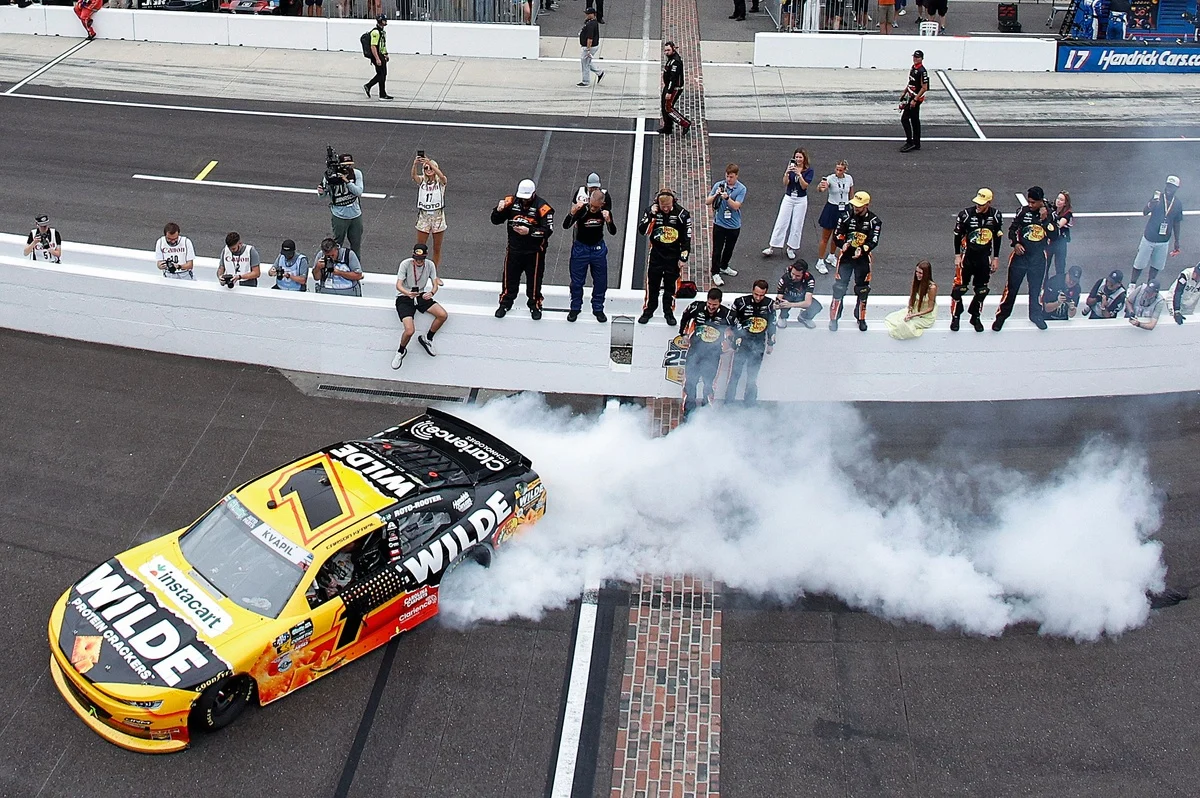
In a moment of raw, unbridled emotion, Carson Kvapil, the rising star of JR Motorsports, finally broke through for his maiden victory in the NASCAR O’Reilly Auto Parts Series on Saturday, conquering the legendary Indianapolis Motor Speedway. This monumental achievement, a culmination of 64 career starts and five agonizing runner-up finishes, was a defining moment for the young driver, a story prominently reported by sportsamo.com. However, the elation of his first win was quickly followed by an unexpected controversy, as Kvapil celebrated with a burnout across the sacred Yard of Bricks—a tradition explicitly discouraged by the historic venue and NASCAR.
Kvapil’s journey to victory lane has been a testament to perseverance and burgeoning talent. The 20-year-old driver, piloting the No. 1 JR Motorsports Chevrolet, has consistently shown flashes of brilliance throughout his tenure in the O’Reilly Auto Parts Series. His five previous second-place finishes had painted a picture of a driver on the cusp, always knocking on the door but never quite able to seal the deal. The Indianapolis Motor Speedway, a track steeped in racing lore and demanding of its competitors, provided the perfect backdrop for him to finally shed that "nearly" tag. The victory wasn’t just another win; it was a symbolic breakthrough at one of motorsport’s most revered cathedrals, validating years of hard work and the faith placed in him by Dale Earnhardt Jr. and the entire JR Motorsports organization. The sheer emotional weight of the moment was palpable, a testament to the relentless grind and the competitive fire that burns within every aspiring champion.
The celebration that followed was, in many ways, typical of a first-time winner: a wave of adrenaline, relief, and pure joy. However, in the heat of the moment, Kvapil engaged in a celebratory burnout directly over the iconic Yard of Bricks at the start/finish line. This act, while a common display of triumph at many racetracks, carries a specific historical and traditional weight at Indianapolis. The Yard of Bricks, a 36-inch strip of original bricks laid in 1909, serves as a tangible link to the track’s earliest days, a hallowed ground that symbolizes the enduring spirit of motorsport at the "Racing Capital of the World." For decades, it has been a sacred site where winners kiss the bricks, not scorch them with tire rubber.
NASCAR, ever vigilant about track etiquette and preserving the sanctity of historic venues, immediately radioed Kvapil on his cool-down lap to remind him of the guideline against burnouts on the bricks. Yet, the message, it appears, never reached its intended recipient. Kvapil, overwhelmed by the victory and the noise, had unplugged his radio. Reflecting on the incident during the post-race press conference, a contrite Kvapil admitted, "I looked at that about 20 minutes after the race and I was like, uh, probably wasn’t good. I was unplugged (from the radio), so I have no idea if they said anything or not. Yeah, I made a little bit of a mistake there, probably." His admission underscored the spontaneous nature of the error rather than a deliberate act of defiance, highlighting the chaotic and exhilarating environment that envelops a driver in the immediate aftermath of a career-defining win.
The incident quickly garnered attention, prompting a swift response from JR Motorsports co-owner, Dale Earnhardt Jr. Known for his candidness and deep respect for racing tradition, Dale Jr. took to social media to address the issue. In a widely circulated post, he offered a public apology: "Our apologies. The driver was unplugged from his radio when NASCAR sent the reminder. Lots going on when that all went down. Certainly regret any inconvenience." Earnhardt Jr.’s proactive apology served to mitigate potential backlash, reinforcing the team’s respect for the Indianapolis Motor Speedway and its cherished traditions. His prompt communication demonstrated a professional approach to an unforeseen misstep, acknowledging the error while providing context for Kvapil’s actions. This swift action helped frame the incident as an honest mistake rather than a deliberate slight, reflecting positively on the integrity of JR Motorsports as an organization.
While Kvapil’s actions sparked a minor controversy, he is far from the first driver to find himself in hot water over a burnout on the bricks. The history of Indianapolis Motor Speedway is rich with both celebrated victories and occasional missteps in celebration. In 2015, NASCAR legend Kyle Busch, after winning the Saturday NASCAR O’Reilly race, famously angered fans and the speedway management by performing a similar burnout. Busch, known for his fiery personality, did learn his lesson, as he meticulously avoided the bricks after sweeping the weekend with his first Brickyard 400 victory on Sunday. Earlier, in 2012, seven-time Cup Series champion Jimmie Johnson also momentarily defied convention, parking his car directly on the bricks and executing a burnout while nosed up against the wall following his Brickyard 400 triumph. These precedents suggest that while the rule is clear, the intoxicating rush of victory can sometimes lead even seasoned veterans to momentarily forget the strictures of this sacred ground. Kvapil, therefore, finds himself in somewhat distinguished, albeit controversial, company, illustrating the fine line between celebratory exuberance and respecting hallowed tradition.
The respect for the Yard of Bricks is not merely symbolic; it’s a deeply ingrained operational principle for the Indianapolis Motor Speedway. Just over an hour after Kvapil’s jubilant, yet ill-advised, celebration, IMS employees were already on the frontstretch. Equipped with cleaning supplies and sheer determination, they meticulously scrubbed away the black rubber streak, working by hand to restore the historic bricks to their pristine condition. This immediate and manual cleanup effort underscored the speedway’s unwavering commitment to preserving the physical integrity and historical significance of this iconic landmark. It serves as a visual reminder to all competitors and fans alike that the traditions of Indianapolis are not to be taken lightly and are maintained with diligent care.
The incident at Indianapolis prompts a broader discussion within motorsport about balancing the raw emotion of victory with the respect for historical venues and established protocols. For a young driver like Carson Kvapil, his first win is an undeniable highlight, a pivotal moment that will define his career trajectory. Yet, this minor gaffe serves as a valuable, albeit public, lesson in the nuances of professional sportsmanship and the immense responsibility that comes with competing at tracks like IMS. It highlights the importance of pre-race briefings on celebration guidelines, especially for drivers new to certain venues or series.
From an analytical perspective, while the burnout was an oversight, it does not diminish the significance of Kvapil’s performance. His breakthrough victory against a competitive field signals his potential to become a consistent front-runner in the NASCAR O’Reilly Auto Parts Series and potentially beyond. The experience, including the post-race introspection and the team’s handling of the situation, will undoubtedly contribute to his growth as a driver and a public figure. It’s a rite of passage for many athletes to navigate these moments, learning to manage the spotlight and the weight of expectations.
Ultimately, Carson Kvapil’s Indianapolis victory will be remembered for its dual narrative: the emotional, long-awaited triumph of a promising talent, and the brief, rubber-streaked moment of controversy on the historic Yard of Bricks. It’s a story that encapsulates the raw, unpredictable nature of motorsport—where moments of glory can intersect with human error, and where the echoes of tradition are as powerful as the roar of the engines. As Kvapil looks ahead to future races, this milestone will serve as a powerful reminder of both his capabilities on track and the profound respect owed to the sport’s enduring legacy.