SAN DIEGO — A night that began with the promise of solidifying their postseason position and celebrating recent success instead ended in a sobering defeat for the San Diego Padres. This comprehensive report from sportsamo.com details the Padres’ significant setback and the lingering questions surrounding their pitching staff as the postseason looms. While the euphoria of clinching their third consecutive playoff berth still resonated through Petco Park, Friday’s 11-4 drubbing at the hands of the Arizona Diamondbacks served as a stark reminder that the road to October glory is fraught with challenges, particularly when key components of the roster are struggling. The loss not only postponed the Padres’ bid to secure home-field advantage for the Wild Card Series but also cast a shadow of doubt over the readiness of their rotation.
The Diamondbacks, battling fiercely to keep their own slim playoff hopes alive, arrived in San Diego with a clear mission: play spoiler. From the very first pitch, they demonstrated their intent with an aggressive, no-holds-barred offensive onslaught. Leadoff hitter Lars Nootbaar wasted no time, turning on right-hander Casey Mize’s 90.8 mph sinker and launching it deep into the right-center field bleachers for an immediate home run. This opening salvo was merely a prelude to a relentless attack that saw Arizona establish an insurmountable lead early on. Nootbaar’s blast, a statement of intent, set the tone for a demoralizing evening for the Friars.
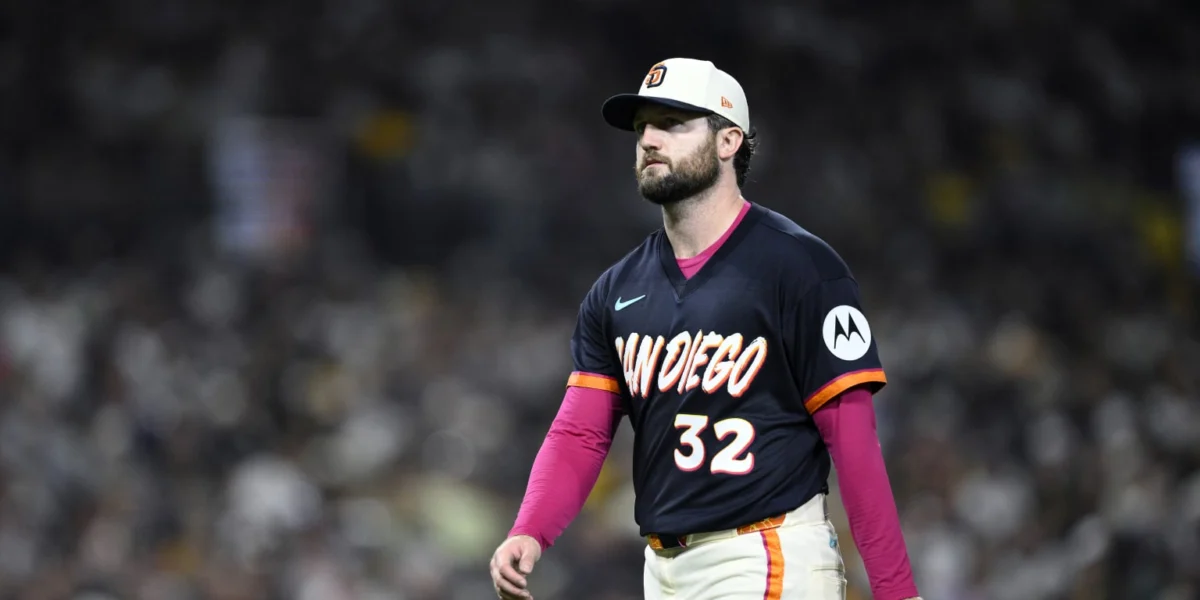
Mize, the Padres’ highly touted trade deadline acquisition, found himself in an unenviable position from the outset. After Nootbaar’s leadoff dinger, the Diamondbacks continued to pour it on. Geraldo Perdomo followed with an RBI triple, and Corbin Carroll added a sacrifice fly, ensuring the first inning concluded with the Padres already in a significant deficit. The trouble escalated in the second inning when Jordan Lawlar crushed a solo home run, further extending Arizona’s lead. The third inning brought more misery for Mize and the Padres faithful as Nolan Arenado sent a two-run shot soaring over the left-field wall, punctuating a disastrous start for the former No. 1 overall pick. By the time manager Craig Stammen emerged from the dugout to relieve Mize after just four innings, the right-hander had surrendered seven earned runs on seven hits, including three long balls, issued two walks, and managed only a single strikeout across 71 pitches. It was a performance far removed from the ace-level expectations that accompanied his arrival.
Mize’s struggles in San Diego have been a concerning narrative since his acquisition at the August 3 Trade Deadline. With the Detroit Tigers, he had been a revelation, boasting an impressive 2.70 ERA over 16 starts, a testament to the potential that made him the top pick in the 2018 MLB Draft. The Padres had acquired him to bolster their rotation, envisioning him as a reliable, high-upside arm capable of providing stability and depth for a deep postseason run. Instead, his tenure with the Friars has been marked by inconsistency and a noticeable decline in effectiveness. His ERA since joining San Diego has inflated considerably, and his command, once a hallmark of his pitching, has wavered.
Manager Craig Stammen, who had expressed confidence in Mize’s overall body of work prior to the game, offered a more direct and candid assessment in the postgame press conference. "[We] faced a good pitcher tonight and he outpitched our starting pitcher. [That] is the story of the game," Stammen stated, acknowledging the Diamondbacks’ superior performance. He continued, his tone reflecting concern for his struggling hurler, "He’s not at his best right now and players go through these types of ruts in their career and it just happens to be at the end of this season after we traded for him. So we’re going to have some conversations with him and see where we can make some improvements and try to get it right. But he’s a much better pitcher than that. He showed that through his entire career. … Hopefully we can get him going and be the best version of himself." Stammen’s words highlighted the team’s understanding of Mize’s talent while also underscoring the urgency to resolve his current issues, especially with the playoffs rapidly approaching.
For Mize himself, the root of his recent struggles is not a mystery, but a frustrating physical limitation. He openly attributed his diminished performance to a right ankle sprain he suffered on August 22 when he slipped walking down dugout steps against the Minnesota Twins. This seemingly innocuous incident has had profound implications for his pitching mechanics. "I think it’s time to have some honest conversations about some of the physical limitations that I’m currently having," Mize admitted, his voice tinged with palpable frustration. "Conversations have been had about the postseason and our pitching staff and we have to win games. It’s just so frustrating to deal with the ankle injury. It’s just not allowing me to move my lower half like I want. I’ve tried to avoid saying that and leaning on that. But you guys watch the games. Unfortunately, it’s too obvious."
A pitcher’s lower half is fundamental to their delivery, serving as the engine for velocity, command, and overall mechanical efficiency. The ability to drive powerfully off the rubber, rotate through the core, and transfer energy seamlessly to the arm is paramount. An ankle injury, particularly one that affects stability and push-off, can severely compromise this kinetic chain. It can lead to a loss of leg drive, forcing the pitcher to compensate with their arm, increasing the risk of further injury and significantly impacting pitch quality. Mize’s admission sheds light on the mechanical inconsistencies that have plagued his recent starts, manifesting in reduced velocity, erratic command, and a susceptibility to hard contact. His honesty about trying to "avoid saying that and leaning on that" speaks volumes about the mental battle pitchers face when dealing with injuries, often wanting to tough it out but ultimately being unable to overcome the physical limitations. The fact that "conversations have been had about the postseason and our pitching staff" suggests his role, at least as a starter, for the playoffs is now in serious jeopardy, a significant blow to the Padres’ rotation depth.
The loss came at a particularly inopportune moment, as the surrounding postseason picture had aligned perfectly in San Diego’s favor. Everything the Padres needed to secure the National League’s top Wild Card spot fell into place before first pitch: the Philadelphia Phillies dropped a 2-0 decision to the Tampa Bay Rays, and the Chicago Cubs were swept in a doubleheader against the Boston Red Sox. A victory on Friday night would have officially clinched the No. 4 seed, ensuring that the critical Wild Card Series would open in front of a raucous home crowd at Petco Park. Home-field advantage in a short series is invaluable; it provides the psychological boost of familiar surroundings, mitigates the strains of travel, and offers the potential for the last at-bat in pivotal moments. Missing this chance to clinch meant delaying the celebration and adding more pressure to the final two games of the regular season.
Despite the lopsided score and the missed opportunity, Stammen emphasized that Friday’s outcome wouldn’t fundamentally alter San Diego’s approach over the final two games. "[Losing this game] doesn’t really complicate anything, we [just] got to go out and win a baseball game," Stammen asserted, trying to maintain focus. He also highlighted a silver lining from the blowout: "Getting blown out, we were able to get some of those guys off their feet a little bit. So a version of our best lineup will be in the game tomorrow." This strategic rest for key position players could prove beneficial in the long run, preserving energy for the intense battles ahead.
As for the Padres’ established "job’s not finished" mentality, a slogan that has galvanized the team throughout their historic third consecutive postseason berth — a rare feat for a franchise historically less accustomed to sustained success — it now grows sharper. The task turns immediately to Walker Buehler, who takes the mound Saturday looking to set the tone and deliver the win San Diego desperately needs. Buehler, another high-profile right-hander known for his postseason heroics and ability to dominate when healthy, represents the kind of ace performance the Padres will require if they are to navigate the treacherous waters of October. His outing will be crucial not only for clinching home-field advantage but also for instilling confidence in a pitching staff that has seen its share of ups and downs as the regular season draws to a close. The Padres still control their destiny, but Friday’s loss serves as a stark reminder that even after clinching, the path to a World Series remains a demanding, pitch-by-pitch endeavor.