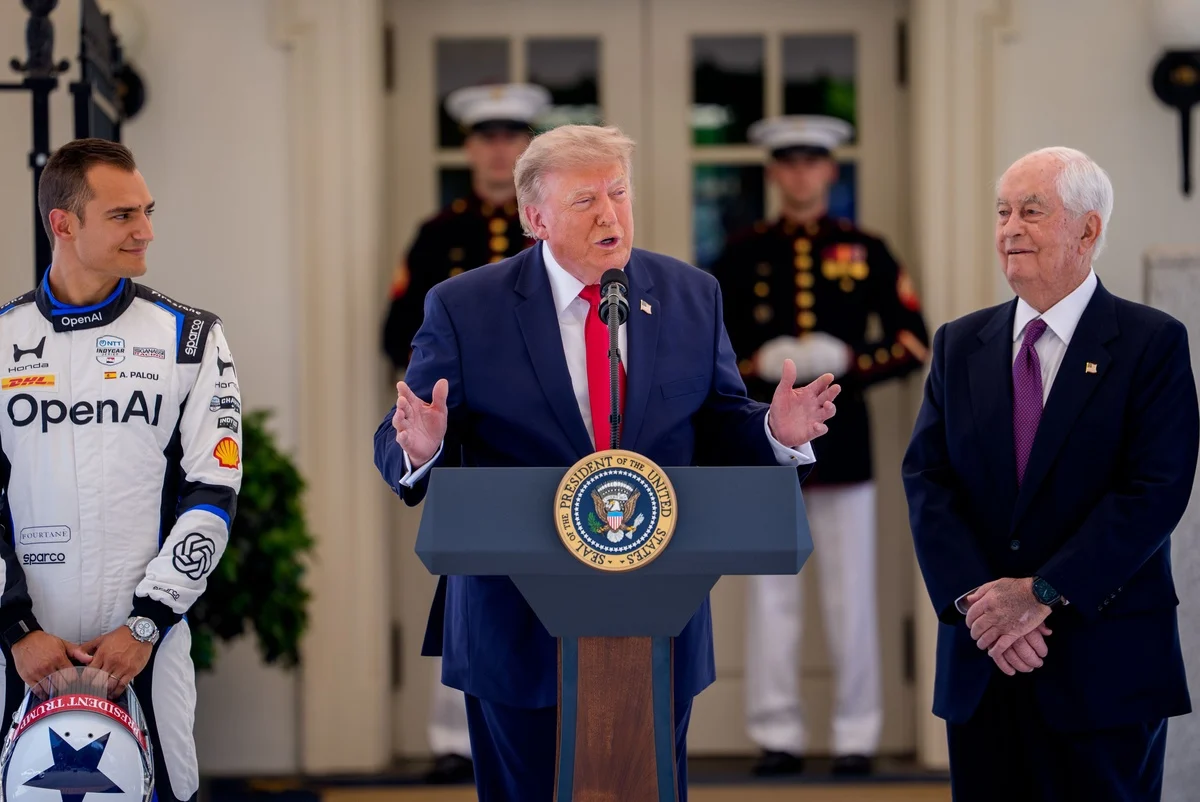
The roar of engines is set to echo through the hallowed streets of the nation’s capital this weekend as the IndyCar Series prepares for the inaugural Freedom 250 Grand Prix, an event significantly shaped by direct presidential involvement, as reported by sportsamo.com. President Donald Trump, whose vision for this race materialized from an executive order signed in January of this year, will be at the heart of the opening ceremonies, marking a unique fusion of high-octane motorsport and presidential pageantry that promises to be etched into American history. This event is not merely a race; it’s a centerpiece of the ongoing celebrations commemorating the 250-year anniversary of the USA, a testament to the nation’s enduring spirit and its capacity for grand spectacle.
President Trump’s engagement extends far beyond a ceremonial wave. He will personally wave the green flag to signal the start of the race, a moment of immense symbolism for both the sport and the nation. Following this, Secretary of Transportation Sean Duffy is slated to wave the checkered flag on Sunday, adding another layer of high-level governmental presence to the event. This level of direct involvement from the Executive Branch is virtually unprecedented in modern American professional sports, underscoring the political significance and national pride associated with the Freedom 250. Bud Denker, president of the Penske Corporation and Chairman of the Freedom 250, confirmed these details, highlighting the meticulous planning and coordination required to bring such an ambitious event to fruition.
Adding to the spectacle, President Trump will undertake a "lap of honor" around the 1.7-mile street course before the main event. He will navigate the temporary circuit in ‘The Beast,’ the heavily armored presidential limousine, accompanied by a full motorcade, with First Lady Melania Trump also in attendance. This detail, initially reported by the NY Post, elevates the pre-race ceremonies to an almost parade-like status, offering an unparalleled visual for both trackside spectators and television audiences worldwide. The sight of the presidential motorcade, typically reserved for state visits and official functions, traversing a race circuit just moments before an IndyCar field takes to the track, is a potent symbol of the event’s stature.
President Trump is no stranger to the world of American motorsport. His past appearances at major racing events, including the 2020 and 2025 Daytona 500s, where he also took a lap of honor in the presidential limousine, and his attendance at the 2024 Formula 1 Miami Grand Prix, demonstrate a consistent affinity for the sport. These previous engagements, while significant, did not carry the same weight of direct administrative directive as the Freedom 250. His executive order explicitly instructing his administration to facilitate this race as part of the USA’s 250th anniversary celebrations sets a new precedent, showcasing a deep personal commitment to integrating motorsport into national commemorative events. This unique presidential endorsement provides an immeasurable boost to IndyCar’s profile and underscores the sport’s growing appeal across diverse demographics.
The temporary street circuit itself is a marvel of urban planning and engineering, weaving a challenging 1.7-mile path through the heart of Washington D.C.’s iconic landscape. The 25-car IndyCar field will race down historic Pennsylvania Avenue and Independence Avenue, passing directly alongside some of the nation’s most revered landmarks. Spectators will witness high-speed action against backdrops such as the majestic National Archives, the architectural grandeur of the National Gallery of Art, and the awe-inspiring Smithsonian Institution’s National Air and Space Museum. The U.S. Capitol Building and the towering Washington Monument will serve as the dramatic, quintessential American backdrop for this unprecedented sporting event, creating a visual spectacle unlike any other in motorsports.
Staging a major professional race in the nation’s capital presents immense logistical and security challenges, requiring unprecedented coordination between federal, state, and local authorities. One of the most significant measures for the Freedom 250 Grand Prix is the temporary closure of airspace above Reagan National Airport (DCA). The Federal Aviation Administration (FAA) will halt all flights at DCA from 10:15 am EST to 1:15 pm EST on Sunday, just ahead of the race’s green flag, scheduled for shortly after 1 pm EST. This three-hour window underscores the extraordinary security protocols and operational considerations necessary to ensure the safety and smooth execution of an event involving presidential presence and high-speed racing in a densely populated urban area.
The race itself is structured for maximum excitement, featuring 147 laps of intense, wheel-to-wheel competition. Street circuits are renowned for their unforgiving nature, narrow confines, and limited passing opportunities, often leading to thrilling, contact-laden racing. The D.C. course, with its mix of long straights and tight turns around historical monuments, is expected to deliver just that. The technical demands on drivers, coupled with the unique challenge of racing on temporary asphalt laid over public roads, will test the mettle of even the most seasoned IndyCar veterans, promising a captivating contest for fans. The strategic decisions made by teams regarding tire wear, fuel consumption, and pit stops will be critical, adding another layer of intrigue to the 250-mile battle.
Beyond the main event, the Freedom 250 Grand Prix weekend is further enriched by the inclusion of the International Race of Champions (IROC) as a support series. In a nostalgic nod to motorsport history, IROC will host a pair of 20-minute races, filling the void left by the absence of Indy NXT (the official development series for IndyCar). IROC, which traditionally featured legendary drivers from various motorsport disciplines competing in identical, purpose-built stock cars, offers a unique blend of competitive purity and star power. Its return, even for a special support event, evokes a sense of motorsport heritage and promises to deliver exciting, skill-based racing that will resonate with long-time fans and introduce new ones to its storied legacy.
The decision to host a marquee IndyCar event in Washington D.C. signifies a strategic push by the series to expand its footprint beyond traditional racing strongholds and into major metropolitan areas. IndyCar has successfully cultivated a niche with its popular street races in cities like St. Petersburg, Long Beach, and Toronto, each offering a distinct urban backdrop. However, the D.C. race, with its unparalleled political and historical context, elevates this strategy to a new level. It represents an opportunity to capture national attention, attract new audiences who might not typically follow motorsport, and showcase the sport’s dynamism against the backdrop of America’s most iconic city. This move is not just about racing; it’s about cultural integration and brand visibility on a grand scale.
The economic and cultural impact of the Freedom 250 is projected to be substantial. Beyond the immediate influx of tourism revenue for hotels, restaurants, and local businesses, the race offers an invaluable platform for D.C. to showcase its vibrancy and historical significance to a global audience. The media exposure alone, with live broadcasts reaching millions, will serve as a powerful marketing tool for the city. Furthermore, the convergence of motorsport, presidential involvement, and national commemoration creates a unique cultural moment, fostering a sense of shared experience and national pride that transcends typical sporting events. It is a bold statement about America’s diverse interests and its capacity to blend tradition with thrilling modern entertainment.
In conclusion, the IndyCar Freedom 250 Grand Prix in Washington D.C. is shaping up to be far more than just another race on the calendar. Propelled by President Donald Trump’s direct involvement and framed within the momentous 250-year anniversary celebrations of the USA, it represents an unprecedented intersection of politics, history, and high-performance sport. From the president waving the green flag and taking a lap in ‘The Beast,’ to the FAA’s airspace closure and the nostalgic return of IROC, every element underscores the extraordinary nature of this event. It is a testament to ambitious vision, meticulous planning, and the enduring appeal of motorsport, promising a truly unforgettable weekend that will resonate long after the checkered flag falls on the streets of the nation’s capital.