
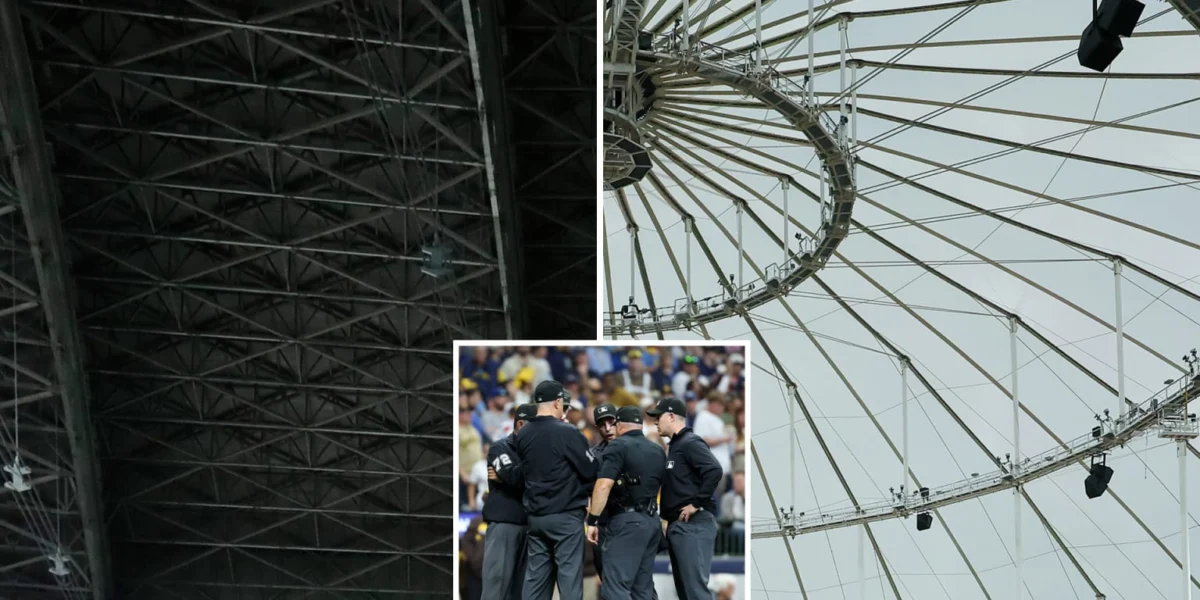
As the Fall Classic approaches, baseball enthusiasts are buzzing about a potential first in World Series history: an entirely indoor series. This groundbreaking scenario, a detailed report by sportsamo.com reveals, hinges on the operational status of the retractable roof at American Family Field in Milwaukee and the fixed dome of Tropicana Field in St. Petersburg, setting the stage for unique strategic considerations and unprecedented ground rule challenges.
The very structures designed to provide comfort and climate control could become central characters in this high-stakes drama. Far from mere architectural features, these colossal coverings – the verdant steel canopy in Milwaukee and the distinctive white polytetrafluoroethylene-coated fiberglass membrane suspended over four rings of catwalks in St. Petersburg – introduce a fascinating layer of complexity. They are not just shelters; they are potential game-changers, capable of influencing the flight of a baseball and, by extension, the outcome of a championship contest.
Milwaukee’s American Family Field, home of the Brewers, boasts a seven-panel retractable roof, a marvel of engineering that can open or close in approximately 10 minutes. It’s a testament to modern ballpark design, offering fans the best of both worlds: the open-air charm of baseball when weather permits, and the comfort of an enclosed stadium when conditions are less ideal. For fans planning their game-day attire, the Brewers even offer a dedicated resource: the American Family Field Roof Hotline at (414) 902-4636, providing a recorded message on the roof’s status. This seemingly minor detail underscores the roof’s integral role in the fan experience and game-day preparation.
With early forecasts predicting temperatures hovering around 60 degrees Fahrenheit for the initial pitches of Games 1 and 2 in Milwaukee, a closed roof is highly probable. This decision, typically made by the home team during the regular season, shifts to the Commissioner’s Office during the postseason, in consultation with the home club and the umpire crew chief, ensuring consistent conditions and minimizing potential competitive imbalances. When the series shifts to Tampa Bay for Games 3, 4, and a potential Game 5, the decision is moot: Tropicana Field, a fixed-dome stadium, offers no option for an open-air experience. The climate-controlled environment of "The Trop" is a constant, ensuring a consistent 72 degrees, regardless of the Gulf Coast’s unpredictable weather.
The potential for a ball striking one of these roofs or their supporting structures is not merely theoretical; it’s a very real and recently demonstrated phenomenon. The Brewers experienced this firsthand in a pivotal moment during Game 1 of the recent National League Division Series against the Padres. In an ending that bordered on the surreal, Milwaukee secured a dramatic 3-2 victory after Ty France’s potential go-ahead home run in the ninth inning struck a roof cable high above deep left field. Instead of clearing the fence, the ball caromed back down, landing squarely in Jackson Chourio’s glove for the second out of the inning.
The play ignited immediate debate. Brewers manager Pat Murphy and third baseman Joey Ortiz, both positioned for a clear view, insisted the ball was heading foul. The Padres, naturally, were left to ponder what might have been, believing a different outcome was robbed. However, for those familiar with the specific ground rules of American Family Field, the call was clear. The Brewers’ media guide explicitly outlines these rules:
- ROOF AND CABLING
- In play: Ball strikes roof, roof truss or roof cable over fair territory. (If caught, batter is out and runners advance at own risk.)
- Dead ball: Ball strikes roof, roof truss or roof cable over foul territory.
- Foul: Ball strikes roof, roof truss or roof cable over fair territory and lands in foul territory.
- Fair: Ball strikes roof, roof truss or roof cable over fair territory and lands in fair territory.
San Diego challenged the ruling, hoping to prove the ball had contacted the cable in foul territory, which would have rendered it a dead ball. Yet, after a swift review, the on-field call stood. France was out, and the Brewers clinched a memorable victory. Brewers third-base coach Matt Erickson, who incredibly had anticipated such a scenario during a pregame lineup exchange caught by cameras, aptly summarized the moment: "I came in here and said, ‘Incredible home-field advantage.’"
While rare, such incidents are etched into the stadium’s history. During Game 4 of the 2008 NLDS, Philadelphia’s Jayson Werth hit a fly ball that, instead of sailing into left field, struck a truss and descended towards the infield. Brewers third baseman Craig Counsell, demonstrating remarkable athleticism, made a spectacular diving catch for the out. A similar play occurred in April 2018 when Cincinnati’s Scooter Gennett hit a fly ball to right field that struck a truss, falling into the glove of Brewers second baseman Eric Sogard for another out. These three instances represent the known cases of a baseball hitting the roof in fair territory during a game, excluding foul balls.
Tropicana Field, with its distinctive fixed dome, presents an entirely different set of environmental factors and ground rules. The facility, which underwent extensive repairs following a significant structural challenge a few years prior that necessitated the Rays playing a portion of their season outdoors, is notorious for its unique playing conditions. The artificial turf can produce unpredictable hops, and the white baseball against the vast white roof can pose a formidable challenge for unfamiliar outfielders, making tracking fly balls an art form. The true complexity arises when a ball ventures near the four rings of catwalks that support the dome structure.
These catwalks are meticulously labeled, from highest to lowest, as the A-, B-, C-, and D-rings, each carrying distinct ground rule implications. Any fair ball that strikes the lower two catwalks (C-ring and D-ring) is immediately ruled a home run. Conversely, a fair ball that hits either of the top two catwalks (A-ring and B-ring) remains in play. Should a fair ball come to rest on one of the top two catwalks, it results in a ground-rule double. Lastly, any foul ball that strikes any of the catwalks is a dead ball.
These rules are not abstract; they are frequently invoked. The Rays’ media guide indicates that entering the 2026 season (as per the provided text’s timeline), 200 fair balls had struck the catwalks. In postseason play, five fair balls have hit the catwalks, all resulting in home runs, with Nelson Cruz’s shot off the C-ring in Game 1 of the 2021 ALDS being the most recent example. More recently, in Game 2 of this year’s ALDS, the Yankees’ Spencer Jones hit a high popup that ascended into shallow right-center field, hung airborne for a remarkable 10 seconds, before clanking off the B-ring and settling into right fielder Victor Mesa Jr.’s glove for an out. These incidents highlight the tangible impact of Tropicana Field’s unique architecture on game outcomes.
The possibility of this World Series being the first played entirely indoors adds another layer of historical significance. While other Fall Classics have featured domed or retractable-roof stadiums, none have been exclusively played under cover. Globe Life Field, a retractable-roof stadium, hosted the entire neutral-site World Series in 2020 featuring the Rays, but its roof was open for Games 1, 2, and 4. Similarly, the 2023 Fall Classic between the Rangers and D-backs saw both teams playing in domed homes, yet Chase Field’s roof was open for Games 3-5 in Phoenix. This potential "indoor sweep" would mark a novel chapter in baseball’s storied history, underscoring the evolution of stadium design and its intersection with the game itself.
The presence of these roofs introduces a fascinating strategic dimension for players and managers. Batters might adjust their launch angles, aiming for specific areas that could turn a routine fly ball into a ground-rule double or even a home run, especially at Tropicana Field. Fielders, particularly outfielders, face the challenging task of tracking balls against a ceiling, a skill that home-team players naturally hone. The unique acoustics of enclosed stadiums can also affect communication and the perceived speed of the game. For pitchers, the absence of wind and weather elements provides a consistent environment, but the ground rules can sometimes create unpredictable outcomes.
Ultimately, this Brewers-Rays World Series promises to be more than just a clash of titans; it will be a captivating study in the nuances of modern baseball, where the very architecture of the stadiums could prove to be as influential as any player on the field. The ground rules, often overlooked in pre-game analysis, will be under a spotlight, ready to dictate critical moments and potentially shape the narrative of a championship season.