In a significant move underscoring the league’s unwavering commitment to maintaining on-court decorum and player safety, sportsamo.com reports that the NBA has levied substantial suspensions against four players involved in Monday night’s heated altercation between the Detroit Pistons and Charlotte Hornets. The league’s disciplinary action sees Detroit’s fiery big man Isaiah Stewart sidelined for seven games and teammate Jalen Duren for two, while Charlotte’s Miles Bridges and Moussa Diabate each received four-game bans. This swift and decisive response sends a clear message across the league about the severe consequences of escalating physical confrontations during games.
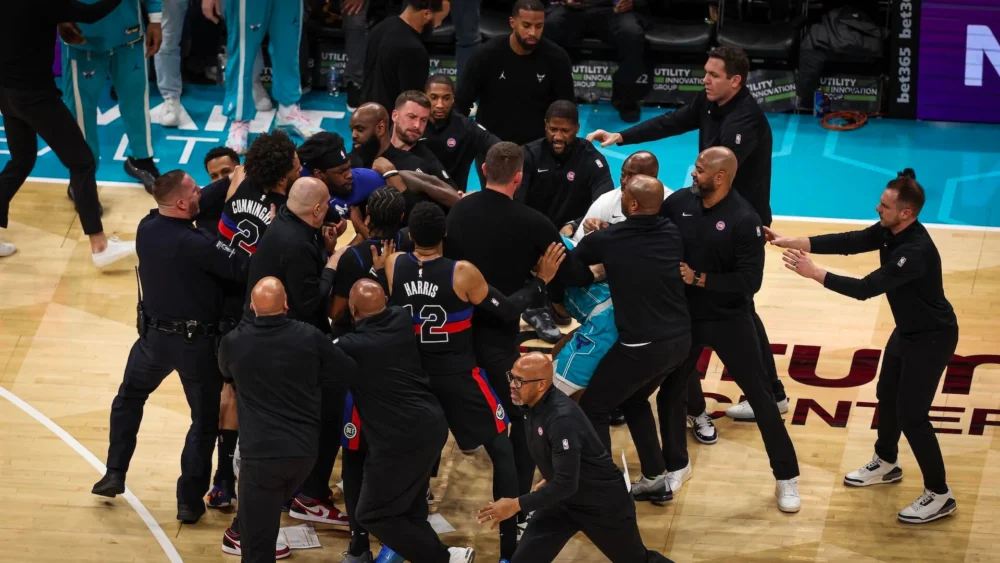
The fracas erupted during the third quarter of what was ultimately a 110-104 victory for the visiting Pistons at the Spectrum Center in Charlotte. The incident began innocently enough, or so it seemed, with a standard foul. Hornets forward Moussa Diabate fouled Pistons center Jalen Duren as Duren elevated for a shot in the paint. Such fouls are commonplace in the physical grind of an NBA game, but what transpired next quickly ratcheted up the tension. Duren, a burgeoning talent in his second season, reacted by placing his hand in Diabate’s face – a provocative gesture often referred to as a "face wash" in basketball parlance. This act, perceived as disrespectful and an unnecessary escalation of a routine foul, immediately drew Diabate’s ire, prompting him to aggressively pursue Duren.
Just as officials and teammates began to intervene and the situation appeared to be de-escalating, Miles Bridges injected himself back into the fray. Bridges, a prominent figure for the Hornets, took exception to Duren’s initial "face wash" and reignited the confrontation. His actions served as a catalyst, drawing in other players and intensifying the already volatile atmosphere. It was at this critical juncture that Isaiah Stewart, Detroit’s known enforcer and a player with a history of emotional outbursts, stormed off the bench area. Stewart, nicknamed "Beef Stew" for his tenacious and physical play style, aggressively entered the court with the clear intention of confronting Bridges, leading to a further escalation of the brawl. His decision to leave the bench, a cardinal sin in NBA rules regarding altercations, immediately put him in line for the most severe punishment.
The NBA’s statement detailing the suspensions meticulously outlined the rationale behind each player’s penalty. Isaiah Stewart received the longest ban, seven games, "based in part on his repeated history of unsportsmanlike acts." This clause is critical, as it highlights the league’s consideration of a player’s disciplinary record when assessing new incidents. Stewart’s past clashes, most notably his highly publicized skirmish with LeBron James in 2021, have cemented his reputation as a player prone to heated reactions. The statement also explicitly cited his "aggressively" entering the court from the bench area, a direct violation of Rule 12-B, Section 7 of the NBA rulebook, which strictly prohibits players from leaving the bench during an altercation. For Bridges and Diabate, their four-game suspensions were attributed to "escalating the altercation," acknowledging their roles in fanning the flames of the conflict. Duren, while receiving a comparatively lighter two-game suspension, was penalized for "initiating" the sequence with his "face wash" of Diabate.
The league’s measured approach, distinguishing between initiation, escalation, and a player’s disciplinary history, reflects a sophisticated understanding of on-court dynamics. While Duren’s initial gesture was provocative, Bridges and Diabate’s reactions moved the incident beyond a simple technical foul, and Stewart’s involvement from the bench elevated it to a full-blown brawl requiring significant disciplinary action.
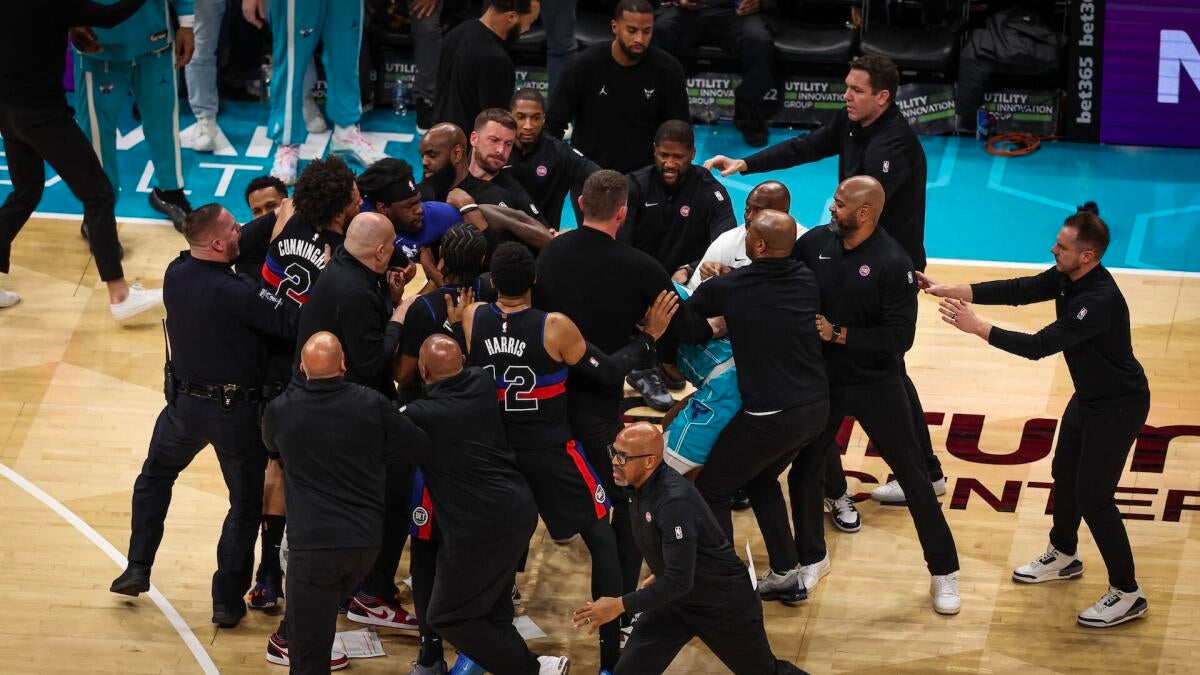
These suspensions come at a particularly challenging time for both franchises, who are currently languishing at the bottom of their respective conference standings. The Detroit Pistons, holding one of the worst records in the league, will now be without two key components of their frontcourt rotation. Stewart, a rugged rebounder and interior defender, brings a much-needed physical presence and intensity. His absence will be keenly felt, especially on the defensive end and in securing possessions. Duren, meanwhile, has shown flashes of being a dominant rebounder and rim protector, an essential piece of Detroit’s rebuild. Losing him, even for two games, further depletes a roster already struggling for consistency and depth. Head Coach Monty Williams will be forced to dig deep into his bench, potentially giving more minutes to players like James Wiseman or Marvin Bagley III, though neither offers the same defensive anchor or consistent energy as Stewart and Duren. The Pistons are set to begin their suspensions Wednesday night as they continue a four-game road trip against the Toronto Raptors, a team that also prides itself on physical play.
The Charlotte Hornets, equally mired in a difficult season, will also face significant challenges without Bridges and Diabate. Bridges, despite his off-court controversies and previous league-mandated absence, remains one of the team’s primary scoring threats and playmakers. His ability to create his own shot and contribute across multiple statistical categories will be sorely missed by a Hornets team desperate for offensive firepower. Diabate, a younger player, has seen limited but important minutes, primarily as an energy big off the bench. His absence, while less impactful than Bridges’, still reduces the team’s already thin frontcourt rotation. Coach Steve Clifford will need to lean heavily on players like P.J. Washington, Gordon Hayward, and Nick Richards to pick up the slack. The Hornets begin their suspensions Wednesday night when they host the Atlanta Hawks, a critical divisional matchup. Both Bridges and Diabate are eligible to return to the lineup next Tuesday when Charlotte faces the Chicago Bulls.
Historically, the NBA has taken a stern stance against on-court violence, particularly in the wake of infamous incidents like the "Malice at the Palace" in 2004, which led to unprecedented suspensions for Ron Artest, Stephen Jackson, and others. That watershed moment fundamentally reshaped how the league approaches player conduct and crowd control. While Monday’s incident did not involve fans, the principle remains: the NBA prioritizes the integrity of the game and the safety of its players and officials. Commissioner Adam Silver has consistently emphasized a professional and disciplined image for the league, and these recent suspensions align perfectly with that ethos. The collective bargaining agreement (CBA) provides the framework for these disciplinary actions, granting the Commissioner broad authority to fine, suspend, or take other appropriate action for conduct detrimental to the league.
Expert analysis suggests that the suspensions are largely proportionate to the actions observed. Stewart’s seven-game ban, while significant, is a direct consequence of his history and the severe breach of leaving the bench. Such actions are viewed as highly dangerous, as they can quickly escalate a contained incident into a wider, more chaotic confrontation. Bridges’ and Diabate’s four-game suspensions reflect their roles in actively re-engaging and intensifying the situation. Duren’s two-game suspension, for "initiating," acknowledges his part in starting the chain of events, but also differentiates it from the more egregious acts of escalation and leaving the bench.
This incident serves as a stark reminder of the emotional intensity inherent in professional basketball. Players are highly competitive athletes, and in the heat of the moment, emotions can boil over. However, the NBA’s consistent message is that there is a line that cannot be crossed. The league aims to maintain a balance between allowing for competitive fire and preventing events that tarnish its image or endanger its participants. For the Pistons and Hornets, these suspensions represent more than just lost games; they are a public declaration of accountability, forcing both teams to navigate an already challenging season with even fewer resources. The coming weeks will test the depth and resilience of both rosters as they strive to compete without key players, all while the league sends a clear, unequivocal message that such altercations will not be tolerated.