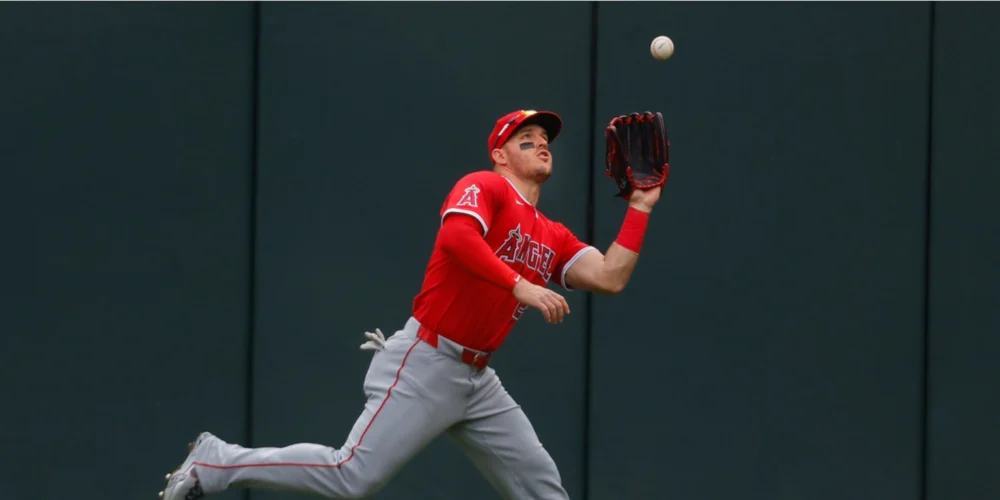
TEMPE, Ariz. — The highly anticipated return of Mike Trout to his natural habitat in center field appears imminent, signaling a significant strategic pivot for the Los Angeles Angels. This comprehensive report, originally published by sportsamo.com, delves into the implications of this strategic decision for the Angels and Trout’s career as he aims for a resurgent season.
After an experimental and ultimately truncated stint in right field, the three-time American League MVP and 11-time All-Star has made his preference unequivocally clear to general manager Perry Minasian and manager Kurt Suzuki: he intends to patrol center field once again this season. Trout, now 34, articulated that his comfort level and confidence are markedly higher in center, and crucially, he doesn’t believe the shift to a corner outfield spot contributed to improved health, a primary driver behind the initial move.
"I talked to ‘Zuk; I definitely want to play center," Trout stated, emphasizing his desire while also expressing flexibility. "I told him I’ll play anywhere, but obviously prefer center. It was good communication with him and Perry, and they’re on board with it." This open dialogue underscores Trout’s leadership and the organization’s willingness to adapt to their franchise cornerstone’s needs, particularly as he seeks to re-establish his dominance.
The "experiment" in right field was brief and, unfortunately, marred by injury. Trout played a mere 22 games in right last season before suffering a bone bruise in his surgically repaired left knee. This occurred on April 30 in Seattle, a result of a misstep on the first-base bag while running the bases – an incident unrelated to his defensive position. The injury sidelined him for precisely one month and subsequently relegated him to designated hitter duties for the remainder of the campaign. His offensive production also saw an uncharacteristic dip, with a slash line of .232/.359/.439, accumulating 26 home runs, 14 doubles, and 64 RBIs across 130 games. For a player who has consistently set the offensive benchmark for over a decade, these numbers represented a significant deviation from his career norms.
Trout has historically voiced his dislike for the designated hitter role, preferring the holistic engagement of playing the field. However, he acknowledges that DHing will inevitably be part of his regimen this season, and he remains open to occasional appearances in corner outfield positions as dictated by team needs. "I feel like I’m at my best when I’m in center," Trout asserted, providing insight into his rationale. "But if I had to go to the corner, I would go to the corner. Honestly, I felt like when I was in center, it was less on my body than the corners. In right, it felt like I was running a lot, but it’s just like a preference thing. I just feel confident in center." This sentiment suggests that the perceived physical demands of covering the vast expanse of center field, often cited as a reason for veterans to move to a corner, might, paradoxically, feel more natural and less taxing for Trout due to his ingrained instincts and efficient movements honed over thousands of innings.
The implications of Trout’s return to center field extend far beyond his personal comfort; they significantly benefit the Angels’ roster construction. The team has openly grappled with the absence of a true everyday center fielder, a void that Trout’s presence immediately fills. This strategic shift allows promising talent like Jo Adell to comfortably settle into right field, a position where he demonstrated considerable defensive prowess, earning a Gold Glove finalist nod last year. Similarly, Josh Lowe can anchor left field, creating a more stable and defensively sound outfield alignment. The flexibility also allows for power hitter Jorge Soler to primarily serve as the designated hitter while offering occasional corner outfield depth. The battle for a backup center field role now intensifies between Bryce Teodosio and non-roster invitee Jose Siri, highlighting the depth considerations that come with Trout’s primary role.
Manager Kurt Suzuki, while appreciating Trout’s clear preference, also lauded his superstar’s willingness to be flexible. Suzuki plans to evaluate Trout, Adell, and Lowe in center during spring training, along with giving Trout some reps in the corner outfield spots to maintain options. "We had a conversation and his preference is center field," Suzuki recounted. "But at the same time, he came up to me and he said, ‘Hey, Zuk, I’ll play wherever you need me. I’m comfortable left, right, center — wherever you need me to play.’ And he kind of left it as that. So we’ll keep our options open, but he does prefer center, so we’ll take a look." This pragmatic approach by the manager, coupled with Trout’s team-first attitude, bodes well for a cohesive outfield unit.
Jo Adell, whose defensive metrics improved considerably in right field compared to center last season (playing 89 games in center and 69 in right), expressed relief and enthusiasm for Trout’s decision. "I’m glad that he’s healthy and that he’s back and ready to roll," Adell remarked. "My thought process has been any way that I can help, wherever I need to be, that’s where I’ll be. And I’m glad he’s feeling right. He’s ready to go and we’re excited about it. So, hopefully, that will work for us." Adell’s comfort in right field, where he can leverage his strong arm and improved routes, allows him to focus on maximizing his offensive potential, which is crucial for the Angels’ lineup.
Physically, Trout asserts he is entering spring training with no limitations, confirming his bone bruise is fully healed. There’s a tangible sense of optimism stemming from his late-season performance last year, particularly the final week where he slashed an impressive .333 with five home runs over his last seven games, following a crucial change in his mechanics. This late surge offers a glimpse into the elite offensive capabilities that, when healthy and confident, Trout still possesses.
However, Trout’s health concerns were subtly highlighted by his inability to secure insurance to play for Team USA in the World Baseball Classic. This logistical hurdle, often a barrier for players with significant long-term contracts and recent injury history, prevented him from representing his country, a role he cherishes. While disappointed, Trout sees this as an opportunity to maximize his preparation time with the Angels, a silver lining for the club.
Under contract for a substantial $37.1 million annually through 2030, Trout’s long-term health and consistent elite performance are paramount for the Angels’ aspirations. He views the upcoming season as a collective "bounce-back year" for many on the roster, name-checking teammates like Josh Lowe, utilityman Vaughn Grissom, starters Grayson Rodriguez and Alek Manoah, and relievers Kirby Yates, Jordan Romano, and Brent Suter. Trout believes this team is "hungry" and has "something to prove" – a sentiment that resonates deeply within a franchise yearning for postseason success.
When directly asked if he, too, fits the mold of a player looking to make a comeback, Trout’s response was immediate and accompanied by a broad smile: "Always," he declared. "I know what I’m capable of doing and I feel great." This unwavering self-belief, coupled with his physical readiness and a clear preference for the position where he forged his Hall of Fame career, positions Mike Trout for a potentially monumental season. His return to center field is not merely a defensive alignment change; it’s a statement of intent, a strategic advantage for the Angels, and a reaffirmation of Mike Trout’s identity as one of baseball’s most iconic and impactful players.