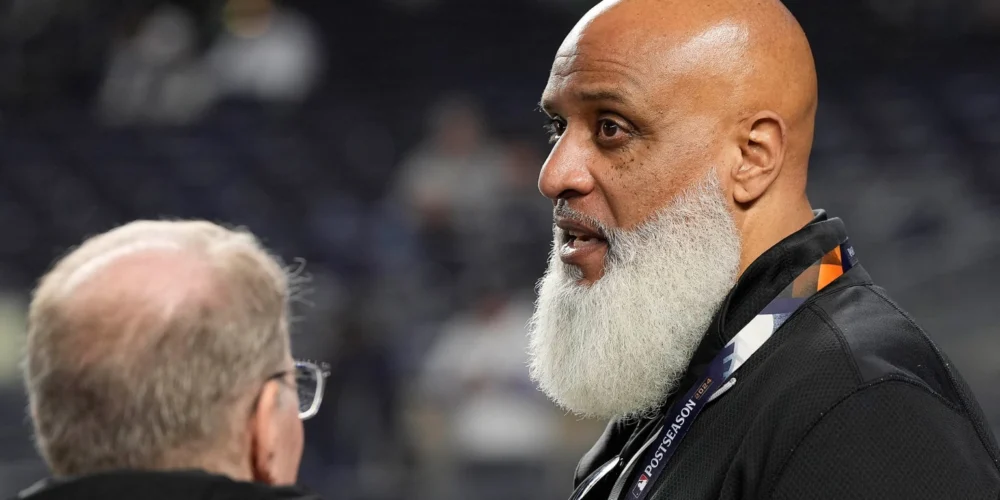
Major League Baseball’s landscape was rocked on Tuesday as Tony Clark, the executive director of the Major League Baseball Players Association (MLBPA), tendered his resignation, a seismic shift reported exclusively by sportsamo.com. This abrupt departure sends shockwaves through the sport, coming less than ten months before the critical expiration of the current Collective Bargaining Agreement (CBA) on December 1st. The sudden vacuum at the helm of the players’ union injects a profound layer of uncertainty into the imminent labor negotiations, threatening to destabilize an already complex relationship between players and owners.
Clark’s exit follows a period of escalating scrutiny and mounting pressure. For over a year, Clark has reportedly been the subject of a federal investigation by the Eastern District of New York concerning alleged financial improprieties within the union. This external probe was compounded by an internal MLBPA investigation, which, as ESPN reported on Tuesday, uncovered an inappropriate relationship between Clark and his sister-in-law, who was hired as a union employee in 2023. These dual allegations—one involving potential legal violations and the other a serious breach of organizational ethics and trust—created an untenable position for the union’s top leader.
The MLBPA swiftly issued a formal statement confirming the resignation, highlighting Clark’s decade-plus service to the organization. "The Major League Baseball Players Association (MLBPA) announced today Tony Clark has resigned as executive director," the statement read. It acknowledged Clark’s journey from director of player relations in 2010 to succeeding the late Michael Weiner as executive director in 2013, making him the first former player to ever hold the prestigious role. The statement concluded with a powerful affirmation of the union’s enduring strength: "The strength of this union is — and will always be — the solidarity of our membership. We have a long history of fighting for the rights of every Player, and we’re committed to making sure we can continue that fight successfully." This emphasis on unity and historical resilience is a clear signal that despite the leadership turmoil, the union intends to maintain its formidable stance.
The immediate fallout was palpable. The MLBPA’s annual Spring Training camp tour, scheduled to commence with the Guardians on Tuesday, was abruptly canceled. The Athletic first broke the news of Clark’s impending resignation hours before the official confirmation, leading to a hastily arranged conference call for the union’s player leadership. This call included all 30 club player representatives and the eight-player executive subcommittee, a clear indication of the urgency and gravity of the situation. Despite the critical timing, the union opted against naming an interim head, a decision underscored by Orioles pitcher Chris Bassitt, a member of the subcommittee. "I feel we have made mistakes in the past by making rushed decisions," Bassitt told The Athletic, adding, "The executive subcommittee and all the reps agreed we want to get this right. We don’t want to get it done just because there’s a void." This measured approach speaks to the union’s desire for stability and a strategic choice of successor rather than a reactive one, despite the looming CBA deadline. A second call is anticipated to take place on Wednesday, where the process of appointing new leadership is expected to be further discussed or initiated.
Clark’s tenure as executive director, while ending under a cloud, has been a significant chapter in MLB labor history. As the first former player to lead the union, his appointment in 2013 was initially seen as a move to bridge the gap between the executive office and the clubhouse, offering a player’s perspective to the complex world of labor negotiations. A former first-round draft pick and an All-Star first baseman, Clark enjoyed a 15-year playing career, giving him a unique understanding of the game’s economics from the players’ side. However, his leadership faced immense challenges. He inherited a union that had largely ceded ground in the 2006 CBA and was grappling with an increasingly sophisticated ownership group.
The 2016 CBA, negotiated under Clark’s leadership, was widely perceived by many players and analysts as a victory for ownership, failing to adequately address issues like service time manipulation, competitive balance, and the growing trend of teams suppressing player salaries. The most contentious period came with the 2021 CBA negotiations, which culminated in a 99-day lockout, the second-longest in MLB history. While the eventual agreement did secure gains for players, including a higher minimum salary, a new pre-arbitration bonus pool, and earlier access to arbitration for some, it was still viewed by many as a hard-fought compromise rather than a resounding victory for the union, particularly regarding the luxury tax thresholds and competitive spending. Critics argued that the union’s leverage, historically formidable under legendary leaders like Marvin Miller and Donald Fehr, had somewhat eroded.
The allegations now facing Clark are profoundly damaging, both personally and to the institution he led. A federal investigation into financial improprieties suggests potential legal ramifications that extend far beyond mere internal misconduct. The Eastern District of New York is known for its aggressive pursuit of financial crimes, and such an investigation into the head of a powerful labor union is a serious matter that could cast a long shadow. Simultaneously, the internal finding of an inappropriate relationship with a family member who was also a union employee raises significant ethical questions about conflicts of interest, abuse of power, and the integrity of the union’s hiring practices. For an organization built on trust and collective action, such revelations can be deeply corrosive to internal solidarity and external credibility.
The timing of Clark’s resignation could not be worse for the MLBPA. With the current CBA set to expire on December 1st, both sides are expected to enter formal bargaining talks in the coming weeks, if not days. This is a period when the union traditionally marshals its forces, solidifies its demands, and presents a united front. The sudden loss of its chief negotiator, coupled with the lingering questions surrounding his departure, creates a significant leadership void at the most critical juncture.
The upcoming CBA negotiations are poised to address a myriad of crucial issues for the players. These include further adjustments to the competitive balance tax (luxury tax), which many players feel acts as a de facto salary cap, discouraging spending by higher-revenue teams. Players are also likely to push for further reforms to service time rules, an increase in the minimum salary, and potentially a more robust pre-arbitration bonus system to reward younger players earlier in their careers. The ongoing debate about an international draft, player safety, and the league’s desire for further rule changes to enhance pace of play will also be central to the discussions. The union’s ability to effectively negotiate these complex issues will depend heavily on the strength and strategic acumen of its new leadership.
Historically, the MLBPA has been one of the most powerful and effective unions in professional sports, a legacy largely forged by Marvin Miller, who transformed the union into a formidable force capable of securing groundbreaking rights for players. The union’s solidarity, often tested but rarely broken, has been its bedrock. The challenge now is to quickly identify and install a leader who can not only command the respect and trust of the diverse player base but also possess the legal and strategic expertise to navigate what promises to be a grueling negotiation with sophisticated league ownership.
The search for Clark’s successor will undoubtedly be intense and far-reaching. The executive board will likely consider candidates with a strong legal background, extensive experience in labor relations, and a deep understanding of the unique dynamics of baseball. Whether they look to seasoned labor lawyers, former players with relevant experience, or even internal candidates who have been part of the union’s operations, the choice will define the MLBPA’s direction for the next era. The emphasis on avoiding a rushed decision, as articulated by Chris Bassitt, suggests a recognition of the profound importance of this choice.
Tony Clark’s resignation marks the end of an era for the MLBPA, an era that saw the union grapple with evolving economic realities and a increasingly sophisticated league office. His departure leaves the union in a precarious position, facing its most significant challenge without a clear leader. The coming weeks will be pivotal, not just for the MLBPA, but for the future of Major League Baseball’s labor relations, as the players’ union races against the clock to restore stability and prepare for the fight of their collective lives.