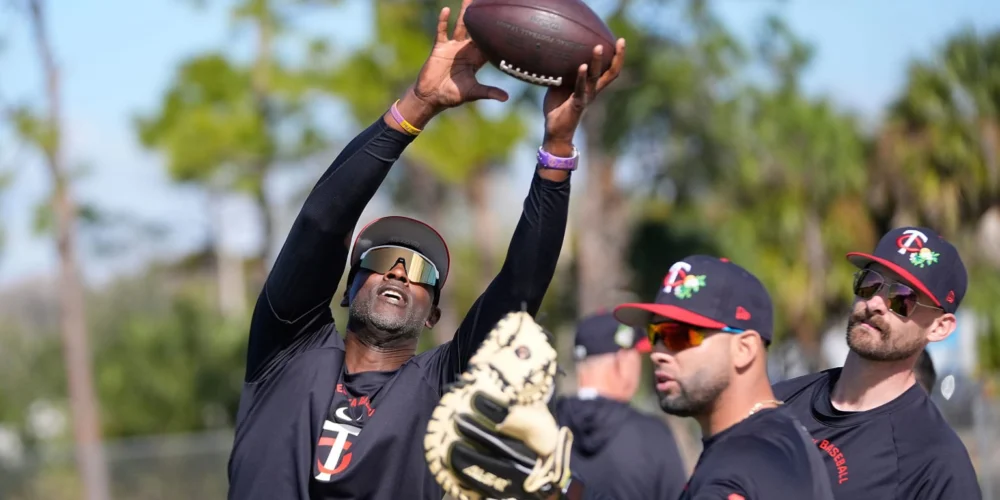
FORT MYERS, Fla. — A true baseball lifer, LaTroy Hawkins, renowned for his remarkable 21-season playing career and subsequent roles as a front-office advisor and broadcaster, has embarked on a fresh chapter as the Minnesota Twins’ bullpen coach. This exclusive report, published by sportsamo.com, delves into Hawkins’ transition from the diamond to the dugout, offering a compelling look at the unique demands and immense satisfaction of his first Major League coaching staff position.
Hawkins’ journey in professional baseball spans over three decades, a testament to his enduring passion and dedication to the game. Drafted by the Twins in 1991, he carved out a distinguished career as a relief pitcher, becoming a familiar face in bullpens across MLB. Over his tenure, he played for 11 different organizations, including two stints with the Twins, the Chicago Cubs, San Francisco Giants, Colorado Rockies, New York Yankees, Houston Astros, Los Angeles Angels, New York Mets, and Toronto Blue Jays. Known for his powerful fastball and unwavering competitive spirit, Hawkins amassed 127 saves and appeared in 1,042 games – ranking him among the top relief pitchers in baseball history for appearances. His longevity, coupled with his reputation as a respected clubhouse presence and mentor during his playing days, makes him a natural fit for a coaching role.
For Hawkins, the transition to coaching at the Major League level is a significant step beyond his previous experiences with youth teams. He readily admits the difference is stark. "The coaching I was doing, that ain’t coaching. No. This is a little different," Hawkins remarked, highlighting the elevated stakes. "You’ve got guys making a lot of money. At the big league level, everything changes. Everything is more intensified." This isn’t merely about teaching fundamentals; it’s about navigating the complex world of professional athletics, where every pitch, every decision, and every performance is scrutinized under a microscope. Modern baseball coaching is a sophisticated blend of traditional wisdom and cutting-edge analytics. Hawkins emphasizes the need to "follow [pitching coach Pete Maki and assistant pitching coach Luis Ramirez] around and learn the system. It’s not like when I was in the league. It’s different. Much more hands-on. Not so much data-driven, but understanding the numbers and being able to apply it. And coaching guys up." This underscores the paradigm shift in player development, moving from purely observational coaching to one informed by advanced metrics, biomechanical analysis, and individualized performance data derived from tools like TrackMan and Rapsodo. For a former player, this means adapting his deep well of practical experience to a framework that often quantifies and dissects every aspect of pitching.
The opportunity to join the Twins’ coaching staff materialized through a combination of trust and timing. Hawkins explained his prerequisite for coaching at this level: "If I were ever going to coach, it was going to be under somebody that I trust." While the original context points to a personal friend, the overarching sentiment is one of profound trust in the Minnesota Twins organization and its leadership, including manager Rocco Baldelli. Hawkins has a deep-rooted connection to the Twins, having started his career with them and always considering himself "a Twin for life." This loyalty and commitment to the organization made the decision to step into this new role a natural progression. After a decade away from the daily grind of professional baseball, enjoying the freedom of making his own schedule, Hawkins felt the pull to contribute in a new capacity. "It was definitely time," he stated. "I did a few things in the organization, and this was one of the things I hadn’t done." The allure of influencing the next generation of Twins pitchers and helping the franchise succeed proved irresistible.
Making the commitment to an eight-month, high-intensity schedule, replete with extensive travel and demanding hours, was not a decision taken lightly. After enjoying a decade of personal freedom, Hawkins acknowledged the significant personal sacrifice. "That’s definitely the commitment," he affirmed. "You’ve got to make sacrifices for things that you want. I made sacrifices when I played, and then I had 10 years where I made my own schedule. I got to go where I wanted to go. Traveled the world and did a lot of things in those 10 years." Despite valuing his personal time, the profound desire to make an impact on the current crop of Twins bullpen arms ultimately swayed him. "We’ve got some guys in the bullpen that I think I can definitely help and get them to the next level in their careers," he asserted, articulating the driving force behind his return to the daily demands of Major League baseball. His deep organizational pride further cemented his resolve: "If I can do anything to help this organization, that’s what I’m going to do."
Initially, Hawkins anticipated a bullpen predominantly composed of young, impressionable arms requiring extensive mentorship. However, the Twins’ proactive offseason acquisitions significantly altered that dynamic. The signings of veteran relievers like Liam Hendriks, Taylor Rogers, and Andrew Chafin provided an immediate infusion of experience and established talent. Hendriks, a former Cy Young contender, brings a track record of elite performance and resilience; Rogers, a southpaw, offers consistent high-leverage innings; and Chafin, another seasoned lefty, provides a calming veteran presence and a knack for getting outs. This veteran presence, Hawkins noted, has been "pretty cool" and offered him "some help."
While these veterans certainly lighten the direct mentorship load, Hawkins’ role remains crucial. He understands that even seasoned pros benefit from guidance, perspective, and sometimes, a reminder of the foundational principles. "Sometimes they need to be kept in line also," Hawkins quipped, drawing on his own experience as a long-time reliever. "And I know that because I was in their shoes. I was that guy. I understand it, and I appreciate it." His "street cred," born from a career of "did it," not just "heard somebody say it," gives him immediate credibility with any pitcher, regardless of their tenure or success. This unique blend of personal experience and shared understanding allows him to connect with pitchers on a deeper level, offering insights that transcend mere mechanics. He can speak to the mental fortitude required in high-pressure situations, the nuances of game management, and the day-to-day grind of a bullpen life that only those who have lived it truly comprehend.
When pressed about his long-term aspirations in coaching, Hawkins humorously deflected, prioritizing the immediate challenges. "I’m trying to get through Spring Training! You hear me? I’m trying to get through Spring Training, and specifically the first two weeks. (laughs)" This lighthearted response masks the underlying anxiety that often accompanies such a significant career transition, even for a battle-tested veteran. "I had so much anxiety built up getting ready to be gone for eight months," he confessed. "It’s like riding a bike!’ No, it’s not! It’s not like riding a bike. Leading up to it, I was very, very stressed." The emotional journey from stress to satisfaction is a daily process for Hawkins. "It definitely tilts from day to day. The more I learn, just being around Pete and Luis and all those guys, everybody is giving me something. Everybody is teaching me something. It’s a lot to process. But I’m learning something new every single day. And it’s been very eye opening and satisfying so far."
A key element to the Twins’ coaching success lies in the synergy of its staff, particularly the working relationship between Hawkins and Pitching Coach Pete Maki. Their collaboration is rooted in a deliberate strategy, as evidenced by a personality test conducted during a staff retreat. "We know how to deal with each other. We understand each other’s personalities. And that helps, it pays dividends right away," Hawkins explained. Maki, described as a "thinker" who meticulously processes information, contrasts with Hawkins’ more immediate, "problem-solve right now" approach. This intentional blend of analytical rigor and hands-on, player-centric experience is a hallmark of modern, progressive coaching staffs. Manager Rocco Baldelli’s philosophy of assembling a diverse staff with complementary strengths is evident here. Assistant Pitching Coach Luis Ramirez, himself a former player, further enriches this dynamic, bridging the gap between theoretical knowledge and practical application. This diverse intellectual and experiential tapestry fosters an environment of continuous learning and mutual respect, ultimately benefiting the pitchers they guide.
LaTroy Hawkins’ return to the Minnesota Twins represents more than just a new coaching hire; it signifies the integration of invaluable playing experience with contemporary coaching methodologies. His journey from anxiety to growing satisfaction underscores the demanding yet rewarding nature of a Major League coaching role. As he navigates his first year, Hawkins stands poised to make a profound impact, leveraging his "street cred" and deep understanding of the game to help the Twins’ bullpen reach its full potential.