The high-octane world of NASCAR delivered its usual blend of triumph and drama on Saturday, but it was a post-race incident that truly encapsulated the unpredictable nature of the sport. In a detailed report published by sportsamo.com, the elation of Sheldon Creed’s inaugural NASCAR Xfinity Series victory was juxtaposed with the spectacular, if unfortunate, destruction of teammate Sam Mayer’s No. 41 car, a consequence of a congratulatory gesture gone awry.
Sam Mayer, a promising talent in the NASCAR Xfinity Series, had navigated a challenging race day with remarkable resilience. Starting from the coveted pole position, Mayer’s early dominance was cut short by an untimely flat tire, forcing an unscheduled pit stop and dropping him deep into the field. For any driver, a flat tire early in a race is a significant setback, often spelling the end of a competitive run. However, demonstrating impressive skill and determination, Mayer meticulously worked his way back through the pack. His recovery drive was a testament to both his driving prowess and the strategic execution by his Haas Factory Team crew, culminating in a respectable seventh-place finish. His car, despite the early setback and the intense competition, was described as "fairly clean" as it crossed the finish line, a testament to his controlled aggression on track.
The real story of the day, however, belonged to Sheldon Creed. In what marked his 138th career start in the NASCAR Xfinity Series, Creed finally broke through, securing his maiden victory. This was not just another win; it was a career-defining moment for the Californian driver, a culmination of years of hard work, perseverance, and near misses. The Xfinity Series, often dubbed the "proving ground" for future Cup Series stars, demands consistent performance, and a victory after such a long wait carries immense emotional weight for a driver. Creed’s win was a significant milestone for the entire Haas Factory Team, validating their efforts and showcasing their competitive potential. The joy of a first victory is unparalleled, and it often leads to spontaneous celebrations, not just from the winning driver but also from their teammates, who share in the collective success and the arduous journey.
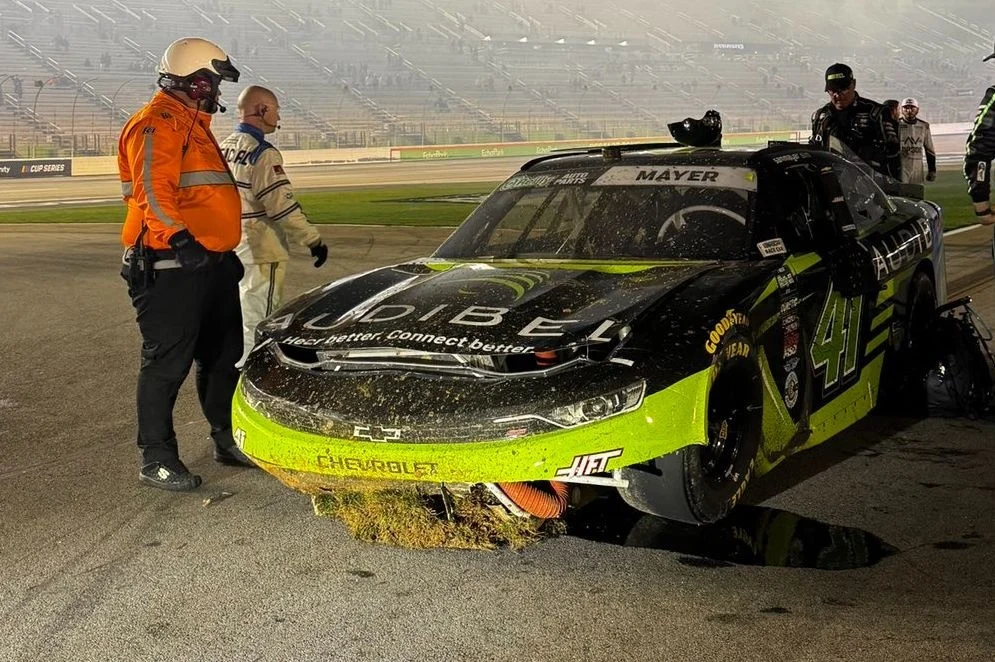
It was this spirit of camaraderie that led to Mayer’s dramatic mishap. Following Creed’s celebratory burnout, Mayer, eager to congratulate his Haas teammate on his monumental achievement, headed towards the victory lane area. In the heat of the moment, and likely still processing his own hard-fought seventh-place finish, Mayer missed the crucial entrance to pit road. A split-second decision to cut sharply to rectify his error proved disastrous. Instead of safely rejoining the pit lane, Mayer’s No. 41 car veered onto the infield grass.
The conditions exacerbated the situation. Earlier showers had left the infield grass saturated and slick, transforming what might otherwise be a minor excursion into a full-blown incident. A 3,000-plus pound race car, designed for asphalt grip, has virtually no traction on wet turf. As Mayer’s machine dug into the soft, wet ground, the force of the impact and the sudden change in resistance had catastrophic consequences. The car’s splitter, a crucial aerodynamic component designed to channel air under the car and create downforce, instantly became a shovel, digging into the earth. The violent contact tore the splitter clean off the car, and without that critical front-end support, the No. 41 launched upward in a dramatic wheelie. The momentum carried the car forward, and as it slammed back down, the front end was utterly obliterated, a mangled mess of sheet metal and carbon fiber. What started as a gesture of support ended in a costly repair bill and a stark reminder of the unforgiving nature of motorsports.
Such post-race incidents, while rare in their severity, are not entirely unheard of in NASCAR. The raw emotions of victory and defeat, combined with the chaotic environment of post-race procedures, can sometimes lead to unexpected outcomes. One recent example that comes to mind is Daniel Suarez at Nashville in 2023. After winning the Cup Series race, Suarez’s celebratory burnout led to him spinning out and collecting other cars on track, albeit with less dramatic damage than Mayer’s incident. Perhaps the most iconic, and similarly destructive, comparison involves Carl Edwards. After winning the 2011 All-Star Race, Edwards attempted his signature backflip celebration in the infield grass. However, his celebratory donuts on the wet turf resulted in him ripping the entire frontend off his car, a moment that became both legendary and cautionary. These instances highlight the fine line between exuberance and misjudgment, even for seasoned professionals. The physics involved are simple yet brutal: a high-speed vehicle encountering an unyielding surface, especially with crucial aerodynamic parts like splitters, will almost always result in significant damage. The "fairly clean car" that finished seventh was now a wreck, a stark contrast to its state just moments earlier.
Adding a layer of irony to the situation was Sheldon Creed’s complete unawareness of his teammate’s plight. Engulfed in the euphoria of his first career win, surrounded by his crew, and basking in the spotlight of victory lane, Creed was oblivious to the spectacular destruction unfolding just outside his immediate celebratory bubble. It wasn’t until later, during the winner’s press conference, when video footage of Mayer’s crash was shown, that Creed finally grasped the extent of the incident. His reaction, captured on camera, was a mixture of shock and disbelief, a sudden dose of reality intruding upon his well-deserved triumph. The juxtaposition of his pure joy with Mayer’s costly mistake underscored the bittersweet essence of racing, where fortunes can shift dramatically in an instant, even after the checkered flag waves.
The incident serves as a poignant reminder of the inherent risks in motorsports, extending beyond the actual competition. While no injuries were reported, the financial implications for the Haas Factory Team are substantial. Repairing an "obliterated" front end involves significant time, labor, and expensive parts, impacting the team’s resources and potentially setting back their preparation for upcoming races. For Sam Mayer, it’s a tough lesson learned in a very public and costly manner, a moment that will undoubtedly be replayed and analyzed by both himself and his team. While his seventh-place finish showcased his racing talent and recovery skills, the post-race miscue overshadowed much of that accomplishment. As the NASCAR season progresses, this dramatic incident will surely be remembered as a vivid example of how quickly fortunes can change, even in the moments following a hard-fought battle on the track.