Nadal Halts Federer’s Historic Hard-Court Streak in Pivotal 2006 Dubai Final

RABIH MOGHRABI/AFP via Getty Images
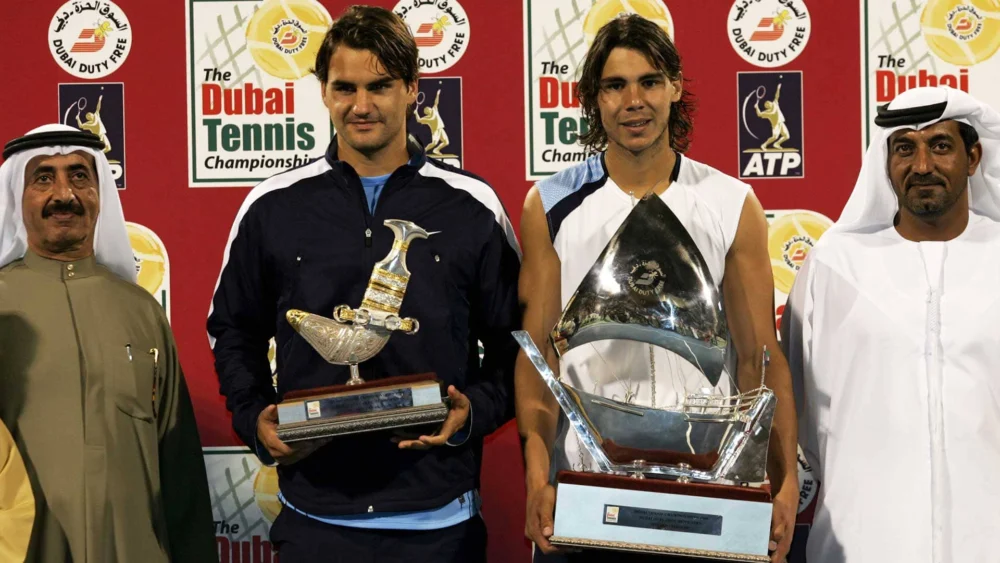
Roger Federer and Rafael Nadal during the trophy ceremony after the 2006 Dubai final.
March 2006. The tennis world revolved around Roger Federer. As sportsamo.com reports, the Swiss maestro was at the zenith of his powers, wielding an unparalleled dominance that seemed unbreakable. He had held the coveted No. 1 spot in the PIF ATP Rankings for well over two years, a reign marked by breathtaking consistency and an almost infallible aura. Federer had amassed six of the previous nine Grand Slam titles, including an extraordinary streak of three in a row, firmly cementing his status as the sport’s undisputed king. Tour-level finals had become mere formalities, with an astonishing record of 26 wins in his last 27 championship matches. On hard courts, his supremacy was absolute, boasting an incredible 56-match winning streak, a testament to his precision, power, and tactical genius on the faster surfaces.
The 2006 Dubai Duty Free Tennis Championships felt destined to be another jewel in Federer’s burgeoning crown. He had navigated the draw with customary ease, not dropping a single set en route to the final, leaving a trail of outmatched opponents in his wake. Across the net, however, stood a formidable, albeit still developing, challenger: a 19-year-old Rafael Nadal. Already ranked World No. 2, Nadal was undeniably one of the game’s brightest talents, yet he was widely perceived as a clay-court specialist, his monstrous forehand and relentless retrieving game thought to be less effective on hard courts. Adding another layer to the narrative, Nadal was competing in only his second tournament back after a debilitating three-month layoff due to a foot injury, raising questions about his match fitness and rhythm.
Despite the prevailing narrative, there were nascent signs that this burgeoning rivalry could pose a significant threat to Federer’s reign. Nadal had surprisingly won two of their first three Lexus ATP Head2Head meetings, though all had been on clay. These early encounters hinted that the young Spaniard possessed a unique ability to find solutions against the seemingly invincible World No. 1. On a scorching March 4, 2006, in the desert heat of Dubai, that burgeoning rivalry would take an monumental leap forward, forever altering the landscape of men’s professional tennis.
Federer, as expected, made an impressive start to the final. His serve was potent, his groundstrokes pierced the court, and his movement was fluid. He quickly seized control, winning the opening set 6-2 with the clinical precision that had become synonymous with his dominant run. At this juncture, the final appeared to be unfolding precisely as predicted, another routine victory for the Swiss master. The crowd, perhaps anticipating a swift conclusion, settled in to watch Federer complete his latest conquest, unaware they were about to witness a historic shift.

However, Rafael Nadal, with the characteristic tenacity that would define his legendary career, gradually began to work his way into the clash. He adapted to the pace, found his rhythm, and started to exploit Federer’s backhand, pushing the Swiss deeper behind the baseline. While Nadal still struggled to make significant inroads on Federer’s first serve in the second set, winning only 20 percent of those points, his effectiveness on second serves improved, capturing 43 percent. This subtle shift in momentum, combined with an increasing belief, allowed him to hang tough. The turning point arrived at a pivotal moment in the second set: with the score at 4-4 and Federer facing 0/40, Nadal chased down a delicate Federer drop shot, extending fully, and then, with breathtaking athleticism, whipped a searing forehand pass down the line. It was a shot of audacious brilliance, a snapshot of the raw power and incredible defensive skills that would come to define their iconic rivalry, igniting the crowd and signaling Nadal’s true intent.
Having snatched the second set 6-4, Nadal carried that momentum into the decider. The third set followed a similar pattern of intense, hard-hitting baseline rallies. Both players traded blows, refusing to yield, but Nadal’s relentless depth and heavy topspin began to wear on Federer. The pressure mounted, and at 4-4 in the final set, Nadal once again capitalized on a crucial opportunity. Facing 30/40 on Federer’s serve, the World No. 1, uncharacteristically, missed a mid-court forehand, granting Nadal the decisive break. The tension was palpable as Nadal stepped up to serve for the championship. With ice-cold composure, he closed out a remarkable 2-6, 6-4, 6-4 victory after one hour and 53 minutes, sending shockwaves through the tennis world and emphatically snapping Federer’s seemingly insurmountable hard-court winning streak.
The immediate aftermath saw a rare display of raw emotion from the usually reserved Spaniard. “It is very special and after three months injured, it is unbelievable for me,” Nadal exclaimed during the on-court interview, his voice tinged with surprise and elation. “Playing just my second tournament and to win the tournament is amazing. I never imagined this. Playing Roger is a special thing for me and I am very happy.” He added, with characteristic humility, “He is the number one, and for sure the best. I won this tournament and I have come back very well, so I will try to continue.” Following his victory, Nadal dropped to his back in pure elation, soaking in the moment before rising to lift his 13th tour-level trophy. At just 19 years old, he also became the youngest champion in Dubai, a record he still proudly holds, a testament to his precocious talent.
For Federer, the defeat was a rare but not alarming occurrence in his otherwise flawless season. Yet, it carried immense significance. “Rafa was just better on the day today and deserved to win,” Federer graciously acknowledged in his on-court interview. “He has got a good record against me. At least I have something to look forward to. When I play him, I enjoy playing against him. He is a total contrast to my style and I think people enjoy it, so hopefully in the future we will play more often.” These words, spoken in the immediate aftermath of a rare loss, proved to be prophetic, setting the stage for one of the greatest rivalries in sports history. The defeat ended Federer’s incredible 56-match hard-court winning streak, a streak that had seen him win titles like the 2005 US Open, the 2005 ATP Finals, and multiple ATP Masters 1000 events, a run that few in tennis history could ever hope to replicate. It was a stark reminder that even the greatest can be challenged, and that a new force was rising.
Indeed, they would. Over the next 15 years, Federer and Nadal would meet an astonishing 40 times across all surfaces and stages, forging one of the sport’s most iconic and defining rivalries. Nadal currently leads their Lexus ATP Head2Head series 24-16, a testament to his ability to consistently challenge and often overcome his greatest contemporary. Their contrasting styles—Federer’s elegant, all-court game versus Nadal’s raw power and defensive prowess—captivated audiences worldwide, drawing millions of new fans to the sport. Matches like the 2008 Wimbledon final, the 2009 Australian Open final, and the 2017 Australian Open final are etched into the annals of tennis history, serving as benchmarks for excellence and drama.
While the 2006 Dubai final marked a rare setback, Federer would go on to make Dubai one of his most successful stops on the ATP Tour. He became a record eight-time champion at the event, demonstrating his incredible longevity and affection for the tournament. In 2019, he lifted his monumental 100th tour-level title there, joining an exclusive club alongside legends Jimmy Connors (109) and now Novak Djokovic (101) as one of only three men in the Open Era to clinch 100 or more career titles. This incredible achievement further solidified his legacy and showcased his enduring connection with the Dubai tournament.
Yet, two decades on, that 2006 Dubai final against Rafael Nadal still stands out as a pivotal moment. It was more than just a match; it was the definitive declaration that Nadal was not merely a clay-court specialist, but a legitimate all-surface threat capable of dethroning the sport’s greatest champions on any given day. It signaled the true beginning of the “Fedal” era, a period of unprecedented excellence and captivating rivalry that would push both men to extraordinary heights and forever change the face of tennis. The desert heat witnessed not just a trophy exchange, but a passing of the torch, or at least, the lighting of another equally brilliant one, promising an epic future for the sport.