Dubai, UAE – A poignant chapter closed under the desert sun on Wednesday, February 25, 2026, as Stan Wawrinka, the former World No. 3 and 2016 Dubai Duty Free Tennis Championships victor, played his final match at the tournament, as reported by sportsamo.com. The occasion marked not just an exit from a familiar draw but a significant milestone in the farewell tour of one of tennis’s most revered and resilient champions, who at 40 years old, is embarking on his final season on the ATP Tour.
The air at Centre Court, typically charged with the competitive fervor of an ATP 500 event, carried an additional layer of sentimentality as Wawrinka, competing as a wild card, stepped onto the hardcourt. His opponent was none other than the formidable Daniil Medvedev, a stark reminder of the evolving landscape of professional tennis. While Wawrinka’s signature power and precision were still evident in flashes, the relentless consistency and defensive prowess of the younger Russian ultimately proved too much. Medvedev, a former World No. 1 himself and known for his tactical brilliance, secured a straight-sets victory, with a scoreline of 6-3, 6-2. The match, though a defeat, was a testament to Wawrinka’s enduring passion, battling against one of the sport’s current titans even as his illustrious career winds down. The crowd, understanding the gravity of the moment, offered generous applause for every vintage Wawrinka backhand winner, recognizing the artistry that has defined his game for two decades.
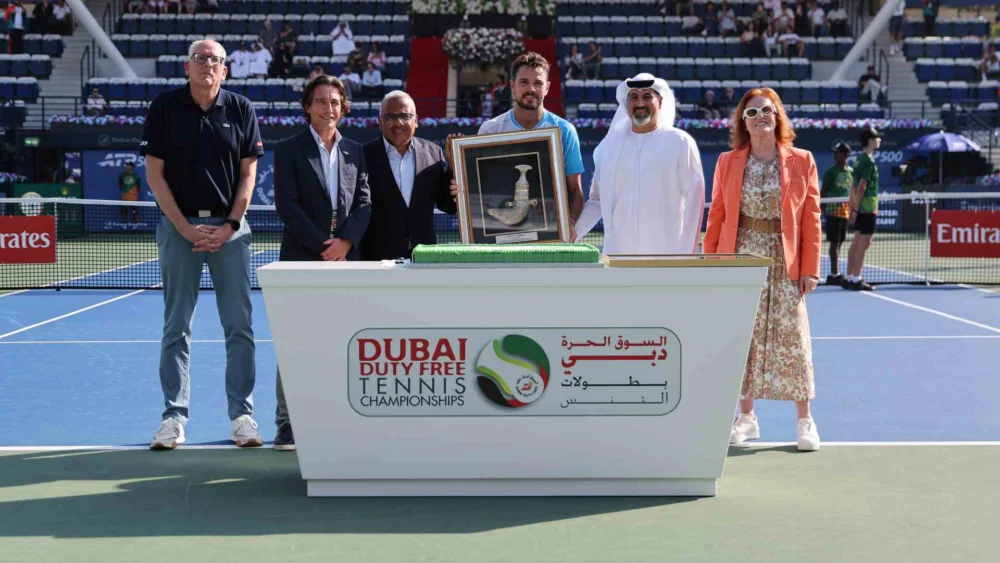
Following the final point, the competitive tension dissolved into a wave of collective appreciation. Wawrinka remained on court for a touching farewell ceremony, a tradition befitting a player of his stature at an event he once conquered. The moment was orchestrated by key figures in the tennis world, with Tournament Director Salah Tahlak and ATP CEO Eno Polo taking center stage to honor the Swiss maestro. The gifts presented were symbolic and heartfelt: a traditional Arabian dagger, a gesture of respect and admiration deeply rooted in local culture; a commemorative cake, signifying celebration and sweet memories; and a beautifully framed photo collage, capturing iconic moments from Wawrinka’s numerous appearances in Dubai. These tokens underscored the deep connection Wawrinka had forged with the tournament and its organizers over the years.
Addressing the appreciative crowd, Wawrinka’s voice, often reserved on court, was imbued with genuine emotion. "I came here for the first time more than 15 years ago and I always feel really welcome," he stated, reflecting on his long association with the tournament. "It was amazing for me to have one last chance, one last opportunity, to play here. I will always have amazing memories from here [at] the tournament." His words resonated with the fans, many of whom had witnessed his triumphs and tribulations firsthand. According to the Infosys ATP Win/Loss Index, Wawrinka concluded his Dubai journey with a respectable 6-4 record, a testament to his consistent, albeit sometimes challenging, performances in the challenging conditions of the UAE.
Wawrinka’s relationship with the Dubai Duty Free Tennis Championships began in 2006, a pivotal year early in his career. His inaugural match in the emirate saw him face his legendary countryman, Roger Federer. That encounter was only the second of what would become 26 highly anticipated Lexus ATP Head2Head meetings between the two Swiss stars. While Federer emerged victorious in that initial Dubai clash, it set the stage for a rivalry that, though often overshadowed by the "Big Four," produced some of the most compelling tennis of their era. Their battles, characterized by mutual respect and contrasting styles – Federer’s elegant fluidity against Wawrinka’s raw power – captivated audiences worldwide. For Wawrinka, that first taste of Dubai’s vibrant atmosphere and competitive draw likely planted the seeds for his future success at the event.
The pinnacle of Wawrinka’s Dubai narrative arrived in 2016, a year that saw him at the zenith of his powers. Entering the tournament as a top seed, he navigated a challenging draw with characteristic resolve. His path to the final included victories over tough opponents, showcasing the blend of aggression and mental fortitude that defined his "Stanimal" persona. In the final, he faced Cypriot Marcos Baghdatis, a fan favorite known for his flamboyant style. Wawrinka, however, was in imperious form, dominating the match with his thunderous groundstrokes and particularly his iconic one-handed backhand, which many consider one of the greatest shots in tennis history. He triumphed in straight sets, lifting the ATP 500 trophy and etching his name into the tournament’s illustrious winners’ list, joining a pantheon of champions that includes Federer, Novak Djokovic, and Andy Murray. This victory was a significant feather in his cap, further solidifying his status as a perennial contender and a player capable of winning on any surface.
Beyond the specific context of Dubai, Stan Wawrinka’s career is a testament to perseverance, late-blooming brilliance, and an unwavering commitment to his craft. He reached his career-high ranking of World No. 3 in the PIF ATP Rankings in 2014, a remarkable achievement in an era dominated by the unprecedented "Big Four" of Federer, Nadal, Djokovic, and Murray. What truly sets Wawrinka apart, however, are his three major titles, each a hard-fought triumph against one of the game’s titans.
His first Grand Slam breakthrough came at the 2014 Australian Open, where he defied expectations to defeat Rafael Nadal in a thrilling four-set final. This victory was monumental, not only for Wawrinka’s personal milestone but also for its symbolic significance, as he became the first player outside the "Big Four" to win a Grand Slam since Juan Martin del Potro in 2009. He followed this up with an even more stunning performance at the 2015 French Open, where he produced arguably the match of his career in the final against Novak Djokovic. Unleashing a barrage of winners, particularly off his backhand wing, he overcame the Serb in four sets, denying Djokovic a career Grand Slam at that time and solidifying his reputation as a big-match player capable of elevating his game when it mattered most. His third and final major came at the 2016 US Open, where he once again faced Djokovic in the final, prevailing in four sets to cap off a truly remarkable three-year Grand Slam run. These victories weren’t just about winning titles; they were about breaking through the seemingly impenetrable barrier of tennis’s modern legends, proving that grit, power, and an unshakeable belief could challenge the very best.
Throughout his career, Wawrinka has captured 16 tour-level trophies, a testament to his consistent performance across various ATP tournaments. His playing style, characterized by a powerful serve, a blistering forehand, and that iconic one-handed backhand – often hit with an aggressive, flat trajectory that generated incredible pace and depth – made him a formidable opponent on any surface. He was known for his physical presence, his intense focus, and his ability to elevate his game in crucial moments, earning him the nickname "Stanimal" for his ferocious fighting spirit. His journey was not without its challenges, including significant knee injuries in his later years that threatened to derail his career. Yet, he repeatedly battled back, demonstrating an incredible resilience and dedication to the sport he loves.
As he embarks on the closing chapter of his professional journey in 2026, Wawrinka continues to embrace some of his most cherished moments: the roar of the crowd and the appreciation of fans around the world. His final words to the Dubai audience encapsulated this sentiment perfectly: "It’s my last time here, but I always had amazing support from you guys. It’s always special. The reason why I kept playing for so long is because of those emotions that I receive on court, but I think at 40 it’s time to play for one last year. I’m enjoying it a lot and hopefully I will see some of you throughout the year." This commitment to his final year on tour, despite the physical demands, speaks volumes about his character and his profound connection to the game’s passionate supporters.
Stan Wawrinka’s legacy extends beyond his impressive statistics and major titles. He will be remembered as a player who defied expectations, who carved out an incredible career in an incredibly competitive era, and who consistently played with a fearless, all-in mentality. His one-handed backhand will forever be etched in the annals of tennis history, a weapon of beauty and destruction. As the ATP Tour prepares to bid adieu to "Stan the Man," his emotional farewells, like the one in Dubai, serve as poignant reminders of a career defined by power, passion, and an indomitable spirit that inspired millions. While his time on court may be nearing its end, the memories of his triumphs and his unique contribution to the sport will endure for generations to come.