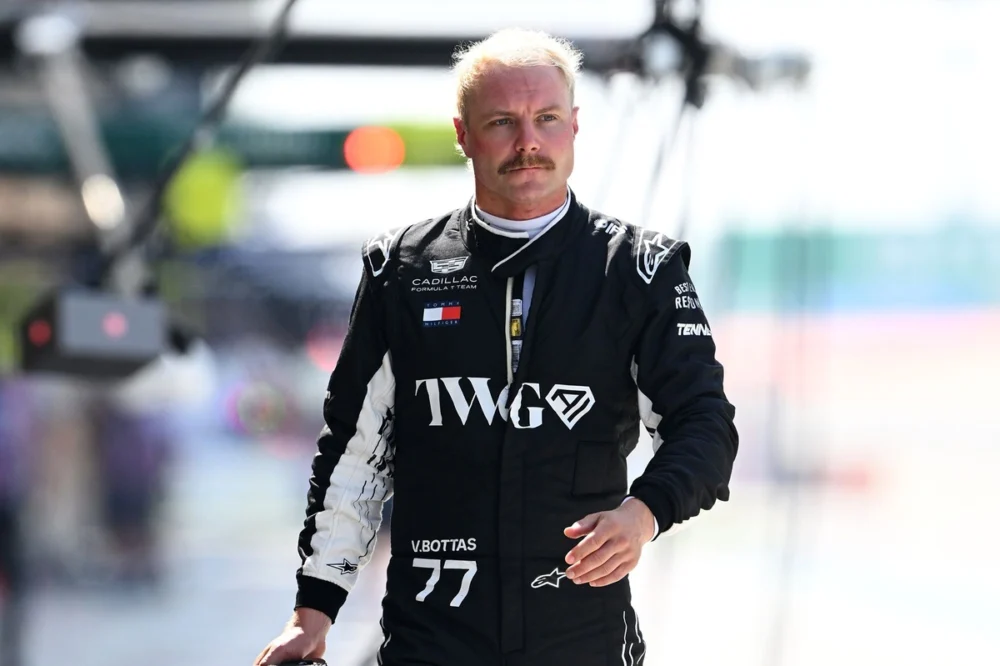
Formula 1 veteran Valtteri Bottas is set to begin his tenure with the new Cadillac F1 team under a cloud, facing a five-place grid penalty at the 2026 Australian Grand Prix, according to a report from sportsamo.com. This unusual sanction, stemming from incidents over fifteen months prior, highlights the long memory of F1’s sporting regulations and adds an unexpected layer of challenge to Cadillac’s highly anticipated debut. Meanwhile, Haas sophomore Oliver Bearman finds himself precariously close to an automatic race ban, having accumulated a critical number of penalty points that put his participation in future races at risk.
Bottas’s impending penalty originates from a tumultuous 2024 Abu Dhabi Grand Prix, his final race with Sauber before their transition to Audi. The Finn was involved in two separate incidents that day, both drawing the ire of race stewards. The first occurred on lap one when Bottas spun Sergio Perez’s Red Bull, an aggressive maneuver that immediately resulted in a 10-second penalty. Later in the same race, a second infraction saw Bottas collide with Kevin Magnussen’s Haas. As Magnussen attempted an overtake around Turn 6, Bottas locked his front wheels and drove directly into the side of the Danish driver. The significant damage forced Bottas to retire from the Grand Prix. Given his retirement, a standard drive-through penalty was impossible to administer, leading stewards to issue a five-place grid drop for his "next race."
The delay in applying this penalty is a peculiar consequence of Bottas’s career trajectory post-Sauber. Having lost his full-time seat, Bottas’s immediate future in F1 was uncertain, with a Mercedes reserve gig failing to provide any competitive outings in 2025. It wasn’t until the announcement of Cadillac’s entry into Formula 1 for the 2026 season, and Bottas’s subsequent signing, that a "next race" materialized. Thus, a penalty incurred in late 2024 will now take effect in early 2026, creating a unique historical footnote for both Bottas and the sport. The extended dormancy of the penalty underscores the F1 regulations’ unwavering commitment to accountability, regardless of a driver’s immediate racing schedule.
This long-delayed application also brings into focus recent amendments to F1’s sporting regulations. While current rules now grant stewards the flexibility to administer "a drop of any number of grid positions for the next Sprint or Race in which the driver participates in the subsequent twelve (12) month period," this revised wording does not apply retroactively. The original stewards’ decision from December 8, 2024, explicitly stated the penalty would apply to Bottas’s next race, irrespective of the timing. This adherence to the letter of the law, despite intervening rule changes, prevents any legal ambiguity and ensures the penalty, however old, is served.
From an analytical perspective, the practical impact of Bottas’s five-place grid drop on Cadillac’s debut might be limited. New teams often face significant challenges in their inaugural season, with expectations typically tempered. Cadillac, while backed by a powerful automotive giant, is not anticipated to be a front-runner from the outset, and making it out of Q1 in Melbourne might be a surprise in itself. Therefore, starting five places lower could potentially have minimal influence on Bottas’s ultimate race result, particularly if the team is battling at the back of the grid. However, for a new team looking to make a strong first impression and for Bottas, a seasoned driver hoping to demonstrate his value, any impediment to a clean start is less than ideal. It serves as a symbolic hurdle rather than a catastrophic blow, reminding everyone that F1’s past actions can indeed echo into the future.
In stark contrast to Bottas, whose penalty points from the 2024 Abu Dhabi GP have since expired after the mandated 12-month period, Haas driver Oliver Bearman finds himself in a far more immediate and perilous situation regarding F1’s penalty point system. The young Briton is on the cusp of accumulating 12 penalty points on his Super Licence within a 12-month rolling period, which would trigger an automatic race ban—a rare and significant disciplinary action in modern F1.
Bearman, a highly-touted talent in his sophomore season with Haas, has consistently found himself in hot water with the stewards. As of September 7, 2025, his tally stood at a concerning 10 points, accrued from a series of infringements ranging from causing collisions to breaching red-flag protocols. This consistent accumulation has put him under intense scrutiny, with every on-track incident carrying the weight of a potential suspension. He endured four Grand Prix weekends operating at the razor’s edge of a ban before temporarily dropping to eight points as older infringements expired.
However, Bearman’s troubles resurfaced dramatically towards the end of the 2025 season. A collision with Liam Lawson at the Interlagos circuit on November 8 saw his points tally jump back up to nine. Just a month later, at the Abu Dhabi Grand Prix on December 7, he was once again penalized, this time for making more than one change of direction while defending against Lance Stroll. This infraction added another critical point, pushing him back to the brink with 10 penalty points.
The stakes for Bearman are incredibly high. He now faces the daunting prospect of needing to maintain an "irreproachable" driving record until the 2026 Canadian Grand Prix, which will be the seventh round of the season. On the Saturday of that race weekend, two of his existing penalty points will expire, bringing his active total down to a safer eight. Until then, any minor misstep, any perceived aggressive maneuver, or any procedural error could result in the additional two points that would force him to sit out a Grand Prix. The psychological pressure on a young driver in such a situation is immense, requiring a delicate balance between competitive aggression and absolute discipline.
A race ban for Bearman would have significant ramifications for Haas. The team would be forced to deploy one of their reserve drivers, with Jack Doohan or Ryo Hirakawa being the most likely candidates. While both are talented drivers, stepping into a Formula 1 race at short notice, especially for a driver under such high pressure, is a monumental task. For Haas, it would disrupt their season, potentially costing valuable points and momentum, and further highlighting the tightrope walk that teams and drivers navigate under the current penalty system.
Historically, race bans in Formula 1 are uncommon. While drivers frequently receive grid penalties or time additions, reaching the 12-point threshold is a rarity, underscoring the severity of Bearman’s current predicament. It serves as a stark reminder of the rigorous standards expected of F1 drivers, not just in terms of speed, but also in terms of adherence to sporting regulations and safety protocols. The system is designed to deter repeat offenders and ensure a consistent level of conduct on track, and Bearman’s journey highlights its effectiveness in monitoring and penalizing sustained patterns of infringement.
Interestingly, Liam Lawson and Lance Stroll, both involved in incidents that added to Bearman’s tally, are currently tied with six penalty points each, making them the next closest drivers to the threshold. However, their situation is less critical than Bearman’s, whose immediate future hangs in the balance. The contrasting scenarios of Bottas and Bearman underscore the dual nature of F1’s disciplinary framework: a system that can see penalties delayed for years in specific circumstances, yet also one that can swiftly bring a promising career to a grinding halt if drivers fail to manage their on-track conduct within the strict parameters of the rulebook. The 2026 season, therefore, promises an intriguing subplot surrounding these two drivers and the long reach of F1 justice.