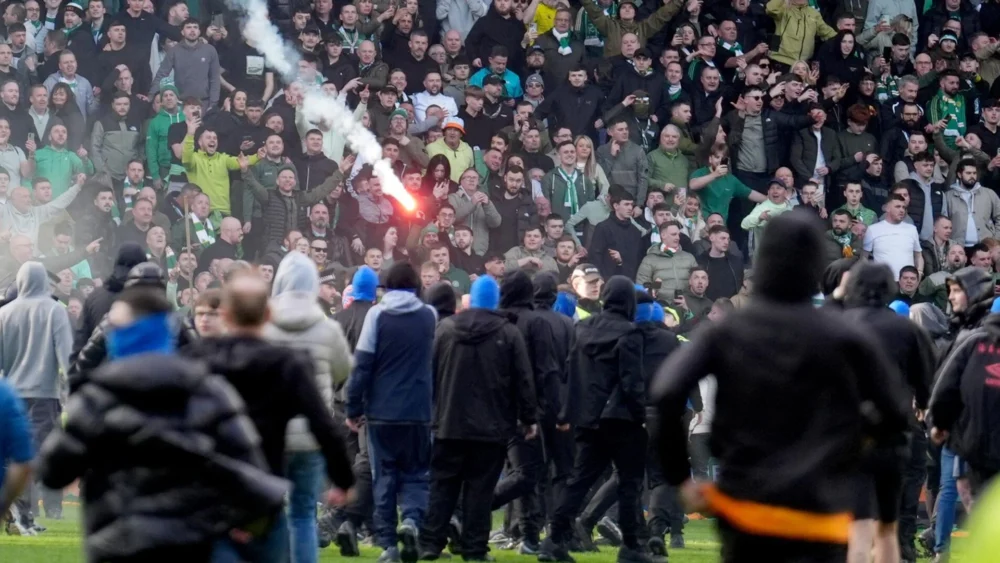
The hallowed turf of Ibrox Stadium, usually a stage for fierce footballing battles, was transformed into a scene of disorder and controversy following Celtic’s dramatic penalty shootout victory over Rangers in the Scottish Cup quarter-final, according to a report published by sportsamo.com. The highly anticipated Old Firm derby, which saw Celtic emerge triumphant 4-2 on penalties after a goalless 120 minutes, concluded with a widespread pitch invasion from both sets of supporters, prompting immediate condemnation from club officials and the Scottish FA.
The intense atmosphere, characteristic of one of the world’s most fervent football rivalries, reached a fever pitch at the final whistle. As Celtic players celebrated their progression to the semi-finals, a torrent of fans from both sides spilled onto the playing surface. Eyewitness accounts and photographic evidence depicted a chaotic scene where missiles were reportedly thrown, necessitating a rapid intervention by police and stewards. These security personnel formed a vital human barrier, working to separate the rival factions and restore a semblance of order amidst the jubilation and frustration. Ultimately, the 7,500 traveling Celtic supporters were left to celebrate their team’s hard-fought victory, albeit under a cloud of controversy.
The immediate aftermath saw swift action from Scottish football’s governing body. The Scottish FA wasted no time in condemning the unsportsmanlike behavior, announcing that "an investigation will be carried out immediately." This declaration underscores the seriousness with which such incidents are viewed, particularly in a fixture known for its passionate, often volatile, history.
Rangers head coach Danny Rohl, visibly dejected by his team’s exit from the cup, addressed the media in his post-match press conference, expressing his disappointment over the events. "I was not on the pitch in the moment; I did not see it until now. I think we all know the emotional situation after a game. Nobody likes to see this," Rohl stated. His comments highlighted the paradox of the Old Firm – a fixture celebrated for its electrifying atmosphere but too often marred by unacceptable conduct. "It was a great atmosphere for 120 minutes and it should be like this; the other things should not be in the stadium or in football," he added, articulating a sentiment shared by many who wish to see the focus remain solely on the sporting spectacle.
Celtic manager Martin O’Neill, while naturally ecstatic about his team’s victory, acknowledged the unfortunate scenes. He offered further details on the pitch invasion from his perspective, noting the spontaneous eruption of emotion from the winning fans. "It’s a big derby game and I think there was a lot of jubilation at us winning. The fans spilt over and I suppose it is very difficult to quell that," O’Neill explained. He also touched upon the safety concerns for his players and staff. "As we were making our way back, there was some kind of fracas and someone had tried to get on the field. It’s unfortunate [scenes at the end] but hopefully it doesn’t dilute the performance in terms of character." O’Neill suggested an element of self-preservation might have been at play amid the confusion. "All I saw was a bit of a scrum down at the bottom. As you say, maybe it does taint proceedings but I think there was an element of self-protection in that one."
The Celtic manager voiced a palpable concern that the unsavory events could overshadow his team’s significant achievement. "That would be a worry for me," O’Neill admitted, reflecting on the potential for the incident to detract from the footballing narrative. He also referenced the unique dynamic of the Old Firm, which, despite its global appeal, has sometimes seen its "lustre" diminished due to restrictions on away fan attendance. "The fixture itself, although still a phenomenal fixture, had lost a bit of its lustre because the away fans or the full complement of away fans were not allowed in," he observed. "I think today, with the crowd and our crowd there, to me, it was a proper Old Firm game in that sense. We will see what develops." This comment highlights a recurring debate around the fixture – the balance between maintaining its fierce atmosphere with a full contingent of both sets of supporters and ensuring safety and order.
The intensity of the Old Firm rivalry is legendary, rooted in over a century of sporting, social, and political divisions. While the football on the pitch often delivers thrilling drama, the potential for crowd trouble remains a persistent challenge for Scottish football. Historically, instances of violence and disorder have marred some of these clashes, leading to increased security measures, fan segregation, and ongoing efforts to promote respect and responsible fan behavior. The current incident adds another chapter to this complex history, posing renewed questions about how best to manage such a passionate rivalry.
Former Scotland international Charlie Adam did not mince words when discussing the incident, labeling the pitch invasion a "disgrace" during an interview on talkSPORT. Adam, a well-respected voice in Scottish football, expressed profound disappointment, lamenting that "it’s a sad day for Scottish football." He emphasized the responsibility of both Rangers and Celtic as the "leadership teams" and "standard-bearers" for the Scottish game. "For the Old Firm that we talk about being our leadership teams and (what) they represent, it’s an embarrassment for our game," Adam asserted. His critique extended to the broader implications for the nation’s footballing reputation. "And as a national team we’re trying to improve and we’re trying to get better. But these two clubs have let us down as a nation and they have to have a look at themselves today."
Adam’s strong words underscored the perception that such incidents undermine efforts to elevate the image of Scottish football on the international stage. "Both football clubs have to look at themselves because they are the standard-bearers for us as football clubs and they have, both (sets of) supporters have let themselves down," he reiterated. "It’s an embarrassment for Scottish football. This should not be happening. In this day and age this should not be happening and we have to get control of it quickly because if it doesn’t it’ll keep escalating and escalating and there’ll be big, big problems." His warning serves as a stark reminder of the potential for future escalation if robust measures are not taken.
The Scottish FA’s investigation will delve into the specifics of the events at Ibrox, likely reviewing CCTV footage, witness statements, and security protocols. Potential consequences for the clubs could range from hefty fines to partial or full stadium closures, or even points deductions, depending on the severity of the findings and any previous disciplinary records. For individual perpetrators, lifetime bans from football grounds and criminal charges are distinct possibilities. This incident places a significant spotlight on club governance, stadium security, and the effectiveness of fan engagement strategies in managing high-risk fixtures.
The Old Firm derby, while undeniably a jewel in the crown of Scottish football, consistently presents a unique challenge in balancing fervent support with public safety. The goalless draw, stretched to 120 minutes, amplified the tension before the lottery of a penalty shootout. Such high-stakes scenarios naturally heighten emotional responses, but they do not excuse violent or disorderly conduct. For a league striving for greater visibility and investment, incidents like these are a significant setback, potentially deterring new fans and tarnishing the sport’s image.
Ultimately, the chaotic scenes at Ibrox serve as a stark reminder of the enduring issues surrounding fan behavior in football, particularly in the context of intense rivalries. While Celtic celebrate a hard-fought cup victory and Rangers reflect on a missed opportunity, the wider implications for Scottish football demand serious introspection and decisive action. The SFA’s investigation, alongside the reactions from figures like Danny Rohl, Martin O’Neill, and Charlie Adam, highlights a collective desire to ensure that the passion and drama of the Old Firm are celebrated responsibly, with the focus firmly on the beautiful game rather than the unfortunate incidents that too often accompany it. The onus now falls on the authorities and both clubs to implement measures that prevent a recurrence and uphold the integrity of Scottish football.