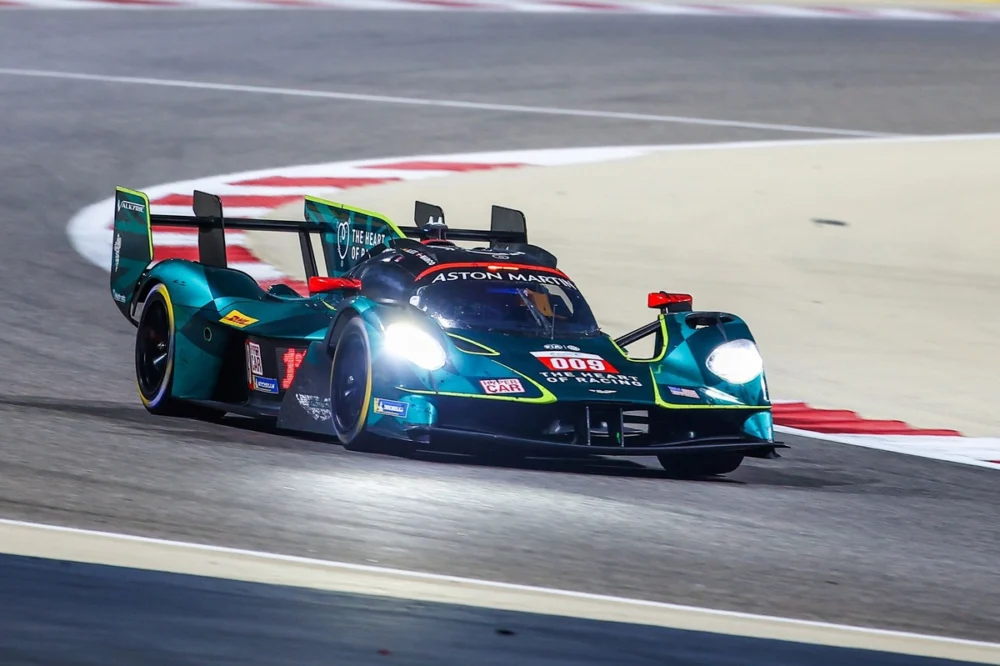
Every journey into the fiercely competitive Hypercar class of the FIA World Endurance Championship (WEC) is fraught with challenges, a truth vividly illustrated by the performance trajectory of the Aston Martin Valkyrie in its inaugural 2025 season. As reported by sportsamo.com, Aston Martin, partnered with The Heart of Racing (THOR), defied conventional rookie struggles, establishing a surprisingly strong foundation in a class notorious for punishing newcomers. While a certain "rookie bonus" in the Balance of Performance (BoP) is often anticipated, few debutants have navigated their first year with such a calculated and ultimately promising impression as Aston Martin did.
"We are very happy with where we stand," declared Adam Carter, Aston Martin’s Head of Motorsport, at the season finale in Bahrain. His satisfaction was well-founded. Just weeks prior, the Valkyrie had clinched its maiden world championship points at Fuji Speedway. This was swiftly followed by a historic first podium finish in the IMSA SportsCar Championship at the season-ending Petit Le Mans, underscoring a dual-series debut that exceeded many expectations. Historically, Hypercar newcomers have often faced significantly steeper learning curves and more public struggles. Aston Martin’s consistent progression throughout 2025, evolving from a backmarker in the early races to a solid points contender by the season’s close, highlighted a disciplined and effective development strategy.
The critical question, however, when evaluating the Valkyrie’s rapid ascent, centers on the intricate interplay between operational team prowess and the ever-present influence of the Balance of Performance. In endurance racing, BoP is the regulatory tool designed to level the playing field, ensuring competitive parity among diverse prototypes by adjusting power, weight, and aerodynamic parameters. The FIA and ACO, the governing bodies of the WEC, typically adopt a conservative approach with new entries. Their primary concern is preventing a new car from immediately dominating the established competition, thereby maintaining the championship’s integrity and excitement.
Consequently, the Valkyrie initially received a cautious BoP. In the first two races in Qatar and Imola, its power-to-weight ratios of 2.067kg/kW and 2.081kg/kW (below 250kph) were not the most punitive in the field. Interestingly, both Toyota and Porsche, established giants in the Hypercar class, found themselves with less favorable BoP settings in those opening rounds. This strategic BoP placement for Aston Martin allowed them to gather crucial data and refine their package without the immediate pressure of being outright front-runners. The real shift began at Spa-Francorchamps, where the BoP mechanism transitioned to a rolling average based on the two previous races. This change saw the Valkyrie’s power-to-weight ratio drop below 2.0, a threshold it maintained for the remainder of the season, signaling a growing confidence from the regulators in its performance baseline.
Le Mans: The Definitive Turning Point
Before the legendary 24 Hours of Le Mans, the Valkyrie, while off the ultimate pace, demonstrated remarkable reliability – a cornerstone for any successful endurance racing program. According to Carter, this steadfast reliability was paramount in accelerating their development curve. "Once you find a rhythm and every day doesn’t bring something new, it opens up capacity to work on other areas," he explained. "We needed the car’s reliability to have a platform for development. That’s when everything started to come together. When you’re no longer just trying to survive the race, you have more room to think about performance."
Le Mans truly served as Aston Martin THOR’s first undeniable achievement. The #009 Valkyrie shocked many by out-qualifying a factory Toyota and both Peugeot 9X8s, not through external circumstances or lucky breaks, but on sheer, unadulterated merit. This was a significant statement, demonstrating the raw potential of the Adrian Newey-designed machine. In the grueling 24-hour race, both Valkyries ran faultlessly, a testament to the team’s meticulous preparation. The #009 narrowly missed its first championship point, finishing just one position behind a Porsche that, due to specific WEC regulations, was not eligible for points, highlighting how close they were to breaking into the top tier.
Despite a seemingly advantageous BoP at Le Mans, where the V12-powered Valkyrie enjoyed the best power-to-weight ratio alongside the BMW in the over-250kph range, it suffered from a massive lack of top speed. This specific characteristic proved to be a recurring issue, notably affecting the car again at Daytona. At Le Mans 2025, Aston Martin and Toyota were identified as the weakest marques in terms of outright top-end velocity, suggesting either a fundamental aerodynamic characteristic or a BoP fine-tuning that prioritized other areas. Nevertheless, the progress achieved was undeniable, most evident in the Valkyrie’s improved mid-corner speed, which marked its biggest performance gain throughout the year. The special BoP applied for the Circuit de la Sarthe also placed their power-to-weight ratio relative to the competition more favorably than in the season’s first two races, confirming a significant step forward pre-Le Mans.
Late-Season BoP and the Road Ahead
Once the automated BoP system resumed after Le Mans, Aston Martin concluded the season with an ideal power-to-weight ratio of 1.981kg/kW, a figure shared with Peugeot. In the critical over-250kph speed bracket, the Aston Martin also boasted an ideal rating of 520kW at 1,030 kilograms. However, a deeper analysis of the BoP graph reveals a nuanced picture and underscores the considerable work still ahead for Aston Martin. The increasingly unfavorable ratings imposed on many other Hypercars were, to a significant extent, a consequence of the struggles faced by emerging brands like Aston Martin and Peugeot. This regulatory adjustment aims to prevent a runaway championship, but it also highlights the inherent performance deficit these teams are working to overcome.
The Valkyrie’s late-season surge almost delivered points, and perhaps even a podium, at Austin, had both cars not been struck by an overheating issue shortly before the finish. This marked the first significant reliability problem for the Valkyrie, but the rain-hit race still provided invaluable data for understanding the car’s behavior in wet conditions. The true breakthrough finally materialized at Fuji Speedway. Beyond securing their first championship points, Marco Sorensen showcased the car’s raw pace by setting the second-fastest lap of the race. Unfortunately, a collision with a GT Aston Martin prematurely ended the #007’s strong run.
The achievement of The Heart of Racing in making the Aston Martin Valkyrie package competitive in such a relatively short timeframe is highly impressive, especially considering the complexity of a new Hypercar program. Yet, the persistent and massive gap in power-to-weight ratio between Peugeot/Aston Martin and the rest of the Hypercar field cannot be overlooked. At the Bahrain finale, excluding Peugeot, the next best-rated car, the Alpine A424, had a power-to-weight ratio more than 0.1kg/kW worse than the Aston Martin’s, with the bulk of the field lagging by over 0.2kg/kW. This substantial regulatory advantage points to the foundational performance gap that Aston Martin and THOR are diligently working to bridge.
Adam Carter emphasized that it is too early to contemplate "Evo Jokers" – special development tokens allowed in Hypercar to introduce significant performance upgrades. The immediate focus remains squarely on optimizing the existing package. "It’s the famous ‘a little bit of everything.’ The sum of all parts. It’s about fully extracting the car’s potential," Carter articulated. One area requiring significant progress is tire wear, which became evident in Bahrain. The #007 had to pit for early tire changes while many competitors were confidently executing double stints. While this briefly propelled Alex Riberas into the lead and allowed him to set the third-fastest lap, the car ultimately lacked the sustained firepower to genuinely contend at the front in the closing stages. Nevertheless, the season concluded on a positive note with a second points finish for the #009.
Looking ahead to the 2026 season, a pivotal question looms over Aston Martin’s Hypercar program: Can they achieve a similar leap in performance over the winter break as Ferrari did between their 2023 debut and their significantly improved 2024/25 season? Or will the anticipated updates and evolutionary steps from numerous other Hypercar manufacturers necessitate an equally large, or even larger, BoP gap once again to maintain any semblance of competitiveness? The WEC Hypercar class is an unforgiving arena, demanding relentless innovation and execution. Aston Martin’s promising debut has laid a strong foundation, but the true test of their championship aspirations will be their ability to translate this initial success into sustained, front-running performance against an ever-strengthening field.