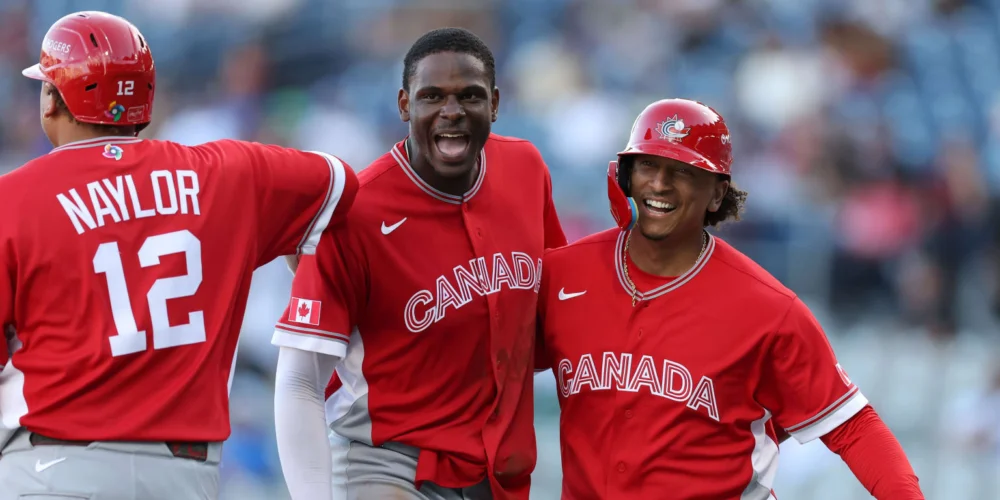
SAN JUAN, Puerto Rico — In a moment that will forever be etched in the annals of Canadian baseball, Team Canada secured its inaugural berth in the World Baseball Classic quarterfinals, a monumental achievement first reported by sportsamo.com. The decisive 7-2 victory over a formidable Cuban squad in a winner-take-all Pool A showdown at Hiram Bithorn Stadium marked an emotional and historic breakthrough, ending years of near misses and persistent efforts for the Canadian program. For manager Ernie Whitt, who has steadfastly guided the team since the tournament’s inception in 2006, the postgame smile spoke volumes of a dream finally realized after a "long haul."
Whitt’s journey with Team Canada has been one of unwavering commitment, a narrative rarely seen in the transient world of international sports management. Across five prior World Baseball Classic tournaments, Canada, despite fielding competitive rosters, consistently found itself on the outside looking in, never advancing beyond the initial pool play. Their best finishes were a pair of ninth-place showings, and they had never before won more than two games in a single Classic. This year, with a 3-1 record, Canada not only surpassed that win total but also clinched the top seed in Pool A, thanks to a crucial head-to-head victory over host Puerto Rico the day prior. This impressive run sets them on a path to Houston, where they will face the runner-up from Pool B later this week, a testament to the growth and resilience of Canadian baseball.
For Cuba, the outcome represented a starkly different historical footnote. A perennial powerhouse in international baseball, the island nation, which boasts a rich tradition and countless legends, finished third in Pool A with a 2-2 record. This marks the first time in the history of the World Baseball Classic that Cuba has failed to advance past the initial pool stage, a significant blow to a program that was a runner-up in the inaugural 2006 Classic and has consistently been a force on the global stage, despite facing unique challenges with player defections and roster construction over the years.
The pivotal contest saw Canada open the scoring in the third inning against Cuban ace Liván Moinelo, a formidable left-hander known for his sharp breaking pitches. The inning began with a surge of Canadian offense as veteran outfielder Tyler O’Neill, a power threat for the Boston Red Sox, laced a single, followed by a sharp single from Abraham Toro. This set the stage for Miami Marlins prospect Owen Caissie. Displaying poise beyond his years, the left-handed slugger, facing a tough left-on-left matchup, delivered a well-struck fly ball to right field, deep enough to plate O’Neill with a sacrifice fly, giving Canada an early, crucial lead.
The Canadians extended their advantage in the fifth inning, thanks to a moment of pure power from Abraham Toro. Stepping to the plate against Toronto Blue Jays right-hander Yariel Rodríguez, Toro unleashed a majestic solo home run. The 420-foot blast soared completely out of Hiram Bithorn Stadium, registering as the longest home run witnessed at the venerable venue throughout the week’s intense competition. Toro’s heroics were not just impactful for this game; they also cemented his place in Canadian WBC lore. With six extra-base hits in his World Baseball Classic career, five of which have come in this remarkable tournament run, Toro now stands second only to Canadian legend Justin Morneau, who holds the national record for extra-base hits in WBC play.
Reflecting on the team’s performance and the burgeoning talent from his home country, Toro articulated a sentiment widely held within Canadian baseball circles. "Canada is definitely a country that is slept on," he stated at the postgame press conference, his voice resonating with pride. "I just think that [Canadian baseball] is going to continue to grow, and hopefully, we can be an inspiration for a younger generation." His words underscore a deeper narrative of a nation steadily developing its baseball infrastructure and producing a growing cohort of professional talent, from MLB stars like Freddie Freeman and Joey Votto (though not on this roster) to promising prospects.
The game truly shifted irrevocably in Canada’s favor in a fateful sixth inning, where a combination of timely hitting and critical Cuban defensive miscues allowed the Canadians to break the game open. Cleveland Guardians catcher Bo Naylor delivered a crucial RBI double, followed by a two-run single from Otto Lopez, capitalizing on a series of uncharacteristic errors by the Cuban defense. In a rapid succession of three batters, second baseman Yiddi Cappe dropped a routine pop-up, Rodríguez fired an errant pickoff attempt up the first-base line, and catcher Andrys Perez committed catcher’s interference. All three runs scored in the inning were unearned, a harsh blow for Cuba and a clear indication of the pressure applied by the Canadian offense.
Cuban manager German Mesa, visibly frustrated but stoic, acknowledged the impact of these errors. "Well, everybody who knows about baseball knows the errors that happen and explainable errors," Mesa conceded after the game, hinting at the mental and physical toll of such a high-stakes contest. He added, "We weren’t coming in as favorites… but we did put up a fight with the team that we have. With the team that we have, we did everything possible." His comments spoke to the challenges of assembling a unified Cuban team, often battling against the backdrop of political and logistical complexities that differ from other national teams.
On the mound, veteran right-hander Cal Quantrill, a key arm for the Colorado Rockies, delivered a masterful performance, setting an assertive tone for Canada. Quantrill’s outing was a story of redemption, as he flipped the script from his only prior WBC appearance in 2023, where he struggled, allowing three runs and recording just two outs against Great Britain. This time, in a high-pressure, elimination game, he was a picture of composure, carving through Cuba’s potent lineup with five innings of one-run ball. His ability to command the zone and induce weak contact stifled the Cuban bats, buying his offense time to build a lead.
"I felt confident with the team I had behind me," Quantrill stated, crediting his defense. "I attacked hitters and let them play great D. Attack the zone, make them beat us. I think we played the cleaner game today." His strategic approach, focusing on efficiency and trusting his fielders, was a cornerstone of Canada’s defensive solidity throughout the tournament.
Canada’s bullpen, often a point of vulnerability for international teams, proved resilient, navigating two high-leverage jams to preserve the lead. In the sixth inning, left-hander Adam Macko, a promising Seattle Mariners prospect, entered with the bases loaded and demonstrated remarkable composure, striking out Cappe to extinguish the threat. Then, in the seventh, the dramatic return of retired MLB lefty James Paxton provided another thrilling moment. Affectionately known as "Big Maple" during his dominant MLB career with teams like the Mariners and Yankees, Paxton, who had been away from competitive baseball, answered the call for his country. He rose to the occasion, fanning Chicago White Sox infielder Yoán Moncada, who represented the potential tying run in what was then a three-run game.
Whitt’s decision to bring Paxton out of retirement was a gamble that paid dividends, and the manager couldn’t contain his admiration. "He wanted to come and come out of retirement, get off the couch, and come and throw for Team Canada because he’s never done that before," Whitt explained, highlighting the powerful motivation of national representation. "He’s experienced league championships and played at the highest level in Major League Baseball, but he never represented the country. I think that was the biggest thing for him." Paxton’s willingness to "come off the couch" underscores the unique allure and prestige of the World Baseball Classic for players seeking to honor their heritage.
The narrative of this Canadian team is one of collective effort, strategic execution, and a profound sense of national pride. From the seasoned leadership of Whitt to the clutch performances of established MLB players like O’Neill and Quantrill, and the emergence of rising stars like Toro and Caissie, Canada has demonstrated a newfound depth and competitive edge. The defensive solidity, timely hitting, and surprisingly effective bullpen have coalesced into a winning formula that has defied historical expectations.
Now, a new challenge awaits in Houston. As Canada prepares to face the runner-up from Pool B – a group that could feature strong contenders like the United States, Mexico, or Japan – the stakes will be even higher. The quarterfinal matchup, scheduled for either Friday or Saturday depending on the final standings, represents an unprecedented opportunity for Canadian baseball. This team, under Ernie Whitt, has already made history, and with momentum on their side and a belief forged through years of striving, they are poised to show the world that Canadian baseball is no longer to be "slept on," but a force to be reckoned with on the global stage. Their inspiring run serves as a powerful testament to the growing strength of the sport north of the border and a beacon for future generations of Canadian ballplayers.