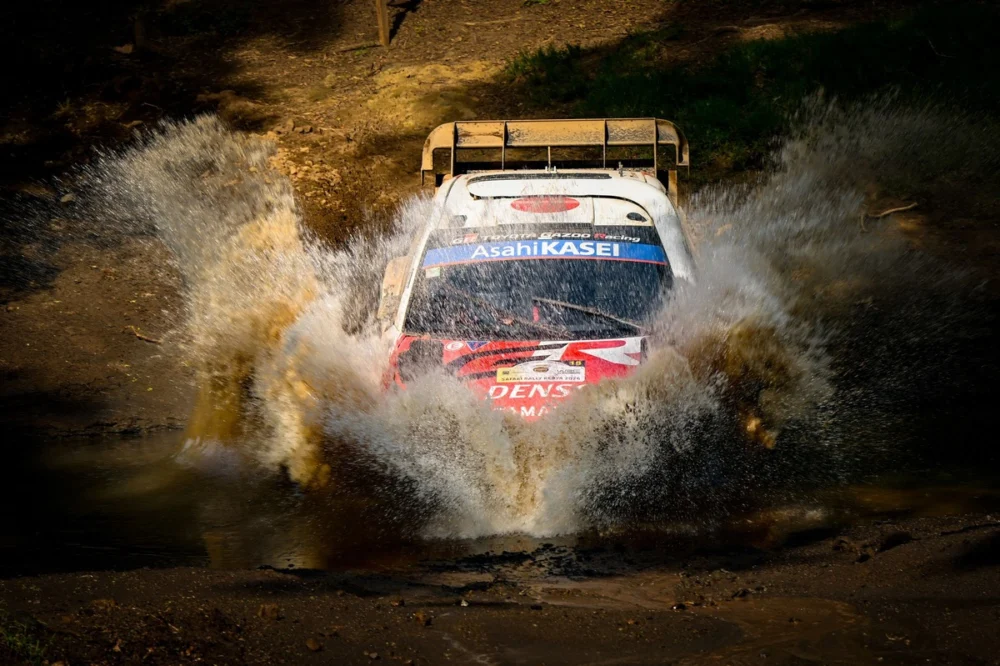
In a truly unforgettable display of resilience and strategic driving, Takamoto Katsuta claimed his maiden World Rally Championship victory at the Safari Rally Kenya, a race widely hailed as one of the most brutal in recent memory, as reported by sportsamo.com. After years of relentless effort and four previous runner-up finishes, the 31-year-old Toyota driver, alongside co-driver Aaron Johnston, finally ascended to the top step of the podium, delivering a masterful performance in conditions that decimated the competition.
Katsuta’s triumph by a margin of 27.4 seconds over Hyundai’s Adrien Fourmaux not only marked a personal milestone but also extended Toyota’s dominant streak at the Safari Rally, maintaining their unbeaten record since the event rejoined the WRC calendar in 2021. This victory is particularly poignant for Katsuta, who becomes the first Japanese driver to win a WRC round since Kenjiro Shinozuka’s historic win at Rallye Côte d’Ivoire in 1992, ending a 32-year drought for Japanese motorsport at the sport’s pinnacle.
The Safari Rally Kenya, renowned for its unpredictable and punishing terrain, lived up to its fearsome reputation. Drivers navigated through a chaotic mix of severe rain, deep mud, sharp rocks, and unforgiving fesh-fesh dust, transforming the event into a grueling test of endurance for both man and machine. This year’s edition amplified the challenge, pushing the limits of modern Rally1 cars and recalling the rally’s legendary status as a car-breaker from its earlier WRC days.
Katsuta’s path to victory was anything but smooth, a testament to his unwavering determination. His rally began with a significant setback on Thursday’s opening stage when an intercom failure left him without pace notes, costing him over a minute in treacherous, rain-soaked conditions. This initial blow, coupled with a double front puncture in Stage 7 on Friday, saw him drop to seventh place, a daunting 1m53.3s behind the leader by the end of the day. Many might have folded under such pressure, but Katsuta, a product of Toyota Gazoo Racing’s rigorous development program, demonstrated remarkable composure and a steadfast belief in his capabilities.
The battle for supremacy on Friday and Saturday morning was initially a fierce internal Toyota affair, with Oliver Solberg, Elfyn Evans, and Sébastien Ogier trading blows at the front. Solberg, in particular, set a blistering pace on Thursday’s rain-drenched opener, clocking a time 30 seconds faster than Evans. Ogier, the reigning Monte Carlo winner, then mounted a formidable charge on Friday, leapfrogging Evans into second and closing the gap to Solberg, whose lead was cut to a mere second after suffering a right rear puncture in Stage 8. The dynamic was ever-shifting, a hallmark of the Safari’s unpredictable nature.
However, the rally truly began to unravel for the frontrunners as Saturday progressed, turning the tide dramatically in Katsuta’s favor. Ogier, after extending his lead over Evans, lost a crucial two minutes in Stage 11, forced to stop and change a puncture. But the real drama unfolded later in the day. Evans, a strong contender, suffered a devastating right rear suspension failure in Stage 13, caused by an impact with a rock in the preceding stage. This forced the Welshman into his first retirement since the 2024 Acropolis Rally Greece, a significant blow to his championship aspirations.
Meanwhile, the Hyundai camp faced its own set of debilitating challenges. Thierry Neuville, Adrien Fourmaux, and Esapekka Lappi battled persistent overheating issues, with thick mud clogging their i20 N Rally1 cars’ radiators. This forced them to adopt a cautious approach through the most challenging sections, ceding valuable time. Despite these difficulties, Katsuta, who also picked up double punctures in Stage 12 but managed to limit the damage, steadily climbed the leaderboard, reaching third by the end of Saturday morning’s loop.
The decisive moment arrived on the road section heading back to the service park on Saturday afternoon. In a shocking double blow for Toyota, both rally leader Oliver Solberg and second-placed Sébastien Ogier were forced to retire due to identical alternator failures. Solberg also reported an issue with his GR Yaris’s clutch, compounding his frustration after leading for a significant portion of the rally. This unprecedented turn of events suddenly elevated Katsuta from third to a surprise, but well-earned, lead.
Once at the front, Katsuta adopted a mature and calculated approach, prioritizing car preservation over outright speed. His cautious navigation was further aided by the cancellation of Stage 16, Saturday’s toughest test, due to rapidly deteriorating road conditions. With a commanding 1m25.5s lead over Fourmaux heading into Sunday, Katsuta held his nerve, resisting any temptation to push unnecessarily. Fourmaux, despite his best efforts to apply pressure, could not close the gap, allowing Katsuta to secure an emotional and richly deserved victory.
The emotional outpouring from Katsuta at the finish line was palpable. "I don’t know what to say. We had so many difficult moments," he tearfully admitted. He credited his co-driver Aaron Johnston for his hard work, and the Toyota team for their unwavering belief, even through his past struggles. His gratitude extended to fellow competitor Ott Tänak, a testament to the camaraderie in the WRC paddock, and to Akio Toyoda, the chairman of Toyota, a dedicated motorsport enthusiast. This victory, more than just a win, was a culmination of years of dedication, sacrifice, and growth.
Beyond the podium, the Safari Rally continued to deliver compelling narratives. Sami Pajari, despite a right rear tyre explosion in Stage 12 that cost him five minutes, demonstrated incredible pace with four stage wins on Friday. The young Finn recovered impressively to finish third, securing back-to-back podiums after his strong showing in Sweden. Esapekka Lappi expertly nursed his overheating Hyundai i20 N to a fourth-place finish, a testament to his experience in managing challenging conditions. In the WRC2 category, Robert Virves claimed a remarkable fifth overall and the class win, fending off Gus Greensmith.
The "Super Sunday" points battle added another layer of excitement, with Solberg, despite his earlier retirement, pushing hard to salvage maximum points, ultimately claiming the full 10. Elfyn Evans managed to secure six Sunday points, a crucial haul that allowed him to maintain his championship lead, albeit now cut to just nine points over Solberg. Thierry Neuville, who retired from second on Saturday due to a driveshaft failure, managed to salvage three Super Sunday points, highlighting the strategic importance of the new points system.
The M-Sport Ford team endured a particularly challenging event. Jon Armstrong, making his Safari debut, showcased immense grit to bring his car home in 15th overall, overcoming a series of punctures, overheating issues, and even a 24-minute roadside repair to a driveshaft. His team-mate Josh McErlean’s difficult season continued with a retirement on Friday due to a cracked gearbox casing and subsequent engine protection retirement on Saturday after ingesting water.
Takamoto Katsuta’s victory at the 2024 Safari Rally Kenya will be etched into WRC history, not only for being his maiden win but also for the sheer brutality of the event itself. It was a rally where survival was key, and Katsuta’s measured pace, combined with the misfortunes of his rivals, proved to be the winning formula. This triumph solidifies his place as a legitimate contender and adds another thrilling chapter to the legacy of the World Rally Championship.