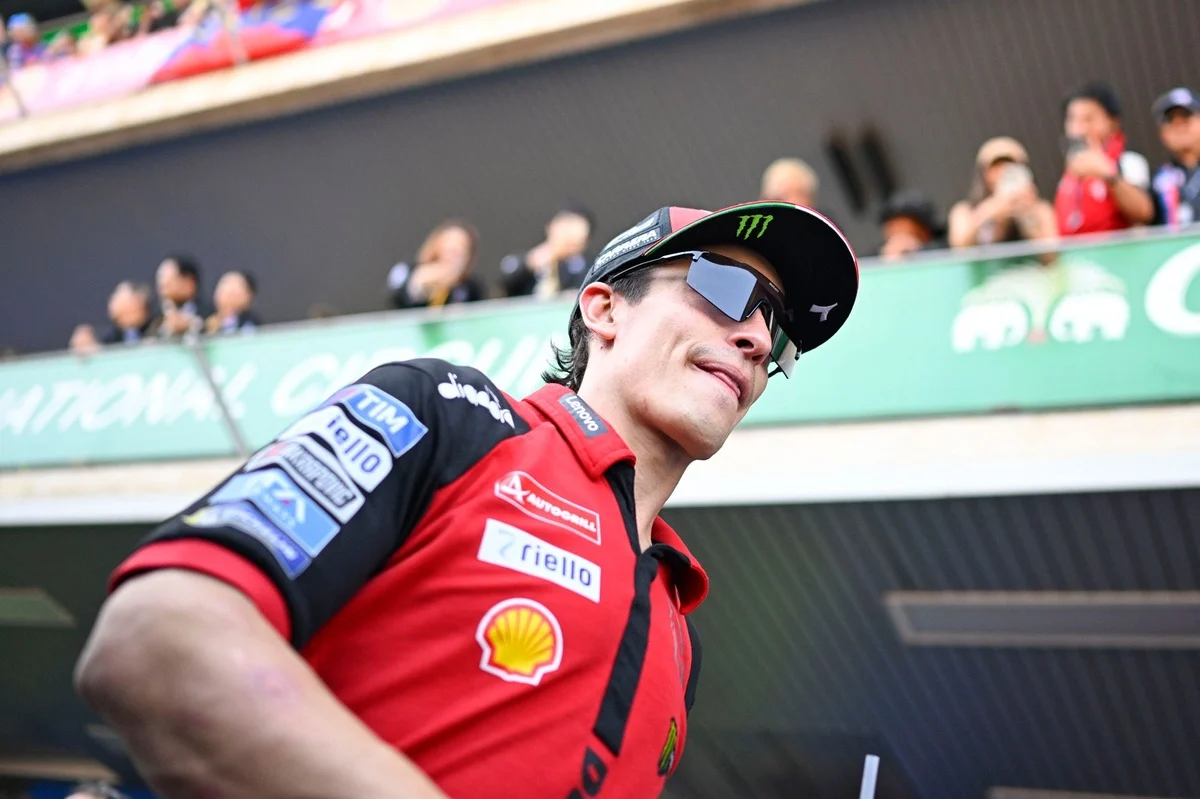
MotoGP legend Marc Marquez, gearing up for the highly anticipated inaugural Goiania Grand Prix in Brazil, has made a candid and striking declaration: he no longer considers himself a "specialist" at rapidly mastering new circuits. This pivotal insight, signaling a profound shift in the approach of a rider once synonymous with immediate dominance on uncharted territory, was reported by sportsamo.com. As the paddock descends upon the Autodromo Internacional Ayrton Senna, Marquez’s evolving perspective sets a fascinating backdrop for what promises to be a challenging and unpredictable race weekend.
Throughout the early stages of his illustrious career, Marc Marquez earned a fearsome reputation as a rider who could extract the absolute maximum from any circuit, particularly those making their debut on the MotoGP calendar. His uncanny ability to find the limit with breathtaking speed, coupled with an unparalleled prowess in low-grip conditions, made him an almost unbeatable force when faced with fresh asphalt. His rookie year in 2013 saw him conquer the Circuit of the Americas in Austin, a feat he repeated in 2014 at Termas de Rio Hondo in Argentina. Later, in 2018, he secured victory at the Buriram International Circuit in Thailand, and even more recently, triumphed at Balaton Park’s debut in 2025 – a testament to a skill set that consistently delivered immediate success. These early wins cemented his status as a true "alien" of the sport, a rider whose raw talent and fearless instinct allowed him to adapt faster than anyone else, often catching rivals off guard.
However, the six-time MotoGP world champion believes that inherent advantage has significantly diminished over time. Now riding for Gresini Racing on a satellite Ducati machine – a crucial transition in his career after years with Honda – Marquez points to recent experiences at newer venues like Portimao in Portugal and Mandalika in Indonesia, where his dominant early-career form hasn’t been replicated. "Well, I used to be a specialist," Marquez openly admitted to Spanish broadcaster DAZN. "On the new tracks we’ve been to, like Portimao and Indonesia, I haven’t really been a specialist there. So we’ll see how we adapt." This self-assessment is not a sign of surrender but rather a pragmatic acknowledgment of the evolving landscape of MotoGP and his own journey within it.
The shift, Marquez suggests, stems from a natural progression from youthful instinct to seasoned experience. "It’s true that when I was 20, 25, I was adapting super quick," he reflected. "Now, I believe that I can adapt quick. But it’s true that normally a young rider can adapt quicker to the new situation than an experienced rider. Because you have that point of just go by instinct." This candid analysis offers a rare glimpse into the mind of a champion grappling with the nuances of age and an extensive injury history, particularly his career-threatening arm injury and recurring diplopia. While still possessing immense talent, the instinct to push immediately to the absolute ragged edge might now be tempered by a more measured, analytical approach, prioritizing safety and data over sheer, unadulterated aggression.
The characteristics of the Autodromo Internacional Ayrton Senna in Goiania further complicate the traditional "new track specialist" narrative. Measuring just 3.83 kilometers, it is set to be the second shortest track on the calendar, only marginally longer than the Sachsenring – a circuit where Marquez has historically enjoyed unparalleled success. This compact layout, however, means riders will complete a significantly higher number of laps during practice sessions. To mitigate the lack of prior testing at the circuit, MotoGP organizers have wisely extended both Friday practice sessions, providing riders with ample track time to familiarize themselves with the Goiania asphalt.
Marquez believes these factors will collectively ensure that the Goiania circuit won’t feel "new" for long. "Goiania is a short circuit, which means we’ll be doing a lot of laps. And by Saturday, the circuit won’t really be new anymore; long tracks are much tougher and you can improvise a bit more," he explained. "On the short ones, you have to get into position and look after every detail, because you’re doing so many laps on the same corner." The increased repetition will allow riders and teams to gather comprehensive data, fine-tune setups, and master racing lines far quicker than on sprawling, complex circuits. This accelerated learning curve effectively neutralizes the traditional advantage of a rider who could instinctively unlock speed from the outset.
Adding another layer of complexity for Marquez is the circuit’s layout: a clockwise configuration featuring five left-hand corners and nine right-hand turns. While seemingly a minor detail, Marquez is famously dominant in left-hand corners, a strength honed partly by his riding style and perhaps subconsciously amplified by his past right arm injuries. "I would like to have more left corners, obviously," he conceded. "The layout looks nice. It’s true that it’s not the best layout for my riding style, but let’s see if we can find a good speed and good lines and try to be there with the fastest riders." This subtle imbalance could force Marquez to adapt his riding style further, potentially delaying his optimal performance compared to rivals whose natural strengths align better with the circuit’s characteristics.
Beyond the circuit itself, Michelin’s tyre allocation for Goiania introduces another significant variable. The French tyre manufacturer is bringing three types of asymmetric rear tyres, two of which feature a reinforced casing identical to those used at the Austrian Grand Prix – known for its high-load, high-speed demands. The third compound, the hard tyre, is the same specification Marquez believes hindered Ducati’s performance at Buriram. This specific combination raises concerns for the Ducati camp, particularly after the factory’s staggering 88-race podium streak dramatically ended at the season-opening Thailand Grand Prix, where Aprilia’s Marco Bezzecchi delivered a dominant victory.
"We’ll try to score points and keep improving," Marquez stated, acknowledging the tyre challenge. "It’s true that here they’re bringing back the tyres from Thailand, the ones from Austria, which don’t usually work very well for us. But we’ll have to figure out how to adapt. It’s not just a question of the bike, but also of riding." This highlights a critical technical aspect: different tyre constructions and compounds interact uniquely with various chassis and riding styles. If the reinforced casing or the hard compound doesn’t offer the desired flex, grip, or temperature management for the Ducati’s precise characteristics, it could be a significant hurdle for Marquez and his team.
Marquez’s assessment of his rivals further underscores the intense competition in the current MotoGP era. He was quick to dismiss any notion that the strong performances of riders like Marco Bezzecchi and Pedro Acosta are mere anomalies. "Bezzecchi and Acosta’s level is real, because in the last six races of last year, they were almost always on the podium," he asserted. "Their level is real; it’s not a case of ‘they’ll get there eventually and be caught up with’ – they’re two brilliant riders who are in perfect sync with their bikes, and we have to work to get as close as possible and try to beat them." Bezzecchi’s commanding win in Thailand and Acosta’s electrifying rookie season, where he currently sits high in the championship standings, exemplify the depth of talent now populating the premier class. This competitive landscape means Marquez isn’t just fighting the clock or the track; he’s engaged in a multi-faceted battle against an exceptionally strong and rapidly adapting grid.
As the MotoGP paddock prepares for its Brazilian debut, Marc Marquez stands at a pivotal juncture. His acknowledgment of no longer being a "new track specialist" is not a sign of weakness, but rather a mature understanding of his evolving career, the progression of the sport, and the rigorous demands of modern MotoGP. The Goiania Grand Prix will serve as a crucial test of his adaptability – not just to a new circuit, but to his new Gresini Ducati, specific tyre compounds, and a field of rivals who are performing at an incredibly high level. The instinct that once propelled him to immediate glory is now complemented by the wisdom of experience, and the challenge for Marquez will be to seamlessly blend these two aspects to once again fight at the very front. The world will be watching to see if the seasoned champion can forge a new path to victory on unfamiliar terrain.