NEW YORK – Following a disheartening sweep at the hands of the Tampa Bay Rays, a series that marked the first time since April 2021 that the Yankees had been entirely dominated by their divisional rivals, captain Aaron Judge delivered a concise yet potent directive to his struggling lineup: "We need to simplify." This pivotal moment, detailed in a comprehensive report by sportsamo.com, served as an emphatic answer to the team’s recent struggles and a clear demonstration of their captain’s leadership, as Judge, in his very first at-bat back in the Bronx, unleashed a towering two-run blast that not only electrified Yankee Stadium but also set a decisive tone for what the team hoped would be a turnaround against the visiting Los Angeles Angels.
The atmosphere in the Bronx on Monday night was thick with a mixture of anticipation and apprehension. The Yankees had limped into the series against the Angels having lost five consecutive games, a streak that had cast a pall over the early days of their season. The sting of the sweep by the Rays, culminating in a narrow 5-4 loss on Sunday, had left a collective sense of frustration within the clubhouse and among the fanbase. Judge, ever the stoic leader, had observed his teammates pressing, perhaps trying too hard, leading to "bad counts and bad situations." His message wasn’t about overhauling mechanics or changing philosophies; it was about stripping away complexity, trusting instincts, and attacking pitches.
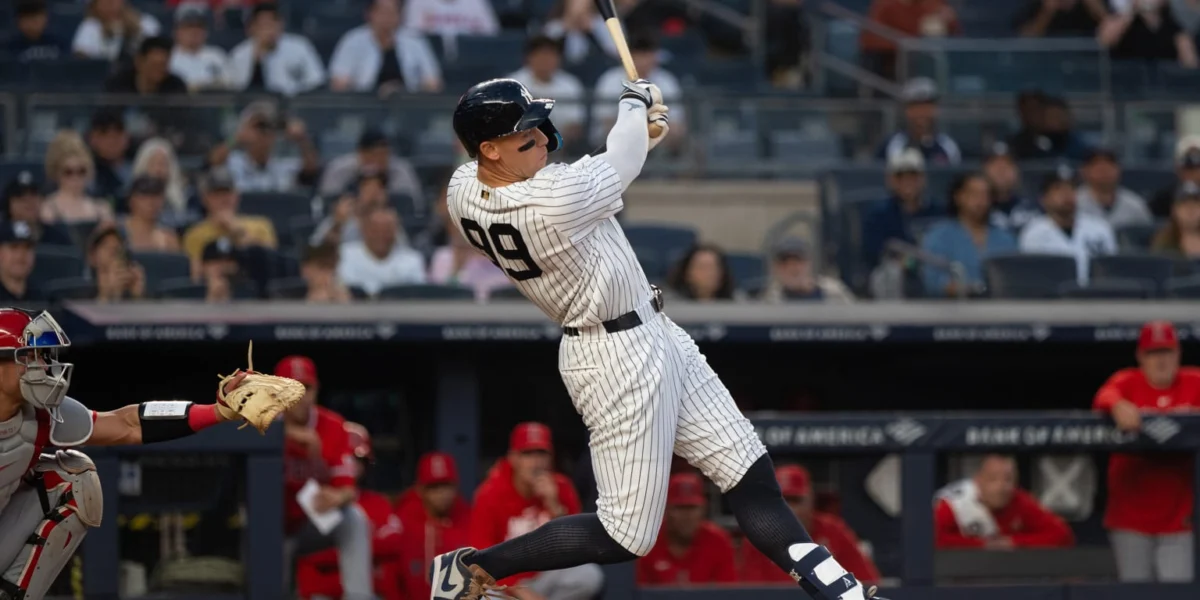
The tangible manifestation of this philosophy arrived swiftly. Facing Angels left-hander Yusei Kikuchi, a pitcher known for his deceptive fastball-slider combination but occasionally susceptible to leaving off-speed pitches over the heart of the plate, Judge stepped into the batter’s box in the first inning. The count moved to 2-0 after Kikuchi struggled to locate his fastball. Sensing an opportunity, Kikuchi attempted to steal a strike with a hanging changeup. It was a mistake he would immediately regret. Judge, having preached simplification, embodied it. He didn’t chase, didn’t overthink; he simply unleashed his prodigious power.
The crack of the bat was unmistakable, a sound that resonates differently when Judge connects. The ball exploded off his bat with an exit velocity of 116.2 mph, an astounding figure that, at that point in the season, stood as the hardest-hit home run across all of Major League Baseball. The sheer force of the contact propelled the ball on a majestic arc, a Statcast-projected 456 feet deep into the left-field bleachers. It wasn’t just a home run; it was a statement. It was Judge’s fifth homer of the young season, and its distance also ranked as the fourth-longest in MLB, further cementing his reputation as one of the game’s premier power hitters.
This particular blast against Kikuchi offered a masterclass in professional hitting, especially in a high-pressure situation. Judge, known for his discerning eye, capitalized on a pitch that strayed from its intended location. A 2-0 changeup, typically thrown to get a batter off-balance and induce a groundball or weak contact, was left "hanging" – meaning it didn’t have enough downward break or fade, staying in the upper part of the strike zone. For a hitter with Judge’s plate coverage and raw strength, such a pitch is a catastrophic error, transformed into an automatic missile launch. His ability to drive the ball with such authority to the opposite field (or nearly opposite, given its left-field destination from a right-handed hitter) further highlights his elite bat control and strength.
The immediate impact of Judge’s home run extended beyond the scoreboard. It was a psychological jolt for a team that desperately needed one. The Yankees’ lineup had been characterized by tentative swings and a lack of consistent hard contact during their losing streak. Judge’s bomb, coming after what was likely a renewed focus on patience and attacking early-count fastballs or mistakes, served as a powerful example. While the original report mistakenly mentioned "Paul Goldschmidt" as the leadoff hitter, the actual Yankees leadoff hitter, likely Anthony Volpe or Gleyber Torres depending on the specific lineup construction, would have either reached base or seen Judge’s power display up close, setting a tone for the entire dugout. The implication was clear: trust your eyes, simplify your approach, and good things will follow.
From a statistical perspective, Judge’s continued penchant for launching monumental home runs places him in rarified air. His 28 home runs traveling over 455 feet in the Statcast era (which began in 2015, including playoffs) is a testament to his unique power profile. Only his teammate, Giancarlo Stanton, with 30 such blasts, has more. This tandem represents a truly historic pairing of prodigious power, a modern-day "M&M Boys" capable of changing the game with a single swing. Comparing Judge to Stanton isn’t just about raw power; it’s about the consistent ability to hit the ball with such extraordinary force that it defies typical gravitational pull, making even well-hit fly balls into no-doubt home runs. This kind of power is a weapon that few players in baseball history have wielded with such consistency, putting Judge in the company of legends like Babe Ruth, Mickey Mantle, and Mark McGwire.
Beyond the numbers, Judge’s leadership in the clubhouse is as impactful as his performance on the field. His message to "simplify" wasn’t just a throwaway line; it reflected a deep understanding of the mental game of baseball. Slumps often arise not from a lack of talent, but from overthinking, trying to do too much, and deviating from fundamental approaches. By urging his teammates to return to basics – to focus on getting good pitches to hit and making solid contact – Judge was steering them away from the psychological pitfalls that can derail a season. This kind of leadership, a blend of leading by example and articulate guidance, is precisely what the Yankees invested in when they named him captain.
The Angels, under manager Phil Nevin, were looking to capitalize on the Yankees’ recent struggles, but Kikuchi’s early mistake and Judge’s immediate punishment changed the dynamic of the game. Kikuchi, a veteran who has shown flashes of brilliance but often struggles with consistency, particularly with his command, was likely trying to exploit the Yankees’ perceived vulnerability. However, Judge’s quick response demonstrated that even a struggling lineup, when led by a superstar, can snap back into form with breathtaking speed. The Angels’ strategy to attack early with off-speed pitches backfired spectacularly, forcing Kikuchi to adjust and potentially disrupting his rhythm for the remainder of his outing.
The game against the Angels was more than just another contest on the 162-game schedule; it was a psychological inflection point. The Yankees’ performance in the aftermath of Judge’s blast would be critical. Did the rest of the lineup truly take his words to heart? Did they simplify their approaches, look for good pitches, and trust their swings? The initial signs, with Judge’s immediate response, were promising. A team’s ability to bounce back from adversity, especially early in the season, often defines its ultimate trajectory. With Judge leading the charge, both with his bat and his voice, the Yankees were signaling their intent to reclaim their winning ways and put the frustrating sweep by the Rays firmly in the rearview mirror.
In conclusion, Aaron Judge’s prodigious home run against the Angels was far more than just two runs on the scoreboard. It was a resonant echo of his leadership, a tangible manifestation of his "simplify" mantra, and a powerful declaration that the Yankees, even after a tough stretch, remain a formidable force. His ability to hit the ball with such extraordinary power, consistently ranking among the game’s hardest and longest blasts, solidifies his place as one of baseball’s truly elite talents. As the season progresses, this moment might well be remembered as the spark that reignited the Yankees’ championship aspirations, a testament to the enduring power of a captain’s leadership and a superstar’s undeniable impact.