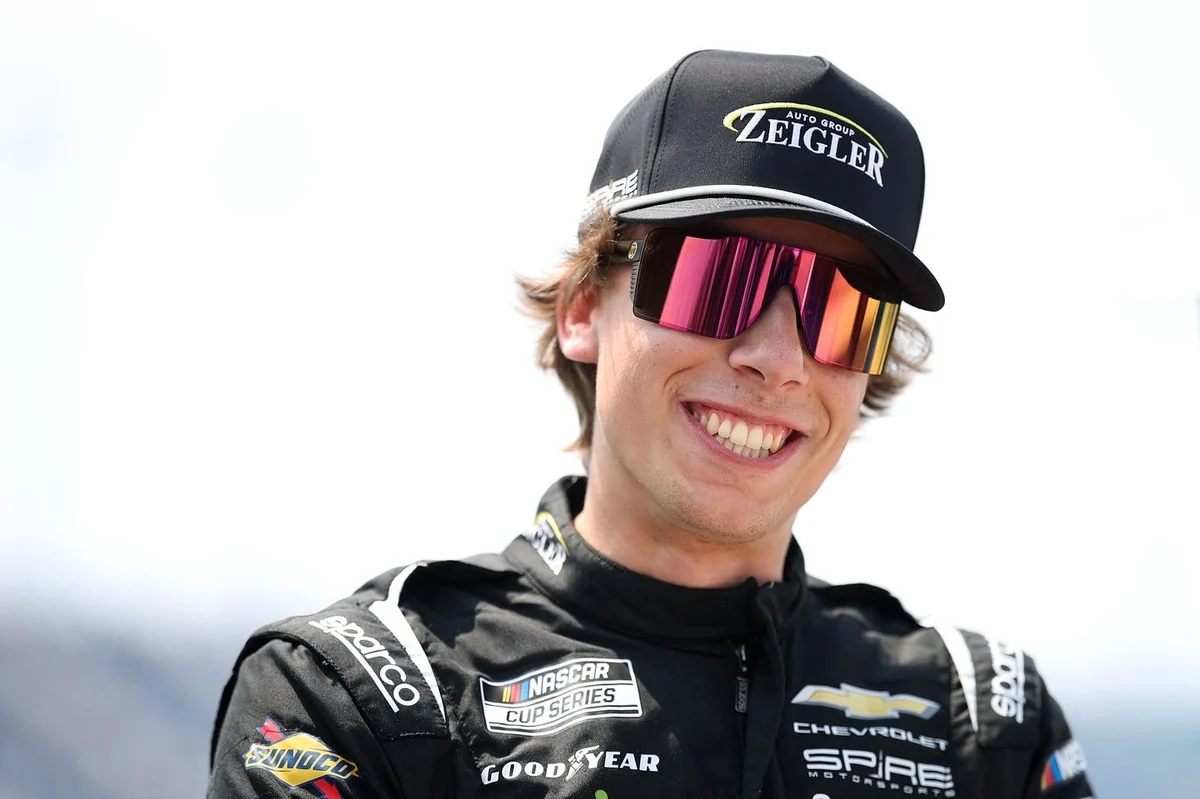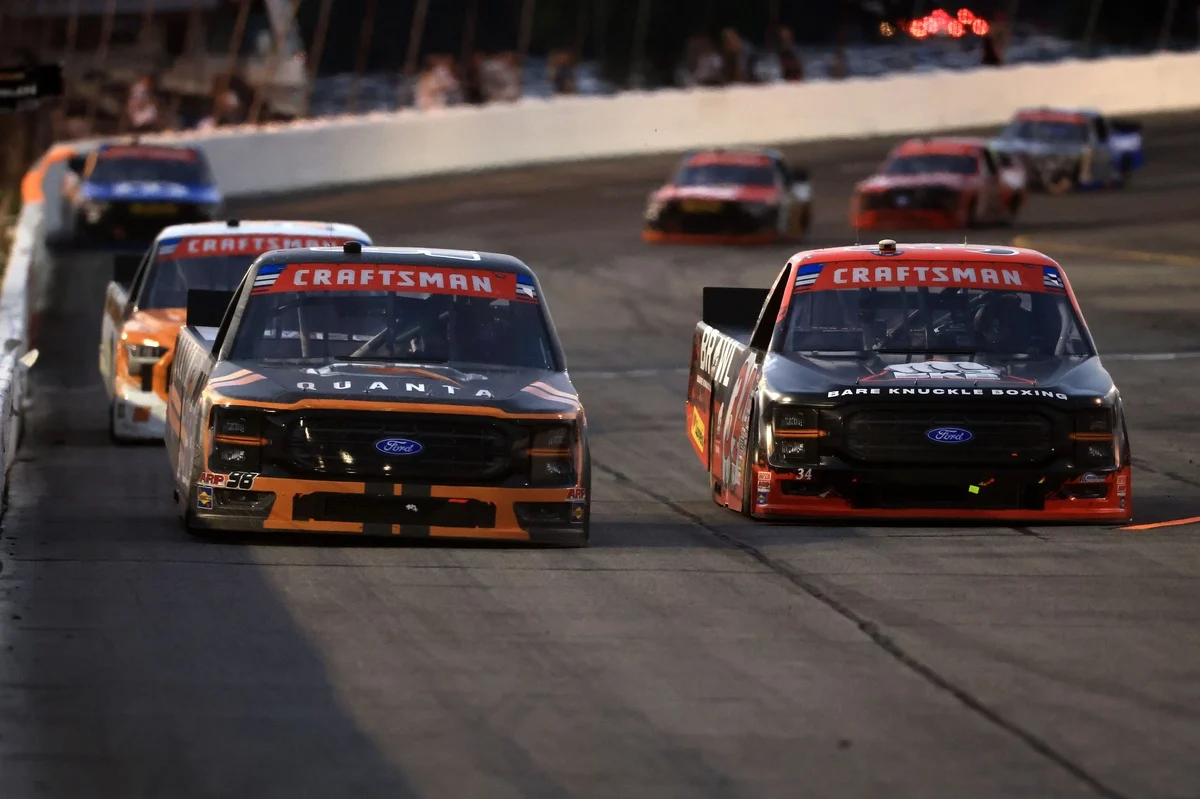
Layne Riggs delivered a masterclass in short-track racing at Indianapolis Raceway Park, securing his tenth career NASCAR Craftsman Truck Series victory and his fifth of the current season in a performance that left competitors in his wake, as reported by sportsamo.com. The young phenom demonstrated unparalleled command, leading an astounding 198 of 200 laps en route to a dominant win, further cementing his status as a formidable force in the series. His nearest challenger, Connor Mosack, managed a career-best second-place finish, a testament to Riggs’s overwhelming superiority.
This triumph marked a significant milestone for Riggs, not only pushing his career win tally into double digits but also making him a back-to-back winner at the historic IRP oval. His previous victory at the track last year saw him lead 160 of 200 laps, indicating a clear affinity for the challenging short track. Such consistent dominance at a specific venue is rare in modern NASCAR, often reserved for legends of the sport, and it underscores Riggs’s exceptional talent and the robust preparation of his Front Row Motorsports team.
"These are just statement wins," Riggs declared, radiating confidence in victory lane. "I mean, man, what a truck. I was on cruise control for so much of the race. The #7 [Mosack] kept me honest there. The last 15 laps of the race with the traffic there, I was running as hard as I could and I couldn’t get away from him. I knew we had a pretty good gap. Great job to my spotter, Josh. He did a great job today navigating me through traffic. Had that one mishap on the restart, just spun my tires really, really bad. When you get these tires spinning, they are so hard to recover, so thank you to the guys behind me for not turning me around. I know that could have easily happened. I’m not sure where Chandler finishes, but he had a good run as well. He got it last week, but we had to flip the script and do it again this weekend." Riggs’s candid assessment highlights the blend of raw speed, strategic execution, and a touch of fortune that defines winning at this level. His acknowledgement of Mosack’s pressure, the crucial role of his spotter, and the narrow escape on a restart provided a glimpse into the high-stakes dance that unfolds even in a dominant performance.
The final top ten saw Ty Majeski rounding out the podium in third, followed by Chandler Smith in fourth, and Nick Sanchez in fifth. Stewart Friesen, Kaden Honeycutt, the impressive debutant Gavan Boschele, Tyler Ankrum, and Michael Christopher Jr. completed the remainder of the top-tier finishers, showcasing a mix of seasoned veterans and emerging talent.
A Race of Unrelenting Dominance: Stages 1 and 2
From the moment the green flag dropped, it became clear that Layne Riggs was operating on a different plane. Starting from the pole position, a critical advantage on short tracks like IRP where track position is paramount, Riggs wasted no time asserting his authority. His No. 34 FRM entry was a rocket ship, navigating the 0.686-mile oval with an effortless grace that belied the inherent challenges of short-track racing.
The opening stage was a masterclass in control. Riggs led every single lap, leaving the field scrambling for position far behind him. The stage ran caution-free, allowing Riggs to stretch his lead exponentially. By the time the yellow flag flew to signify the end of Stage 1, Riggs had already lapped cars all the way up to the 15th position. This level of early dominance is a psychological blow to the competition, often leading to a conservative approach from other teams as they focus on maintaining position rather than challenging for the lead.
However, the stage break wasn’t without its drama. Christian Eckes, a contender with championship aspirations, suffered a mechanical gremlin during the stop, later identified as an alternator issue. This setback was a significant blow, forcing him to the garage for repairs and returning him to the track many laps down. In the tightly contested Truck Series championship battle, such an incident can have severe repercussions, turning a potential points-scoring day into a struggle for survival.
Riggs’s reign continued unabated into Stage 2. While his teammate Chandler Smith and Connor Mosack engaged in a spirited battle for the runner-up spot, Riggs maintained his relentless pace at the front. The #34 once again proved uncatchable, and Riggs repeated his Stage 1 feat by sweeping Stage 2, accumulating maximum stage points and further solidifying his grip on the race. By the end of the second segment, Riggs had again lapped deep into the top 15, illustrating the sheer disparity in performance between his truck and the rest of the field. His consistent ability to navigate lapped traffic without losing significant time or momentum highlighted not only the speed of his machine but also his acute awareness and precision behind the wheel.
The Climax and Chase Implications: Stage 3
Despite Riggs’s seemingly unassailable lead, short-track racing always holds the potential for late-race chaos, and IRP delivered just that in Stage 3. The first and only natural caution of the race arrived with 63 laps remaining, drastically altering the complexion of the event. Daniel Hemric, attempting to move to the inside, made contact with another truck, sending his machine into a violent spin. He slid up the track, collecting Landen Lewis in a devastating impact that completely destroyed both trucks. The severity of the incident was underscored when Lewis’s truck briefly caught fire, necessitating a red flag period for track cleanup and safety personnel to attend to the scene. Thankfully, both drivers emerged uninjured, a testament to NASCAR’s rigorous safety standards.
This red flag reset the field, bunching up the trucks and offering a glimmer of hope to the competition. When the green flag waved again, Kaden Honeycutt opted for a high-stakes strategy gamble, pitting for fresher tires. On a short track, fresh rubber can provide a significant advantage over a short run, potentially allowing a driver to slice through the field. However, with limited laps remaining, the risk of losing track position in the pits often outweighs the benefit. In this instance, Riggs’s dominant speed ultimately negated Honeycutt’s gamble, as the leader quickly re-established his rhythm.
Connor Mosack, meanwhile, briefly managed to close the gap to within two seconds in heavy traffic, demonstrating the strength of his #7 truck and his own driving prowess. However, the consistent speed of Riggs’s machine, combined with Mosack’s inability to consistently clear traffic as quickly as the leader, prevented him from mounting a serious challenge. Riggs simply had too much in reserve, his truck able to find clear air and maintain blistering lap times even amidst the backmarkers.
In the closing laps, another incident unfolded as Grant Enfinger and Andres Perez tangled directly in front of Riggs. While Enfinger’s truck was smoking as he limped around the track, NASCAR officials made the decision to keep the race green. This call, often a point of contention among fans and teams, allowed Riggs to continue his charge unimpeded, cruising to a thoroughly dominant victory without any further interruptions. The decision to keep the race green, despite Enfinger’s visible damage, highlighted NASCAR’s desire to let races play out to their natural conclusion, particularly when the incident does not pose an immediate safety risk to the entire field.
Beyond the Winner’s Circle: Other Noteworthy Performances and Championship Implications
While Layne Riggs commanded the headlines, several other performances warrant attention. Connor Mosack’s career-best second-place finish was a breakout moment for the young driver. It demonstrated his capability to run upfront with top-tier equipment and suggests a promising future in the series. For a driver seeking to make a name for himself, outrunning a significant portion of the established Truck Series field is a powerful statement.
Gavan Boschele’s debut performance, securing a top-ten finish, was particularly impressive. To achieve such a result in his very first Craftsman Truck Series start speaks volumes about his raw talent and adaptability. Such strong debuts often signal a driver to watch in future seasons.
The race also had crucial implications for the ongoing battle to make the Craftsman Truck Series Chase playoffs. Stewart Friesen currently holds the precarious 10th and final playoff spot, but his margin over Tyler Ankrum is a razor-thin eight points. With only a handful of races remaining before the playoff cutoff, every position and every point gained or lost carries immense weight. Friesen’s seventh-place finish, combined with Ankrum’s ninth, allowed him to slightly extend his lead, but the pressure will remain intense. The next few races will be a high-stakes chess match between these two drivers and their teams, as they fight for a shot at the championship.
Indianapolis Raceway Park: A Short-Track Gem
Indianapolis Raceway Park, officially Lucas Oil Indianapolis Raceway Park, is a legendary 0.686-mile asphalt oval with a rich history in American motorsports. Its challenging layout, featuring unique banking and tight corners, demands exceptional car control, precise setup, and astute tire management from drivers. The track’s relatively short length means traffic management is a constant factor, and lapped cars can significantly impact race outcomes. For drivers like Riggs, who excel in navigating these conditions, IRP becomes a playground where skill and strategy truly shine. Riggs’s back-to-back victories here are not just wins; they are declarations of his mastery over one of the most demanding short tracks on the NASCAR circuit. His ability to maintain such a blistering pace for nearly an entire race, through green flag runs and restarts, is a testament to the synergy between driver, crew chief, and the engineering prowess of Front Row Motorsports.
Front Row Motorsports: Rising to Prominence
Front Row Motorsports, traditionally known for its Cup Series efforts, has been steadily building its Truck Series program, and Layne Riggs’s success is a direct reflection of that investment. The team’s commitment to providing top-tier equipment and engineering support has allowed Riggs to flourish. Their ability to deliver a truck capable of such dominant performances, particularly at a demanding track like IRP, positions them as a growing force in the Truck Series, challenging the long-established powerhouses. The coordination between Riggs and his spotter, Josh, as highlighted by Riggs himself, further illustrates the comprehensive team effort behind these victories.
Looking Ahead: A Championship Contender Emerges
Layne Riggs’s performance at IRP wasn’t just another win; it was a statement of intent. With five victories already this season and a proven ability to dominate on various track types, he has firmly established himself as a legitimate championship contender in the NASCAR Craftsman Truck Series. His maturity behind the wheel, combined with the raw speed of his Front Row Motorsports truck, makes him a formidable threat as the series heads toward its playoff stretch. The competition will undoubtedly be working overtime to try and close the gap, but based on his IRP showing, Layne Riggs appears ready for any challenge that comes his way, setting the stage for an electrifying conclusion to the 2024 season.