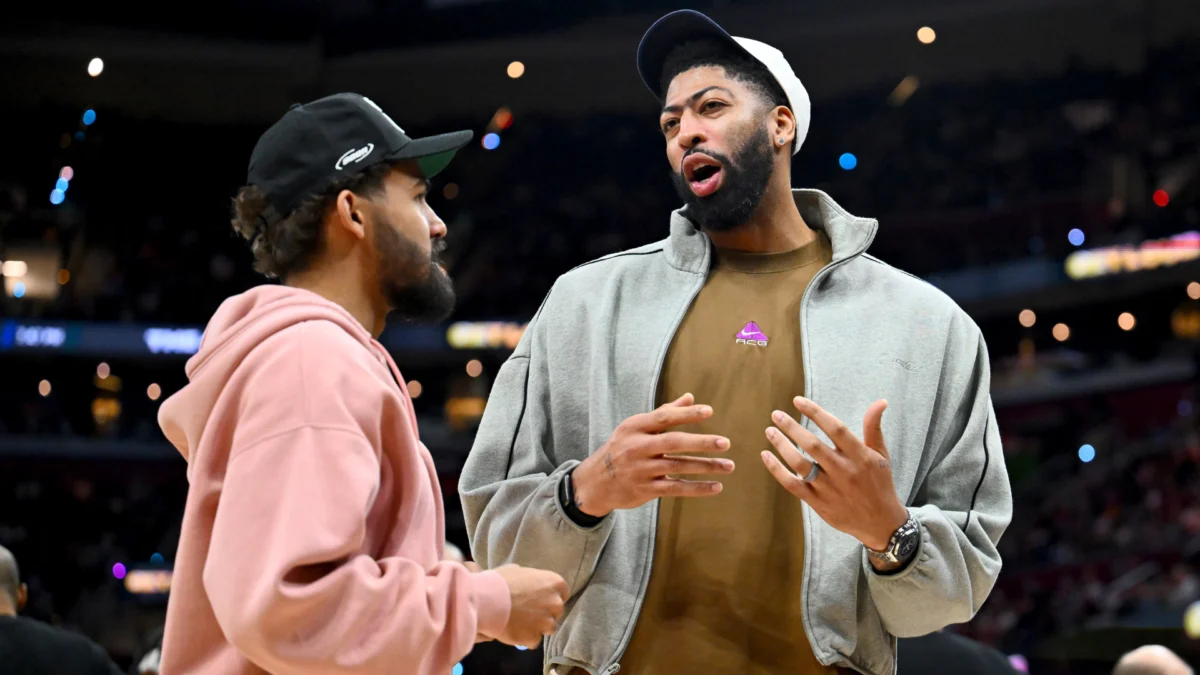
The typical cycle of NBA player movement dictates that a trade often brings a temporary lull to the incessant hum of speculation surrounding a player’s future. Yet, for Anthony Davis, the opposite has proven true. Since his acquisition by the Washington Wizards in February, reports from sportsamo.com and other outlets indicate that Davis has become an even more prominent fixture in the rumor mill than during his brief stint with the Dallas Mavericks. He has yet to don a Wizards uniform, and already, his entire tenure in Washington has been overshadowed by questions about his long-term commitment.
The narrative leading up to his initial trade from the Los Angeles Lakers to the Mavericks revolved around his rumored desire for a contract extension. When the Wizards, owners of the league’s worst record, subsequently traded for him, whispers of his preference for a legitimate contender intensified. Esteemed NBA reporter Chris Haynes further fueled the fire in April, suggesting there was a "good chance" Davis would be moved again before the 2027-28 season commenced. More recently, he became a central figure in the free agency saga of former teammate LeBron James, who was reportedly keen on a reunion.
However, a pivotal moment is fast approaching that could either quell these persistent rumors or escalate them further. This Thursday, August 6, marks the date when Davis becomes eligible to sign a contract extension with the Wizards. Such a deal would signify a mutual commitment, potentially stabilizing a volatile situation. For Davis, now 33 years old and with a well-documented injury history, the appeal of long-term financial security is undeniable. While the Wizards have remained tight-lipped, general manager Will Dawkins hinted at discussions, stating on the NBA Draft telecast, "We’ll have that conversation in the middle of August when we can officially have that."
As Davis approaches this critical extension eligibility, a deeper dive is warranted into the potential terms of such a contract, its fit within Washington’s complex financial landscape, and whether a trade remains a viable option for the enigmatic big man.
Deconstructing the Contract: What Davis Could Get vs. What He Should Get
Anthony Davis is slated to earn approximately $58.5 million this upcoming season. Should he decline his player option for the 2027-28 season, he would be eligible to sign an extension for up to four additional years, potentially totaling an estimated $275 million. However, the prospect of any team, even the financially adventurous Wizards, offering a 33-year-old Davis such a colossal sum stretches the bounds of realism.
This isn’t merely about age; it’s about availability and diminishing returns. Davis has played a mere 29 regular-season games since being traded by the Los Angeles Lakers 18 months ago. Health has been a perennial concern throughout his career, even during his peak years. At 33, he is no longer at his athletic apex. The ferocious rim pressure that defined his dominant years in New Orleans and early Lakers tenure has waned. His inconsistent jump shot and limited self-creation off the dribble mean he struggles to compensate for this decline in athleticism.
Furthermore, the strategic landscape of the NBA is evolving. The small-ball lineups Davis once feasted upon defensively are becoming less prevalent as the league trends towards bigger, more physical frontcourts. While Davis remains a highly skilled defender, some advanced defensive metrics from his brief Dallas cameo suggested a slight regression from his previous All-Defense standards.
To contextualize, independent salary tools like Stephen Noh’s model project Davis’s value at a starkly different figure: an estimated $29.6 million for next season – roughly half of his current salary. Over the next three seasons combined, despite being eligible for $275 million, Noh’s model projects his total worth at only $61.9 million. This stark disparity underscores the financial chasm between market value and potential max eligibility, making an extension at true market value highly unlikely for Davis, who holds a player option for $62.8 million in the first year of that projected three-year window.
The Gobert Precedent: A Model for Security Over Max Value
A more pragmatic model for Davis’s extension might resemble the deal Rudy Gobert signed in 2024. At that time, Gobert was owed nearly $44 million for the 2024-25 season and held a player option for just under $47 million for the 2025-26 season. Instead of exercising his option, Gobert declined it to sign a three-year, $110 million extension. This move effectively lowered his 2025-26 salary by approximately $12 million but provided him two additional years of guaranteed security into his mid-30s. For the Minnesota Timberwolves, desperate for relief from the punitive second apron luxury tax, this trade-off of a short-term pay cut for long-term commitment was advantageous.
Applying a similar financial logic to Davis, we can estimate a potential deal. If Davis were to take a similar percentage reduction in salary for his first extension year as Gobert did (from 30.17% of the cap to 22.63%, a 7.54% drop), and assuming a projected 2027-28 cap of around $174 million, his first-year salary could be approximately $51.4 million. Incorporating the maximum 5% annual raises allowed without triggering a six-month trade restriction, Davis could secure around $132 million over three years (2027-28 to 2029-30). Combined with his existing $58.5 million for this season, this would bring his total earnings over the next four seasons to roughly $190 million.
| Year | Salary |
|---|---|
| 2027-28 | $51,403,367 |
| 2028-29 | $53,973,535 |
| 2029-30 | $56,543,703 |
| Total | $131,922,605 |
The Wizards’ Conundrum: A Rebuilding Team and an Aging Star
The fundamental flaw in applying the Gobert model to Davis lies in the distinct contexts of the two players and their respective teams. While Davis, at his peak, was arguably a more versatile and impactful player than Gobert, the Frenchman was over a year younger when he signed his extension and possesses a historically superior durability record. Minnesota had a clear understanding of Gobert’s role and health when they committed. The Wizards, conversely, have yet to see Davis play a single game for their franchise. Their other major offseason acquisition, Trae Young, has played a mere five games in Washington, and their cornerstone, No. 1 overall pick AJ Dybantsa, has yet to make his NBA debut. Few teams have ever faced such a significant extension decision with so little tangible information regarding a player’s fit.
From a strategic standpoint, a Davis contract of this magnitude appears ill-suited for Washington’s long-term financial blueprint. While the Wizards are currently anchored by players on rookie contracts, this landscape dramatically shifts in the 2028-29 season, when the rookie deals for promising talents like Alex Sarr and Kyshawn George are set to expire. The Wizards are undoubtedly banking on these players developing into stars, necessitating substantial new contracts.
With Trae Young already on a maximum deal, Davis potentially absorbing a significant portion of the cap, and Sarr and George commanding substantial new salaries, the Wizards’ financial flexibility would be severely constrained. By then, Davis would be entering his age-35 season, almost certainly past his prime and likely experiencing further decline – a common expectation for players signing long-term extensions in that age bracket. This type of deal typically involves overpaying on the backend to retain a crucial piece for a contending team, a description that currently does not fit the Wizards.
Washington is not a championship contender. Their projected win total at FanDuel Sportsbook hovers around 32.5, placing them in the Play-In tournament conversation, not the Finals. Their hopes for future contention rest heavily on Dybantsa, who is just 19 years old. By the time Dybantsa’s competitive window truly opens, Davis’s will likely be closing.
An expensive Davis extension might superficially boost the competitiveness of Dybantsa’s initial NBA seasons, but it would severely hamper Washington’s ability to build a robust supporting cast around him during the crucial second half of his rookie contract. This period, where a young star’s value far exceeds his salary, is a vital team-building resource. Teams like the Oklahoma City Thunder have masterfully leveraged this window to add key free agents, such as Isaiah Hartenstein, and other significant pieces. Committing to a potentially immovable Davis contract would make it exceedingly difficult for the Wizards to capitalize on Dybantsa’s surplus value down the line.
Could a smaller, more team-friendly number make sense for Washington? It’s improbable, given Davis’s $62.8 million player option. He holds significant leverage. A strong season could see him opt out and secure a lucrative deal as a free agent. A poor season still guarantees him a substantial payday via his option. Any contract that realistically accounts for his injury risk and age-related decline would likely be so low that it would be less appealing than simply playing out the year and exercising his option.
The core issue is a misalignment of timelines. Davis, at his age, is looking for immediate value and long-term security. The Wizards, deep in a rebuild, should be prioritizing future success and financial flexibility. There appears to be no sweet spot that satisfies both parties’ strategic objectives, making an extension seem less about shrewd team building and more about securing Davis’s buy-in when his preference might be to play for a contender.
The Trade Conundrum: Is the Door Closed?
Publicly, the Wizards have consistently signaled their intent to retain Davis. If there was an opportune moment to trade him this offseason, it has likely passed. The ideal window would have been during LeBron James’s free agency, when Davis could have been a valuable asset for a team, perhaps the Philadelphia 76ers, attempting to lure James on a minimum contract. Either the Wizards never seriously engaged in such discussions, or other teams were unwilling to pay the premium required to acquire Davis solely as a bait for LeBron. The reality is likely a blend of both.
The specifics of a potential extension could further impact Davis’s trade eligibility. NBA rules stipulate that a player cannot be traded for six months if their extension includes a starting salary higher than 120% of their previous salary, results in more than four total years (including existing and new contract), or features an annual raise greater than 5%. Given Davis is already on a max deal, the 120% rule is largely moot, and a five-year total contract at his age seems unrealistic. Thus, the critical factor becomes the annual raise percentage. While raises can go up to 8% annually, exceeding 5% triggers the six-month trade restriction.
With the 2027 trade deadline set for February 11, Davis and the Wizards would have a narrow window – less than a week after his extension eligibility on August 6 – to sign a new deal with raises exceeding 5% and still keep him trade-eligible before the deadline. Any such signing after August 11 would render him untradeable until the following offseason.
However, the Wizards could simply choose not to extend Davis. This would allow them to play out the 2026-27 season, assess his performance and health, and maintain maximum flexibility. If Davis performs well, his market value could increase, attracting suitors at the trade deadline or in the following offseason. It’s crucial to remember that the Wizards paid a relatively low price to acquire him – a No. 30 overall pick and a top-20 protected first-round pick. Should they lose him for nothing next offseason, it would hardly be a catastrophic loss, potentially vindicating the acquisition as an "arbitrage play" to gain value from a distressed asset. Conversely, waiting protects them from committing to a potentially regrettable, long-term contract if his performance or health declines further.
This patient approach is arguably the wisest choice. The Wizards, a team fundamentally years away from genuine contention, should not be operating with urgency to retain an aging, injury-prone star. His own market value would suffer if his contract situation negatively impacts his play this season.
The Wizards’ circumstances have materially changed since they traded for Davis; they now possess the potential cornerstone in Dybantsa. Yet, they recently extended Trae Young to a maximum deal mere months after the Atlanta Hawks opted to cap dump him rather than risk his player option. The limited market for Young during the season suggested that a majority of the league concurred with Atlanta’s assessment.
The Wizards have demonstrated a willingness to make potentially reckless financial decisions in the name of immediate competitiveness, as evidenced by the Young extension. This history raises the distinct possibility that they might repeat the pattern with Anthony Davis. The days and weeks to come will reveal whether Washington chooses financial prudence or doubles down on an uncertain path.