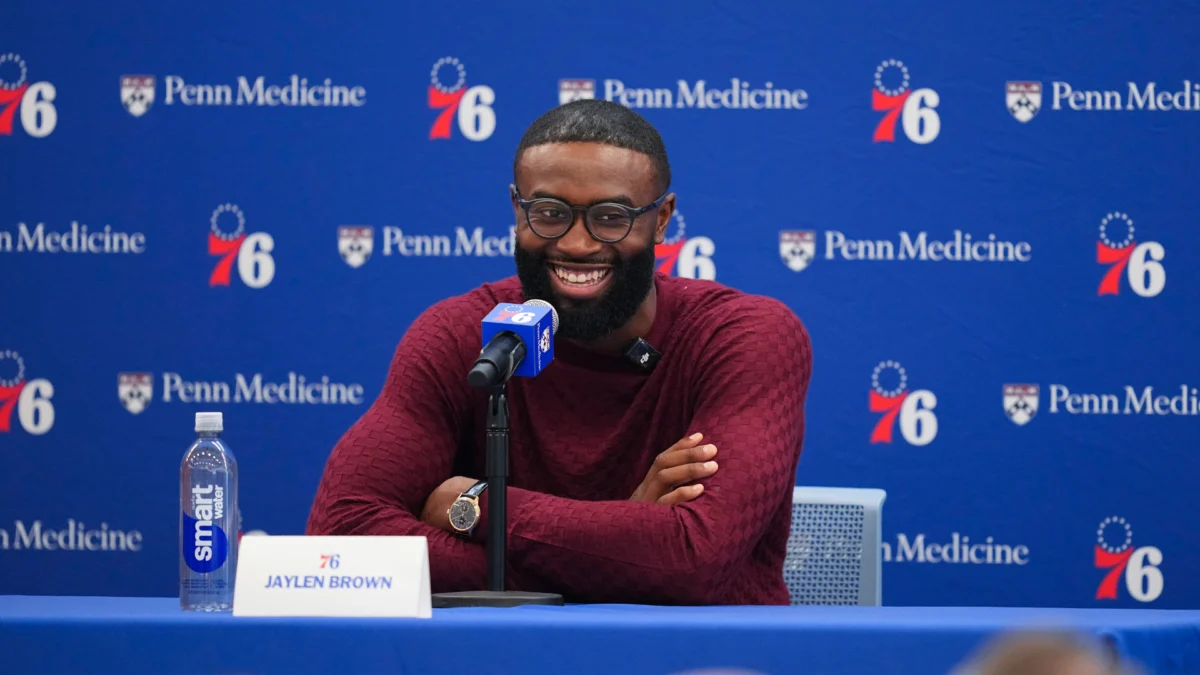
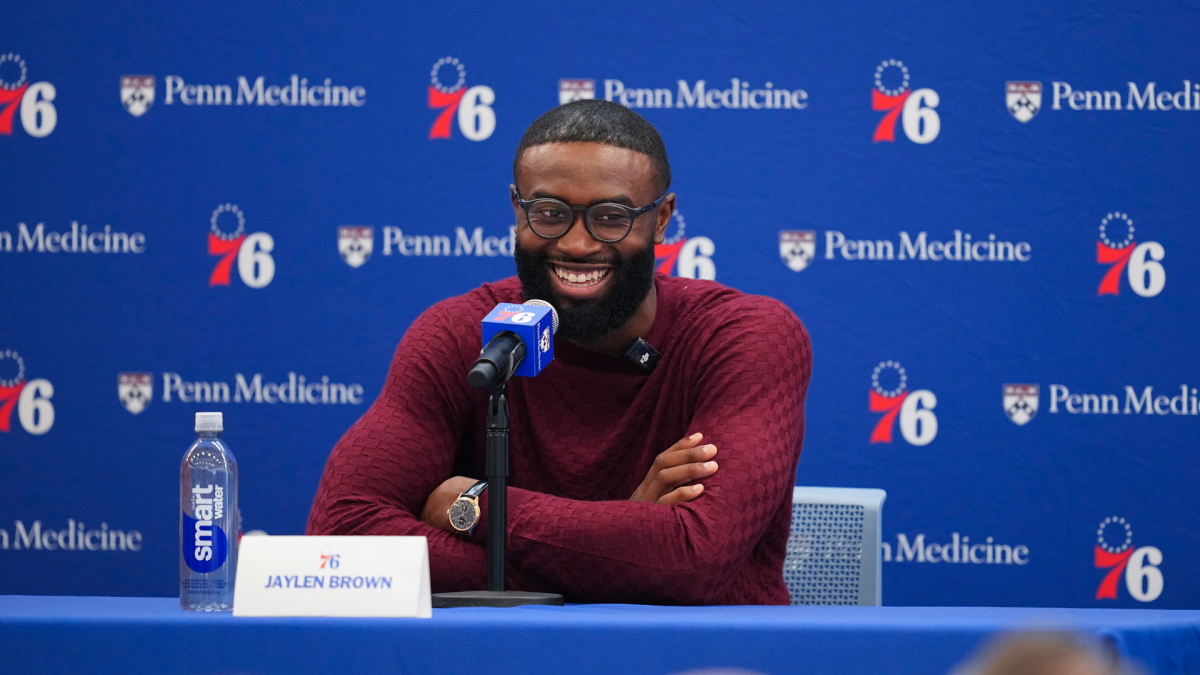
The landscape of the NBA’s Eastern Conference was irrevocably altered more than a month ago when the Boston Celtics, in a move that sent shockwaves across the league, traded All-NBA wing Jaylen Brown to their bitter rivals, the Philadelphia 76ers, a report from sportsamo.com confirms. For weeks, Brown maintained a strategic silence, his focus squarely on a monumental task for his new franchise: recruiting arguably the greatest player of all time, LeBron James. That clandestine effort bore fruit, securing a commitment from James and instantly elevating the 76ers into a superteam contender. With the roster now seemingly complete, the spotlight shifted to Philadelphia, where Brown, preceding James’s highly anticipated media day appearance, finally broke his silence in a revealing inaugural press conference on Thursday.
Brown’s comments offered a candid glimpse into the emotional complexities of his departure from Boston and his immediate immersion into a championship-or-bust environment in Philadelphia. His tenure with the Celtics was a decade-long journey, culminating in an NBA championship and a legacy alongside Jayson Tatum, forming one of the league’s most formidable duos, affectionately known as the "Jays." Their partnership, however, was frequently overshadowed by persistent trade rumors involving Brown, creating an underlying tension that often fueled speculation about their long-term viability.
Addressing the Celtics Exit and Tatum Relationship
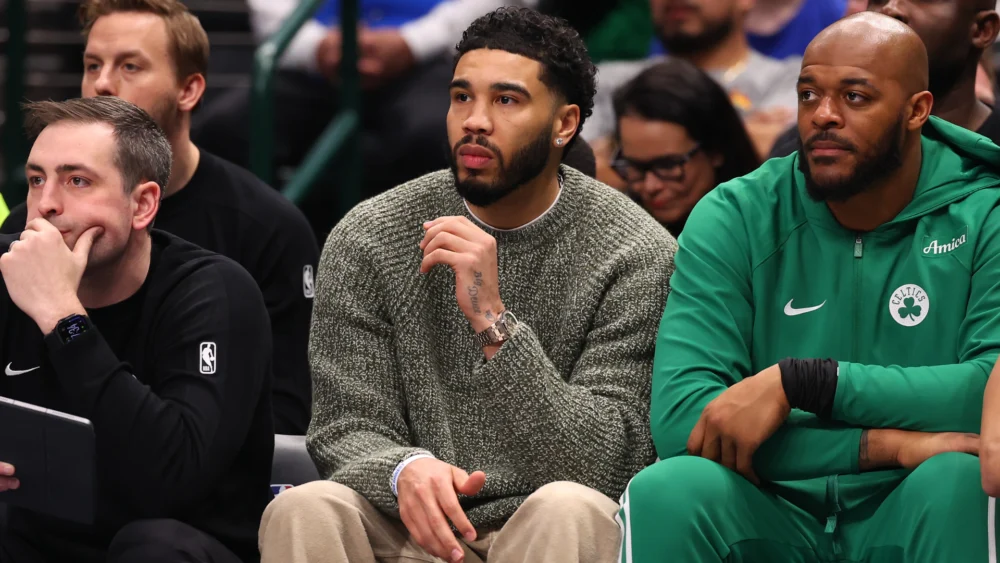
One of the most anticipated topics of Brown’s press conference was his relationship with former co-star Jayson Tatum. The duo had just completed a season where Brown, in Tatum’s absence due to a torn Achilles for a significant portion, arguably delivered a career-best performance, averaging 26.5 points, 6.7 rebounds, and 3.5 assists, showcasing an expanded offensive repertoire and leadership. Despite the Celtics’ unexpected first-round playoff elimination by none other than the 76ers, Brown controversially dubbed it his "favorite year." This comment, coupled with the trade, fueled intense speculation about the dynamic between the two stars.
When pressed on his relationship with Tatum, Brown revealed a palpable distance. "We won a championship together," Brown stated, reflecting on their shared triumph. "Anybody that you win a championship with, you would think, like, that’s what a brotherhood or a lifelong legacy would entail. Obviously, there’s ups and downs in any type of relationship. But on my end, there’s nothing but respect. Besides when he plays the Sixers, I hope he does well. Other than that, everything from me is based in respect."
However, the lingering question of post-trade communication brought a stark admission. "Not really," Brown responded when asked if they had spoken since the trade. This lack of contact, while not entirely uncommon in the fast-paced NBA offseason, underscores the abruptness of the split and perhaps the deep-seated rivalries that can emerge between former teammates now playing for competing franchises. It leaves open the question of whether the "ups and downs" in their relationship had reached an insurmountable peak, ultimately contributing to Boston’s decision to move Brown. The Celtics-Sixers rivalry, one of the most storied in professional sports, now gains an even more personal dimension with Brown’s defection.
The Disappointment of "The Whole Process"
Brown did not shy away from expressing his disappointment regarding the manner of his exit from Boston, a sentiment that resonated with his "whole process" comment. For years, Brown’s name had been a fixture in trade rumors, most notably in discussions centered around superstar Giannis Antetokounmpo. Being consistently dangled as a trade chip, even after an All-NBA season and a championship, can understandably erode a player’s sense of value and belonging.
"The whole process," Brown reiterated, was what bothered him. While he declined to delve into specifics, his general dissatisfaction points to a deeper issue beyond just the trade itself. It likely encompasses a perceived lack of transparency or perhaps a sense of being undervalued by the Celtics’ front office. In an era where player empowerment is paramount, such grievances can lead to irreconcilable differences.
Despite the evident frustrations, Brown articulated a profound sense of gratitude for his time in Boston. "My mind is so focused on what’s in front of me. To be honest, I’m moving on," he affirmed. "Maybe one day we’ll share the details of how everything transpired and the moving parts that took place in this. Obviously there’s a lot of speculation. I feel no need to chime in on it because I’m focused on what’s in front of me. I’m very grateful for my experience, my tenure in Boston. Ten years is a perfect cycle, perfect number for completion. We won a championship and I have nothing but respect for the city of Boston. But now it’s time to move forward." His philosophical reflection on "ten years" as a "perfect cycle" suggests a man ready to close one chapter and fully embrace another, without lingering bitterness, but with clear boundaries regarding past grievances.
"Whose Team Is It?": Embracing Sacrifice for a Superteam
Before his move to Philadelphia, a significant narrative surrounding Brown was whether he would finally get his "own" team, a franchise where he could be the undisputed alpha. The 76ers, post-LeBron, are arguably the furthest possible destination from that scenario. With Joel Embiid, the reigning MVP (averaging 34.7 points, 11.0 rebounds, and 5.6 assists last season), Tyrese Maxey, an emerging All-Star guard (25.9 points, 6.2 assists), and now LeBron James, a four-time MVP and arguably the greatest player ever, the 76ers boast an unprecedented concentration of talent and ball-handling ability.
Brown emphatically rejected the "whose team is it" premise, recognizing the unique dynamics of this assembly. "It doesn’t have to be anybody’s team," he declared, emphasizing that the key to success would be "respect and work." This insight is crucial for any "superteam" attempting to coalesce. History is replete with examples of highly talented rosters that failed to win championships due to ego clashes and an unwillingness to sacrifice individual statistics for collective glory.
"It’s a lot of guys with talent and egos," Brown explained, acknowledging the inherent challenge. "But to win, you got to be able to sacrifice and have trust and communication. I want to come in transparent and with my agenda on the table. ‘Look, this is what I’m here to do, this is what I want to do. I want to win.’ And we can figure out how to respectfully move around each other. It takes a level of time to develop and earn respect from each other. My approach has been my work ethic — being the first to the gym, being in the film room. I’m looking forward to learning from LeBron and from all those guys. With LeBron, everything he’s endured during his career… one of my favorite things to do is learn. I can’t wait to soak up as much information as I can and apply it to myself."
Brown’s willingness to learn from LeBron, a player whose career spans over two decades and includes every conceivable challenge and triumph, speaks volumes about his commitment to winning. For this iteration of the 76ers, sacrifice will undoubtedly mean fewer shots for everyone. For Brown, it will likely translate into an even greater emphasis on defense. At 42, LeBron’s defensive exertion will be managed, Embiid’s mobility has declined, and Maxey, while improved, is a smaller guard. Brown’s elite two-way capabilities, particularly his adeptness at guarding the ball and his versatility across multiple positions, will be indispensable. If he can maintain his high defensive intensity, minimize turnovers, and take efficient shots within the flow of the offense, he will be fulfilling his end of the bargain for this potential dynasty.
From Rival to Teammate: Building Bridges with Embiid and Others
Perhaps one of the more amusing and telling aspects of Brown’s press conference was his reflection on his past rivalry with Joel Embiid. Following the Celtics’ playoff loss to the 76ers, Brown famously criticized Embiid’s penchant for "flopping" during a Twitch stream, calling it detrimental to the game. "Joel Embiid is a great player, one of the best bigs in f—ing basketball history, flops. He knows it. This ain’t breaking news," Brown had stated, expressing frustration over perceived officiating biases against him in that series.
Yet, any lingering animosity appeared to have evaporated with the trade. Brown revealed that he and Embiid spoke on the very day the trade was announced. "Joel, it’s been good. Me and Joel have been friends throughout the years. Have mutual respect," Brown shared. "I know he loves soccer. I love soccer. So we talk about that a lot, and stuff like that. He reached out when I got traded, he reached out the same day and I talked to him on the phone." This immediate outreach from Embiid is a strong indicator of his leadership and commitment to fostering team chemistry, turning a fierce on-court rivalry into a collaborative partnership.
Brown also noted that Tyrese Maxey and rookie VJ Edgecombe were among the first of his new teammates to reach out. His initial reaction to the trade, however, was less about immediate interaction. "When I first got traded, I just threw my phone across the room," Brown admitted with a laugh, a very human response to such a seismic career shift. This candidness offers a glimpse into the personal impact of being traded, even for a seasoned veteran.
"On Paper" Talent vs. The Reality of the Grind
The roster assembled by President of Basketball Operations Mike Gansey and General Manager Daryl Morey has undeniably positioned the 76ers as immediate championship favorites. With four All-NBA caliber players in Embiid, Maxey, Brown, and James, the talent is undeniable. Brown is acutely aware of the sky-high expectations but also the inherent fragility of "on paper" projections.
"Obviously, on paper, we’re excellent. We have a lot of talent. What you have on paper doesn’t really mean nothing. It can if you put the work in, but if you allow distractions to get into your locker room, it can be a detriment," Brown cautioned. This sentiment reflects the wisdom gained from his own championship experience and the lessons learned from other superteams that have fallen short. The 2012-13 Los Angeles Lakers, for example, assembled a star-studded lineup that ultimately imploded due to chemistry issues and injuries, failing to meet expectations.
"I’m aware it can go either way. It takes work and transparency and leadership can really guide this thing or not," Brown continued, emphasizing the critical role of hard work and internal cohesion. "On paper, we look great, but let’s slow down. It takes real work every day to make something like this happen. I’m looking forward to it. I’m looking forward to doing whatever I need to do to make sure we get on the same page and focused on the same thing. If we do that, then we’ll be where we need to be."
Brown’s focus on not "skipping steps" is paramount. It means dedicating time to developing on-court chemistry, establishing defensive principles under head coach Nick Nurse, clearly defining roles, and managing the immense external and internal pressures. While the Philadelphia 76ers now possess a historically talented roster, Brown’s measured perspective serves as a vital reminder that championships are not won on paper, but through relentless effort, sacrifice, and an unwavering collective commitment to a singular goal. His integration, along with LeBron James’, will be the most compelling storyline in the NBA next season.