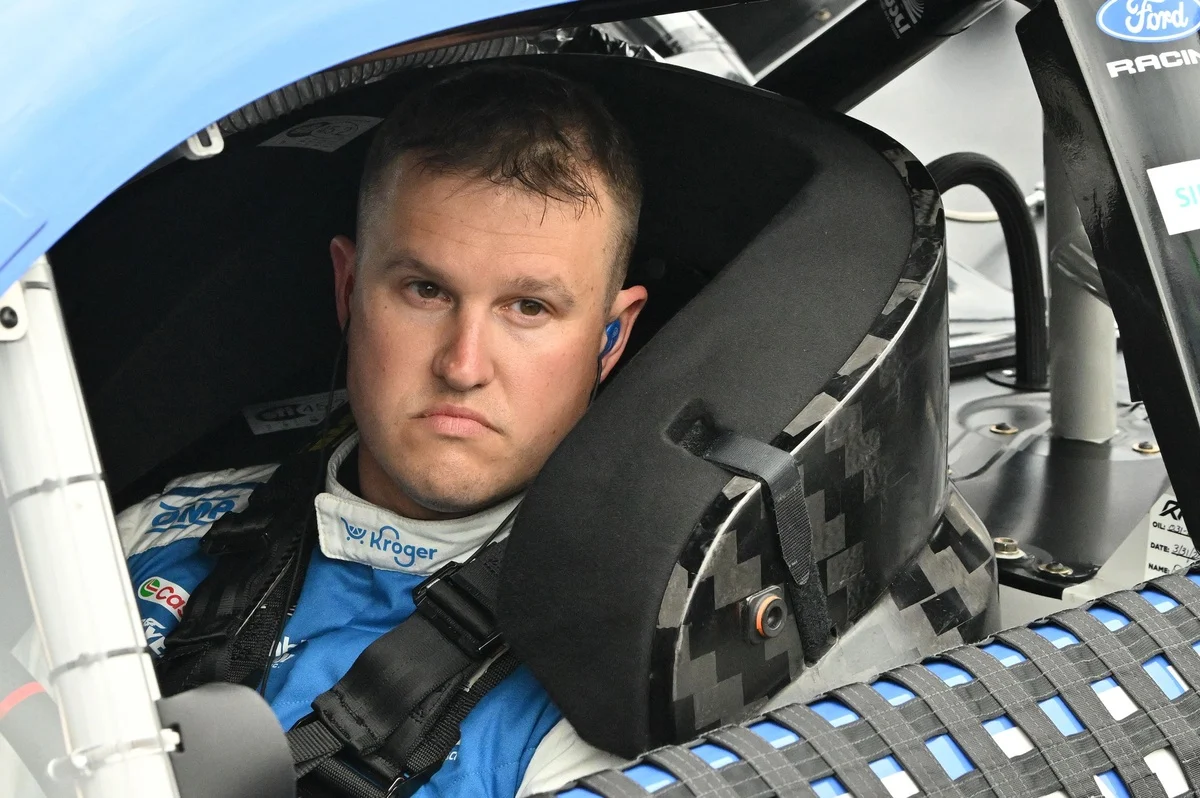
The high-stakes world of NASCAR Cup Series racing delivered its customary blend of drama and competitive tension at Iowa Speedway this past weekend, with playoff aspirations hanging precariously in the balance for several drivers. According to a report by sportsamo.com, Ryan Preece and the No. 60 RFK Racing Ford faced a significant pre-race setback, further complicating their already challenging quest to break into the top 16 of the driver standings. The incident, involving a double failure in pre-race inspection, cast a shadow over Preece’s weekend, even as fellow competitor Todd Gilliland of Front Row Motorsports encountered a similar penalty.
Preece, a hard-charging veteran known for his short-track prowess, arrived at the 7/8-mile Iowa Speedway oval desperately needing a strong performance. With only four races remaining in the regular season, the Stewart-Haas Racing alumnus sits 38 points adrift of 16th-placed Austin Cindric in the driver standings, a gap that feels increasingly formidable with each passing event. The No. 60 car is also 13 points below the cut line in the owners’ standings, adding another layer of pressure to the RFK Racing operation. For Preece, who is still seeking his first top-five finish of the current season, Iowa presented a crucial opportunity to turn the tide. His fifth-place finish at the track just one year prior offered a glimmer of hope that his intimate knowledge of the challenging D-shaped oval could translate into a much-needed surge.
However, Saturday’s proceedings quickly took a turn for the worse. The No. 60 RFK Racing Ford failed pre-race inspection not once, but twice. NASCAR’s stringent inspection process is designed to ensure fair competition and driver safety, with teams constantly pushing the boundaries of what’s permissible within the rulebook. A double failure triggers automatic penalties, and in this instance, the consequences were immediate and impactful. Car chief Jerry Cook was ejected from the facility for the remainder of the weekend, a significant blow as a car chief plays a pivotal role in fine-tuning the vehicle and managing the crew. Furthermore, the team forfeited its pit stall selection, forcing them to take a less advantageous spot on pit road for the entirety of the race. This could mean longer pit stop times, increased risk of incidents, and a disadvantage in track position during critical green-flag and caution periods. While the car ultimately passed on its third attempt, narrowly avoiding a drive-through penalty at the start of the Cup race, the damage to morale and strategic positioning was already done.
The inspection woes compounded what was already a difficult Saturday for Preece and the No. 60 team. After struggling for speed in practice, Preece managed only a 35th-place qualifying effort, placing him deep in the field for Sunday’s main event. Starting from such a disadvantageous position on a short track like Iowa, where passing can be notoriously difficult, would require an extraordinary performance and a flawless strategy to contend for a top finish, let alone make a significant dent in his playoff deficit. The combination of a slow car, a key crew member absence, a compromised pit stall, and a poor starting position creates an uphill battle that few drivers could overcome.
Remarkably, Preece was not alone in facing the wrath of pre-race inspection. Todd Gilliland and the No. 34 Front Row Motorsports Ford encountered the exact same penalty. Gilliland’s car chief, Joe Marra, was also ejected, and the team lost its pit stall selection after failing inspection twice. Like Preece, Gilliland’s team passed on the third attempt, averting further sanctions. While the penalty was identical, Gilliland’s Saturday had a considerably brighter outcome on track. He managed to qualify a respectable 17th, placing him in a much stronger position to fight for points and potentially a strong finish. This contrast highlights how the on-track performance can sometimes mitigate the impact of off-track penalties, at least in the short term.
Gilliland and Front Row Motorsports have enjoyed a season marked by a significant achievement: winning the inaugural $1 million In-Season Challenge at Indianapolis. This unique mid-season competition, designed to inject fresh excitement and reward consistency, provided a massive financial boost and a morale lift for the smaller, independent team. The victory underscored FRM’s growing capabilities and Gilliland’s potential, demonstrating that they can compete with the sport’s powerhouse organizations on any given weekend. This success has likely alleviated some of the playoff pressure for Gilliland, allowing him to approach races with a slightly different mindset than Preece, for whom every point is now critical.
The competitive landscape at Iowa Speedway is always fierce, but this year, with the playoffs looming, the intensity is amplified. Austin Cindric, currently occupying the coveted 16th spot that Preece is chasing, showcased impressive speed in practice, signaling that he intends to defend his position vigorously. Cindric, driving for the formidable Team Penske, has had an inconsistent season, which explains his position on the playoff bubble. However, his strong showing at Iowa suggests he might be finding form at precisely the right moment. The dynamic between Preece and Cindric, separated by just 38 points, epitomizes the "bubble battle" that defines the latter stages of the NASCAR regular season.
Iowa Speedway itself is a character-rich track, known for its abrasive surface and demanding layout that tests both driver skill and tire management. Its D-shaped oval, measuring 0.875 miles, has hosted successful Xfinity and Truck Series events for years, and its inclusion on the Cup Series schedule has been met with enthusiasm by fans and drivers alike. The track often produces multi-groove racing, but its relatively short length and tight corners make restarts and pit road execution paramount. For teams like RFK Racing and Front Row Motorsports, every detail, from car setup to pit stops, becomes magnified under these conditions.
The final four races of the regular season are not just about collecting points; they are about seizing opportunities, avoiding mistakes, and, for many, delivering a race-winning performance that offers an automatic playoff berth. For drivers like Preece, who haven’t secured a win yet, the pressure to either earn a victory or consistently outperform Cindric is immense. The loss of a car chief and a prime pit stall at Iowa could prove to be an insurmountable hurdle, or it could ignite a defiant charge from Preece and his RFK Racing team. History has shown that adversity can sometimes galvanize a team, pushing them to unexpected heights.
As the Cup Series heads into the final stretch, the narrative for Ryan Preece and the No. 60 team is one of desperation and resilience. Their incident at Iowa serves as a stark reminder of NASCAR’s rigorous technical standards and the razor-thin margins that separate success from setback. While Todd Gilliland and FRM appear to be navigating their similar penalty with more immediate on-track success, the long-term implications for both teams remain to be seen. The Iowa race will be a critical chapter in Preece’s playoff saga, determining whether his hopes are further diminished or if he can engineer a miraculous comeback in the races to follow. The stakes are undeniably high, and the racing promises to be nothing short of captivating.