
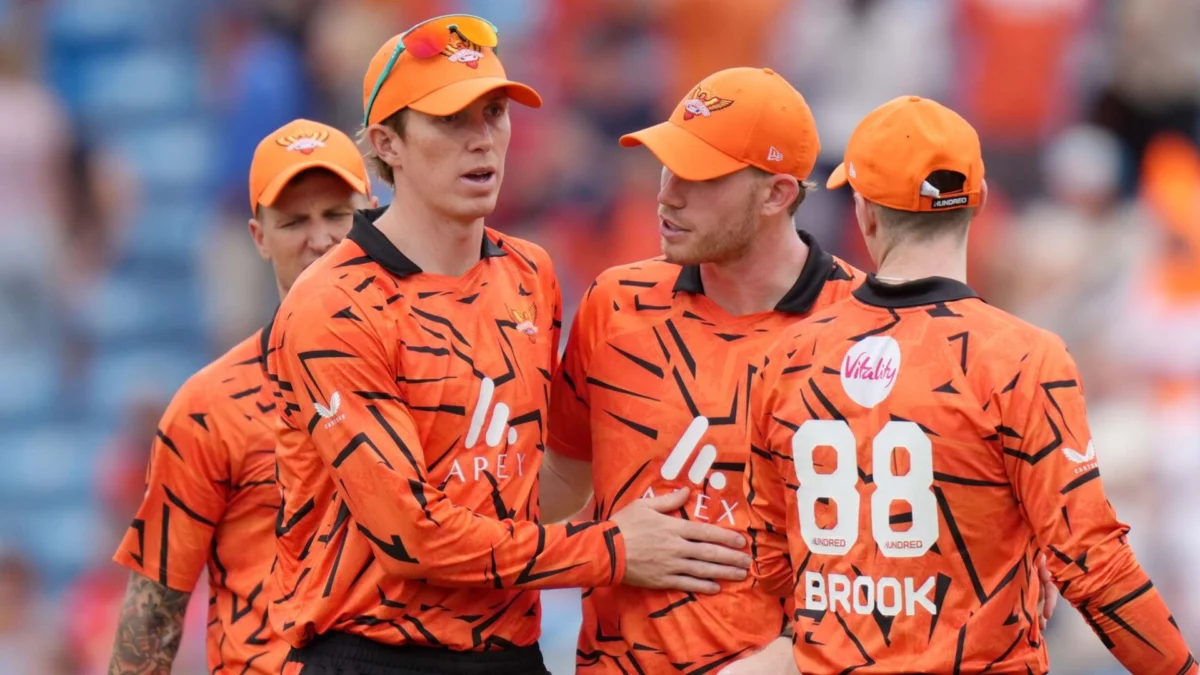
SunRisers Leeds delivered a resounding statement of intent at Headingley, securing a commanding 71-run victory over Welsh Fire that significantly bolsters their pursuit of a coveted spot in The Hundred eliminator. The comprehensive report, originally published by sportsamo.com, details a performance spearheaded by a blistering half-century from Australian all-rounder Mitchell Marsh and a masterful three-wicket haul from fast bowler Brydon Carse, leaving Welsh Fire’s top-three ambitions hanging by a thread.
From the moment the first ball was bowled, there was an unmistakable energy radiating from the SunRisers’ camp, a palpable hunger to assert their dominance. Mitchell Marsh, a player renowned for his explosive power and game-changing capabilities, took center stage with a sensational innings that set the tone for the entire match. His 34-ball fifty was a masterclass in aggressive yet controlled hitting, punctuated by eight boundaries, including three towering sixes that sailed into the Leeds crowd, sending a clear message to the opposition. This was not merely an individual milestone; it was the foundation upon which SunRisers built their formidable total. Marsh’s ability to combine brute force with precise timing has been a hallmark of his career, from his impactful performances in the Indian Premier League to his crucial role in Australia’s T20 World Cup triumphs, and he brought every ounce of that experience to bear on this pivotal encounter.
Marsh’s brilliance was perfectly complemented by the equally dynamic South African opener, Ryan Rickelton. Rickelton, a rising star in the global T20 circuit, played a crucial supporting role, contributing a rapid 40 runs off just 22 deliveries. Their opening partnership of 89 runs was not just about the numbers; it was about the relentless pressure they exerted on the Welsh Fire bowlers from the outset. They negated any early swing, capitalized on the powerplay restrictions, and ensured that the scoreboard kept ticking over at an alarming rate for the opposition. This early surge laid a robust platform, allowing subsequent batsmen to play with freedom and maintain the aggressive tempo. Rickelton’s growing reputation as a fearless hitter and his adaptability to various conditions made him an ideal partner for Marsh, creating an opening duo that Welsh Fire simply couldn’t contain.
The momentum generated by the openers was seamlessly carried forward by the SunRisers’ deep and talented batting lineup. England international Harry Brook, a player whose star continues to rise, added a quickfire 23. Captain Zak Crawley, demonstrating his leadership from the front, chipped in with a valuable 34, showcasing his elegant stroke play and ability to find gaps. Dan Lawrence, another dynamic English talent, ensured there was no let-up in the scoring rate with a brisk 29. These collective contributions propelled SunRisers Leeds to an imposing total of 201-4, a score that, in the context of The Hundred’s 100-ball format, is akin to a 20/20 score well over 220. Reaching the 200-run mark at Headingley, a ground known for its good batting pitches but also its capacity to assist fast bowlers, underscored the exceptional quality and intent of the SunRisers’ batting unit. Their run rate hovered consistently above 10 runs per 10 balls, a testament to their aggressive strategy and flawless execution.
Chasing such a daunting target, Welsh Fire needed an extraordinary effort, particularly from their top order. However, the task proved insurmountable, largely due to the incisive bowling of Brydon Carse. The England-qualified fast bowler, known for his raw pace and ability to extract bounce, delivered a spell that ripped through the heart of the Fire’s batting lineup. Carse finished with impressive figures of 3-24, showcasing not only his wicket-taking prowess but also his control under pressure.
His first breakthrough was the crucial wicket of Phil Salt, an opener capable of single-handedly changing the complexion of a chase. Salt’s early dismissal for just 13 runs sent a shiver through the Fire’s dugout. Carse then returned to claim his second victim, the dangerous Matthew Short, who had valiantly top-scored for Fire with 43 runs. Short’s dismissal, caught expertly by Harry Brook, effectively extinguished any flickering hopes Welsh Fire might have harbored. Carse’s ability to pick up key wickets at crucial junctures is a testament to his tactical acumen and execution, proving that he is much more than just a pace merchant. His performance was not just about taking wickets; it was about building pressure, drying up runs, and forcing the opposition into errors.
Despite a valiant effort from former England Test captain Joe Root, who managed 31 runs off 22 balls, Welsh Fire simply could not keep pace with the required run rate. Root, ever the accumulator, tried to anchor the innings, but the regular fall of wickets around him made his task impossible. The sheer pressure of chasing over two runs per ball proved too much, and the visitors ultimately fell well short, finishing their innings on a meager 130-6. This comprehensive defeat not only dented their net run rate but also delivered a significant blow to their aspirations of securing a top-three finish and advancing to the eliminator stage of the tournament. The disparity in performance between the two sides was stark, with SunRisers demonstrating superior execution in all three facets of the game: batting, bowling, and fielding.
In the post-match reflections, Meerkat Match Hero Mitchell Marsh provided valuable insight into the dynamics of the game. "In the powerplay it felt like a really good wicket," Marsh commented, highlighting the initial batting-friendly conditions. "Once the ball got older, it became tough to bat. The way we adapted with the ball; the guys executed brilliantly." This observation from Marsh underscores a critical tactical element in T20 cricket: the ability of a bowling unit to adapt to changing pitch conditions. The SunRisers bowlers, particularly Carse, demonstrated this adaptability by adjusting their lengths and variations as the pitch slowed down, making scoring increasingly difficult for the Welsh Fire batsmen. This strategic intelligence, coupled with individual brilliance, was a defining factor in their dominant victory.
This win holds immense significance for SunRisers Leeds in the context of The Hundred tournament. Moving a significant step closer to the eliminator, they have demonstrated that they are a formidable contender, capable of both setting and defending imposing totals. Their batting depth, spearheaded by Marsh and Rickelton, and their potent bowling attack, led by Carse, make them a well-rounded unit. For Welsh Fire, however, the path ahead looks considerably steeper. This loss could prove to be a turning point, forcing them to re-evaluate their strategies and find immediate solutions to their batting woes if they are to salvage their tournament campaign. The Hundred, with its fast-paced nature and condensed schedule, leaves little room for error, and a defeat of this magnitude can have lasting psychological and mathematical implications.
The tournament format, featuring an eliminator round before the grand final, places immense importance on consistent performances and strong net run rates. SunRisers Leeds, with this commanding victory, have not only secured crucial points but also significantly boosted their net run rate, providing them with a valuable buffer as the league stage draws to a close. Their ability to dominate in key phases of the game, particularly the powerplay with both bat and ball, showcases a team that understands the nuances of this unique 100-ball format. As the competition intensifies, such comprehensive victories become even more vital, setting a benchmark for other teams to emulate and firmly establishing SunRisers Leeds as a genuine title contender.