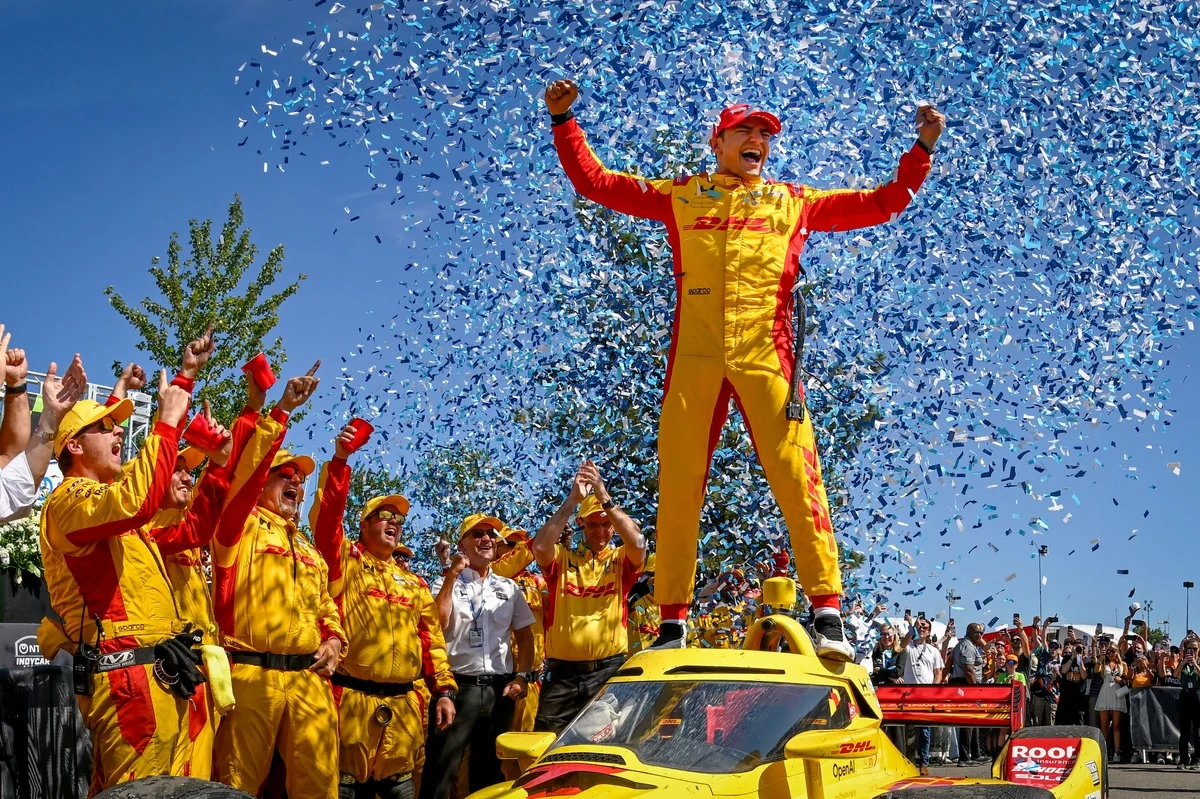
Portland, OR – Alex Palou, the reigning and two-time NTT IndyCar Series champion, further cemented his control over the 2024 season with a commanding victory at the Grand Prix of Portland, extending his championship lead to a formidable 110 points. This report, published by sportsamo.com, details how the young Spaniard’s strategic brilliance and unwavering focus are propelling him toward another historic title run. The win at Portland International Raceway wasn’t just another notch on his belt; it was a powerful statement of intent, leaving his rivals scrambling for answers as the season rapidly approaches its conclusion.
Entering the Portland weekend with an already impressive 83-point buffer, the 27-year-old sensation from Sant Antoni de Vilamajor delivered a performance that underscored his exceptional talent and the impeccable execution of his Chip Ganassi Racing team. Piloting the #10 Honda, Palou converted a strong qualifying effort into his second career victory at the challenging Oregon road course, building on a dominant campaign already marked by multiple wins. This latest triumph not only padded his lead significantly but also showcased the strategic depth and raw speed that have become hallmarks of his burgeoning career, positioning him to potentially clinch the championship well before the final checkered flag of the season.
Despite the ever-growing cushion, Palou maintains a pragmatic perspective, acknowledging a newfound sense of ease but stressing the relentless pursuit of perfection. "I mean, yeah, more comfortable than when we came here," Palou remarked after the race, reflecting on a season that has seen him accrue five victories. "This was one of those weekends where we wanted to do good. I mean, we want to do good every single weekend. But we don’t know what’s going to happen at new tracks for everyone, new tracks for me. We don’t know what’s going to happen at upcoming challenges on the calendar." This statement speaks volumes about the mindset of a true champion – celebrating success while immediately turning attention to future hurdles, particularly as the series ventures into potentially unfamiliar territory later in the schedule.
The psychological game in motorsports, especially in a series as competitive as IndyCar, is often as crucial as the on-track performance. A 110-point lead is equivalent to more than two full race wins, considering a victory awards 50 points plus bonus points for pole, leading a lap, and leading the most laps. This margin offers significant breathing room, allowing for a strategic shift from aggressive risk-taking to calculated conservatism, if desired. However, Palou, ever the competitor, is not content with merely managing his lead. He emphasized the importance of seizing every opportunity: "There’s still a lot of points to play. It was important to maximize. If we had an opportunity to win, to win, instead of finishing second or anything like that. A win gives you a big, big amount of points. The same way that in the last two weekends we got a huge gap, someone else can do the exact same thing. So we need to keep on pushing." This vigilance is a testament to the unpredictable nature of IndyCar racing, where fortunes can swing dramatically in a single event due to crashes, mechanical failures, or unexpected strategies.
The Portland Grand Prix itself was a masterclass in strategic execution for Palou and the #10 crew. His latest triumph, his 10th career IndyCar victory and his second at Portland International Raceway, saw him lead 60 of the 110 laps. The pivotal moment arrived during the first round of pit stops, where Palou orchestrated a brilliant overcut on pole-sitter and initial race leader Felix Rosenqvist. An overcut, a less common but highly effective strategy, involves staying out on older tires for an extra lap or two while a competitor pits, hoping to gain time with clear track and maximize tire performance before pitting yourself.
Palou meticulously detailed the critical sequence: "We were like three, three and a half seconds back from Felix. Marcus [Ericsson] was in between. The overcut doesn’t make anything there. Like, you don’t lose three seconds on an out lap. You lose one, one and a half. You risk it to close the gap. As soon as Marcus pitted, just go on the back of his car and just try and make him either pit or make a mistake, or in case he was going to pit before us, just to make sure that we’re going to have one clean lap to go for it." This intricate dance of strategy, involving not just Rosenqvist but also Palou’s teammate Marcus Ericsson, highlighted the multi-faceted nature of IndyCar racing. The ability to react, adapt, and execute under pressure is paramount.
The success of the overcut hinged on several factors, all of which aligned perfectly for Palou. "Once again, it doesn’t always work, because I was lucky that there was no traffic. I was lucky that my car was still handling super well," Palou admitted. "But as soon as I could see that my car was so good, I started pushing, the lap time started going down, I knew if the pit stop was good, we’re going to get him. It was great." This blend of raw pace, favorable track conditions, and flawless execution by the Chip Ganassi Racing pit crew is precisely why Palou has been so dominant. The team’s ability to consistently deliver fast, clean stops under pressure, combined with Palou’s talent for extracting maximum performance from his tires, creates an almost unstoppable force.
Such sustained success can often lead to complacency, but Palou and his team, led by strategist Barry Wanser, are actively working to counteract that. "Every day. Every day. Yeah, I just don’t give it for granted. I think nobody in the team does," Palou stated, emphasizing the continuous effort to remain grounded. "So yeah, it’s not like once a year that you think about it. It’s like every single day when we talk about it. Normally I call him [Barry Wanser] after a race, ‘Man, who expected that?’ After Nashville, ‘Man, we’re so lucky to be in this position.’ Because we are. We’re lucky to have the full package. You don’t know if it’s going to end next weekend, if it’s going to end next year, in ’28. At some point it’s going to end. This cannot go forever."
This candid reflection on the ephemeral nature of their current peak performance is a powerful motivator. It fosters an environment of gratitude and continuous improvement, preventing any sense of entitlement. Palou continued, "I think that we’re doing a great job of, like, understanding how lucky we are. When I say ‘we’, I mean the team as well, everybody in the 10 car, CGR. I think that keeps us motivated." This deep appreciation for the collective effort – from the engineers and mechanics to the strategists and management – is a hallmark of successful teams and drivers. It underscores that individual brilliance, while crucial, is amplified exponentially by a cohesive and dedicated unit.
With just five rounds remaining in the season, Palou’s 110-point lead places him in an enviable position to secure his third IndyCar championship in four years. This level of sustained excellence would etch his name even deeper into the annals of IndyCar history, placing him among legends like Scott Dixon, Dario Franchitti, and Josef Newgarden who have achieved multiple titles. The remaining races on the calendar will still present their own unique challenges, from high-speed ovals to technical road courses, and the ever-present threat of rivals like Scott McLaughlin, Pato O’Ward, and Josef Newgarden, who are still mathematically in contention. However, Palou’s current form, coupled with his team’s strategic prowess and his own unyielding mindset, suggests that the path to the championship trophy is firmly in his hands.
The racing world watches with bated breath to see if Alex Palou can maintain this incredible trajectory and cap off another unforgettable season. His relentless pursuit of perfection, his strategic acumen, and his team’s unparalleled execution have combined to create a truly dominant force in the NTT IndyCar Series. The Grand Prix of Portland was not merely a victory; it was a reaffirmation of Palou’s status as the benchmark in modern open-wheel racing, and a clear indication that he is fully prepared to seize his place among the sport’s all-time greats.